

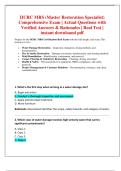
IICRC MRS (Master Restoration Specialist)
Comprehensive Exam | Actual Questions with
Verified Answers & Rationales | Real Test |
instant downloand pdf
Prepare for the IICRC MRS Certification Real Exam with this full-length, real exam. This
resource covers:
Water Damage Restoration – Inspection, mitigation, drying methods, and
documentation
Fire & Smoke Restoration – Damage assessment, deodorization, and cleaning methods
Mold Remediation – Identification, containment, and removal
Carpet, Flooring & Upholstery Restoration – Cleaning, drying, and repair
Health & Safety – Personal protective equipment, OSHA compliance, and safety
protocols
Project Management & Customer Relations – Documentation, estimates, and client
communication
1. What is the first step when arriving at a water damage site?
A. Begin extraction
B. Conduct a thorough inspection and assessment
C. Apply antimicrobial treatment
D. Move furniture
Rationale: Assessment identifies the scope, safety hazards, and category of water.
2. Which class of water damage involves high-velocity water that carries
significant contaminants?
A. Class 1
B. Class 2
C. Class 3
D. Class 3
,Rationale: Class 3 water involves ceilings, walls, insulation, and significant
contamination.
3. Which moisture measurement tool is best for detecting moisture inside walls
without destruction?
A. Standard moisture meter
B. Infrared (IR) camera
C. Thermometer
D. Hygrometer
Rationale: IR cameras detect hidden moisture behind surfaces non-invasively.
4. What is the main purpose of applying antimicrobial treatments during water
restoration?
A. Clean carpets
B. Prevent microbial growth
C. Dry walls faster
D. Deodorize the structure
Rationale: Antimicrobials inhibit mold, bacteria, and fungi growth.
5. When should a moisture map be created during restoration?
A. Before drying
B. After drying
C. Both before and after drying
D. Only if insurance requires
Rationale: Moisture mapping documents the initial conditions and progress for
drying verification.
6. What is the typical drying goal for structural materials?
, A. 25% moisture content
B. 50% moisture content
C. Return to normal equilibrium moisture content (EMC)
D. 10% moisture content
Rationale: Materials must be dried to their normal EMC to prevent decay or
mold.
7. What is the first action to take when entering a fire-damaged structure?
A. Begin soot cleaning
B. Ensure structural stability and safety
C. Remove smoke odor immediately
D. Extract water
Rationale: Safety is the priority; unstable structures can collapse.
8. Which type of smoke causes yellow-brown staining and is acidic?
A. Protein-based smoke
B. Wet smoke
C. Dry smoke
D. Fuel oil smoke
Rationale: Wet smoke leaves sticky, acidic residues that must be neutralized.
9. When remediating mold, what is the minimum containment method
recommended?
A. Open windows
B. Use 6-mil plastic sheeting with negative air
C. Cover surfaces with towels
D. Spray mold with water
Rationale: Proper containment prevents spore spread to unaffected areas.
Comprehensive Exam | Actual Questions with
Verified Answers & Rationales | Real Test |
instant downloand pdf
Prepare for the IICRC MRS Certification Real Exam with this full-length, real exam. This
resource covers:
Water Damage Restoration – Inspection, mitigation, drying methods, and
documentation
Fire & Smoke Restoration – Damage assessment, deodorization, and cleaning methods
Mold Remediation – Identification, containment, and removal
Carpet, Flooring & Upholstery Restoration – Cleaning, drying, and repair
Health & Safety – Personal protective equipment, OSHA compliance, and safety
protocols
Project Management & Customer Relations – Documentation, estimates, and client
communication
1. What is the first step when arriving at a water damage site?
A. Begin extraction
B. Conduct a thorough inspection and assessment
C. Apply antimicrobial treatment
D. Move furniture
Rationale: Assessment identifies the scope, safety hazards, and category of water.
2. Which class of water damage involves high-velocity water that carries
significant contaminants?
A. Class 1
B. Class 2
C. Class 3
D. Class 3
,Rationale: Class 3 water involves ceilings, walls, insulation, and significant
contamination.
3. Which moisture measurement tool is best for detecting moisture inside walls
without destruction?
A. Standard moisture meter
B. Infrared (IR) camera
C. Thermometer
D. Hygrometer
Rationale: IR cameras detect hidden moisture behind surfaces non-invasively.
4. What is the main purpose of applying antimicrobial treatments during water
restoration?
A. Clean carpets
B. Prevent microbial growth
C. Dry walls faster
D. Deodorize the structure
Rationale: Antimicrobials inhibit mold, bacteria, and fungi growth.
5. When should a moisture map be created during restoration?
A. Before drying
B. After drying
C. Both before and after drying
D. Only if insurance requires
Rationale: Moisture mapping documents the initial conditions and progress for
drying verification.
6. What is the typical drying goal for structural materials?
, A. 25% moisture content
B. 50% moisture content
C. Return to normal equilibrium moisture content (EMC)
D. 10% moisture content
Rationale: Materials must be dried to their normal EMC to prevent decay or
mold.
7. What is the first action to take when entering a fire-damaged structure?
A. Begin soot cleaning
B. Ensure structural stability and safety
C. Remove smoke odor immediately
D. Extract water
Rationale: Safety is the priority; unstable structures can collapse.
8. Which type of smoke causes yellow-brown staining and is acidic?
A. Protein-based smoke
B. Wet smoke
C. Dry smoke
D. Fuel oil smoke
Rationale: Wet smoke leaves sticky, acidic residues that must be neutralized.
9. When remediating mold, what is the minimum containment method
recommended?
A. Open windows
B. Use 6-mil plastic sheeting with negative air
C. Cover surfaces with towels
D. Spray mold with water
Rationale: Proper containment prevents spore spread to unaffected areas.


