

GPH leerdoelen
HC 1: meet and greet with Mendel
Explain the principles of monogenetic (Mendelian) inheritance
and illustrate them with examples.
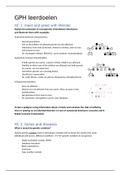
Autosomal dominant characteristics:
- Several generations.
- 50% of the children of affected parents are also affected.
- Inheritence from man to woman, woman to woman, man to man,
and woman to man.
- Vb: Huntington disease, BRCA1&2, Lynch syndrom, Achondroplasia
Autosomal recessive characteristics:
- If both parents are carrier, a qurter of their children are affected.
- (families in which non of the children are affected, but both parents
are carrier, are not observed.)
- Sometimes parents are consanguineous.
- Usually just 1 generation.
- Vb: cystic fibroso, sickle cel anemia, thalassemia, phenylketonuria
X-linked characteristics:
- Sons are affected.
- Women are not affected; they are carrier, they can pass on the
predisposition.
- No inheritance from man to man.
- Vb: Duchenne, hemophilia A and B, color blindness
Create a pedigree using information about a family and calculate the risks of suffering
from or passing on an inherited disorder, in case of autosomal dominant, recessive and X-
linked recessive transmission.
HC 2: Genes and diseases
What is meant by genetic variation?
Human genetic variation leads to phenotypic variation and increases the chance that some
individuals will survive, different variations: ~15*10 6 genetic variations in our genome
- Single nucleotide variants (SNPs)
- Deletions/insertions
- Block substitutions
- Inversions
- Copy number variants
, - Polymorphism vs mutation (change that disturbs protein function,
germline or somatic)
o Chromosome mutation
Loss (monosomy) or gain (trisomy) of whole
chromosomes = aneuploidy
Structural changes within the chromosomes –
translocations, deletions, etc.
o Gene mutation: point mutation (single base), insertion, deletions.
Chromosomal disorders, monogenic disorders, Mendelian subsets of common diseases,
multifactorial and complex disorders.
If known about a genetic risk (for children): early detection & screening possible.
Hereditary = inherited, derived from parents (genetic disorder is usually, but not always inherited)
Congenital = apparent at birth, not all congenital disorders are genetically determined (40-60%
unknown cause), not all hereditary diseases are congenital (vb BRCA).
Classification of genetic disorders:
- Chromosomal disorders; mostly autosomal with numerical or structural changes.
o Loss is more harmful than gain of chromosomes
o Abnormalities of sex chromosomes are better tolerated than autosomal.
o Usually origin de novo (both parents and siblings don’t have the abnormality)
- Monogenic disorders; single gene
o Enzyme defects
Storage disease Tay-Sachs Disease: material to be degraded builds up in
certain cells in the body and causes problems.
o Defects in membrane receptors/transport systems
Familial Hypercholesterolemia: mutations in gene encoding for LDL receptor
elevated cholesterol levels, early-onset heart disease.
o Alterations in structure, function, or quantity of non-enzyme proteins
Marfan syndrome: disorder of connective tissue of the body.
o Genetic variants leading to unusual drug reactions.
Cytochrome P450 enzymes altered drug metabolism in the liver.
- Mitochondrial disorders
- Multifactorial and complex disorders = environmental factors + multi- or polygenic (>1 gene,
each convey a low risk) complex interactions.
HC 3: Public health and genetics
Explain the definition of public health genomics.
The responsible and effective translation of genome-based knowledge and technologies into public
policy and health services for the benefit of population health.
- Genetics: the study of genes and their roles in inheritance.
- Genomics: the study of the genome, including interactions of those genes with each others
and the environment.
, structured, stratified and relevant approaches for predictive, preventive, personalized, and
participatory health care with clinical and technological information.
Explain how the benefit of the individual vs the group plays a role in public health
genomics, clinical genetics and community genetics.
Genetics in medicine for individual genetics
- Primary care: GP, midwives, child health centers get most simple questions, but have a
deficiency in knowledge of genetics and genetic tests.
- Clinical genetics: medical specialty ( physicians + 4 years of training) and involves few people
to help with questions about the diagnosis, prognosis and recurrence risk to help in complex
decisions about cancer/hereditary disorders/child planning informed choice and personal
control.
o Genetic testing guidelines: counseling/support, psychological consequences of
testing, family issues, issues of genetic discrimination.
o Individualism & autonomy insurance payment
Goal: empower counselees.
Outcome: informed choice and personal control
Public health for population benefits: collectivism & paternalism government funding.
- Goal: promote health and prevent disease.
- Outcome: uptake, compliance, decrease number affected, economic benefits.
It focusses on populations where human diseases result from gene-environment interaction
possibilities for disease prevention. This includes the translation of research into practice and
services.
Explain optimistic visions on genomic medicine and give arguments against optimism.
Optimistic visions:
- More than 50.000 articles are published a years about [genetics OR genomics] AND [public
health].
- Public health genetics: emerging field, multidisciplinary, transdisciplinary.
- Balance individual and social ethics
Pessimistic visions:
- Only a limited amount of the heritable component if common complex traits had been
identified.
- Difficult to use in risk prediction
- Prevention model in public health raises problems
- Peoples’ genotypes are not changeable (eugenics)
o Phenotypic prevention: of disease and death among people with specific genotypes.
o Genotypic prevention: of genetic trait transmission from one generation to another.
This term should be avoided in case of interruption of genetic trait
transmission through reproductive selection (conflict ethical principles of
individual and social ethics).
HC 1: meet and greet with Mendel
Explain the principles of monogenetic (Mendelian) inheritance
and illustrate them with examples.
Autosomal dominant characteristics:
- Several generations.
- 50% of the children of affected parents are also affected.
- Inheritence from man to woman, woman to woman, man to man,
and woman to man.
- Vb: Huntington disease, BRCA1&2, Lynch syndrom, Achondroplasia
Autosomal recessive characteristics:
- If both parents are carrier, a qurter of their children are affected.
- (families in which non of the children are affected, but both parents
are carrier, are not observed.)
- Sometimes parents are consanguineous.
- Usually just 1 generation.
- Vb: cystic fibroso, sickle cel anemia, thalassemia, phenylketonuria
X-linked characteristics:
- Sons are affected.
- Women are not affected; they are carrier, they can pass on the
predisposition.
- No inheritance from man to man.
- Vb: Duchenne, hemophilia A and B, color blindness
Create a pedigree using information about a family and calculate the risks of suffering
from or passing on an inherited disorder, in case of autosomal dominant, recessive and X-
linked recessive transmission.
HC 2: Genes and diseases
What is meant by genetic variation?
Human genetic variation leads to phenotypic variation and increases the chance that some
individuals will survive, different variations: ~15*10 6 genetic variations in our genome
- Single nucleotide variants (SNPs)
- Deletions/insertions
- Block substitutions
- Inversions
- Copy number variants
, - Polymorphism vs mutation (change that disturbs protein function,
germline or somatic)
o Chromosome mutation
Loss (monosomy) or gain (trisomy) of whole
chromosomes = aneuploidy
Structural changes within the chromosomes –
translocations, deletions, etc.
o Gene mutation: point mutation (single base), insertion, deletions.
Chromosomal disorders, monogenic disorders, Mendelian subsets of common diseases,
multifactorial and complex disorders.
If known about a genetic risk (for children): early detection & screening possible.
Hereditary = inherited, derived from parents (genetic disorder is usually, but not always inherited)
Congenital = apparent at birth, not all congenital disorders are genetically determined (40-60%
unknown cause), not all hereditary diseases are congenital (vb BRCA).
Classification of genetic disorders:
- Chromosomal disorders; mostly autosomal with numerical or structural changes.
o Loss is more harmful than gain of chromosomes
o Abnormalities of sex chromosomes are better tolerated than autosomal.
o Usually origin de novo (both parents and siblings don’t have the abnormality)
- Monogenic disorders; single gene
o Enzyme defects
Storage disease Tay-Sachs Disease: material to be degraded builds up in
certain cells in the body and causes problems.
o Defects in membrane receptors/transport systems
Familial Hypercholesterolemia: mutations in gene encoding for LDL receptor
elevated cholesterol levels, early-onset heart disease.
o Alterations in structure, function, or quantity of non-enzyme proteins
Marfan syndrome: disorder of connective tissue of the body.
o Genetic variants leading to unusual drug reactions.
Cytochrome P450 enzymes altered drug metabolism in the liver.
- Mitochondrial disorders
- Multifactorial and complex disorders = environmental factors + multi- or polygenic (>1 gene,
each convey a low risk) complex interactions.
HC 3: Public health and genetics
Explain the definition of public health genomics.
The responsible and effective translation of genome-based knowledge and technologies into public
policy and health services for the benefit of population health.
- Genetics: the study of genes and their roles in inheritance.
- Genomics: the study of the genome, including interactions of those genes with each others
and the environment.
, structured, stratified and relevant approaches for predictive, preventive, personalized, and
participatory health care with clinical and technological information.
Explain how the benefit of the individual vs the group plays a role in public health
genomics, clinical genetics and community genetics.
Genetics in medicine for individual genetics
- Primary care: GP, midwives, child health centers get most simple questions, but have a
deficiency in knowledge of genetics and genetic tests.
- Clinical genetics: medical specialty ( physicians + 4 years of training) and involves few people
to help with questions about the diagnosis, prognosis and recurrence risk to help in complex
decisions about cancer/hereditary disorders/child planning informed choice and personal
control.
o Genetic testing guidelines: counseling/support, psychological consequences of
testing, family issues, issues of genetic discrimination.
o Individualism & autonomy insurance payment
Goal: empower counselees.
Outcome: informed choice and personal control
Public health for population benefits: collectivism & paternalism government funding.
- Goal: promote health and prevent disease.
- Outcome: uptake, compliance, decrease number affected, economic benefits.
It focusses on populations where human diseases result from gene-environment interaction
possibilities for disease prevention. This includes the translation of research into practice and
services.
Explain optimistic visions on genomic medicine and give arguments against optimism.
Optimistic visions:
- More than 50.000 articles are published a years about [genetics OR genomics] AND [public
health].
- Public health genetics: emerging field, multidisciplinary, transdisciplinary.
- Balance individual and social ethics
Pessimistic visions:
- Only a limited amount of the heritable component if common complex traits had been
identified.
- Difficult to use in risk prediction
- Prevention model in public health raises problems
- Peoples’ genotypes are not changeable (eugenics)
o Phenotypic prevention: of disease and death among people with specific genotypes.
o Genotypic prevention: of genetic trait transmission from one generation to another.
This term should be avoided in case of interruption of genetic trait
transmission through reproductive selection (conflict ethical principles of
individual and social ethics).


