BFC 2751 Derivatives 1 Notes: Key Concepts & Hedging Strategies
BEST FOR EXAM 2025-2026 PREPARATION Monash University
Titles
Topic
Learning Objective
Concept
Key Definition
Miscellaneous Topics
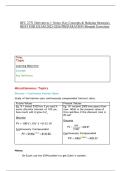
Discrete v Continuous Interest Rates
Study of derivatives uses continuously compounded interest rates.
Future Values Present Values
Eg. If I invest $100 for 3 yrs and it Eg. If I receive $500 two years from
earns discrete interest of 10% pa, now. What is the present value of
how much will it grow to? this cashflow if the discount rate is
8% pa?
Discrete
Discrete
FV = 100*(1.10)^3 =$133.10
Continuously Compounded
Continuously Compounded
Notes:
• On Excel use the EXP(number) to get Euler’s number.
, • Discounting calculations require a –ve symbol in the exponent, whilst
‘investments’ do not.
Short Selling
,Short selling involves selling an asset you don’t own.
• Imagine ‘borrowing’ an asset from someone – then selling it straight at
away at its current price. This raises money for you today.
• After short selling, you have an obligation to settle this short sale by
‘returning’ the asset to its original owner at some point in the future.
o You will have to go to the market (at some point) and buy the
asset at whatever its price is at that time.
o You then give the assets back to the original owner.
• People short sell when they expect the price to fall.
Recent Short Selling Examples.. - Banking Royal Commission
, • Before the Royal Commission into banking, many investors feared that
the RC would make strong recommendations that would hurt the banks
and their profitability.
• Many investors (especially hedge funds) entered short positions on the
Big 4 banks over the days prior to the report release (approx 5bn).
• These bets would make a lot of money if banking stocks fell.
Outcome
• However, the report’s recommendations (released 4 Feb-2019) were
nowhere near as painful for banks as was expected.
• On Tuesday 5 Feb-2019, banking stocks soared (Westpac 7.4%,
Commonwealth 4.9%, ANZ 6.1%, NAB 5.2%)
• Those with short positions got ‘squeezed’ - as bank prices
rose, these short positions started making big losses. The
short sellers scrambled to buy bank shares (to cover their
short positions) before losses got too high.
What is Arbitrage?
Arbitrage
The simultaneous purchase and sale of an asset in different markets to
exploit tiny differences in their prices.
• Arbitrage trades are most commonly made in stocks, commodities, and
currencies, but can be accomplished with any asset.
• Arbitrage takes advantage of the inevitable inefficiencies in markets.
• By exploiting market inefficiencies, however, the act of arbitrage
brings markets closer to efficiency.
Example
The stock of Company X is trading at $20 on the New York Stock Exchange
(NYSE), while, at the same moment, it is trading for $20.05 on the London
Stock Exchange (LSE)
A trader can buy the stock on the NYSE and immediately sell the same
shares on the LSE, earning a profit of 5 cents per share.
The trader can continue to exploit this arbitrage until the specialists on the
NYSE run out of inventory of Company X’s stock, or until the specialists on
the NYSE or the LSE adjust their prices to wipe out the opportunity.
BEST FOR EXAM 2025-2026 PREPARATION Monash University
Titles
Topic
Learning Objective
Concept
Key Definition
Miscellaneous Topics
Discrete v Continuous Interest Rates
Study of derivatives uses continuously compounded interest rates.
Future Values Present Values
Eg. If I invest $100 for 3 yrs and it Eg. If I receive $500 two years from
earns discrete interest of 10% pa, now. What is the present value of
how much will it grow to? this cashflow if the discount rate is
8% pa?
Discrete
Discrete
FV = 100*(1.10)^3 =$133.10
Continuously Compounded
Continuously Compounded
Notes:
• On Excel use the EXP(number) to get Euler’s number.
, • Discounting calculations require a –ve symbol in the exponent, whilst
‘investments’ do not.
Short Selling
,Short selling involves selling an asset you don’t own.
• Imagine ‘borrowing’ an asset from someone – then selling it straight at
away at its current price. This raises money for you today.
• After short selling, you have an obligation to settle this short sale by
‘returning’ the asset to its original owner at some point in the future.
o You will have to go to the market (at some point) and buy the
asset at whatever its price is at that time.
o You then give the assets back to the original owner.
• People short sell when they expect the price to fall.
Recent Short Selling Examples.. - Banking Royal Commission
, • Before the Royal Commission into banking, many investors feared that
the RC would make strong recommendations that would hurt the banks
and their profitability.
• Many investors (especially hedge funds) entered short positions on the
Big 4 banks over the days prior to the report release (approx 5bn).
• These bets would make a lot of money if banking stocks fell.
Outcome
• However, the report’s recommendations (released 4 Feb-2019) were
nowhere near as painful for banks as was expected.
• On Tuesday 5 Feb-2019, banking stocks soared (Westpac 7.4%,
Commonwealth 4.9%, ANZ 6.1%, NAB 5.2%)
• Those with short positions got ‘squeezed’ - as bank prices
rose, these short positions started making big losses. The
short sellers scrambled to buy bank shares (to cover their
short positions) before losses got too high.
What is Arbitrage?
Arbitrage
The simultaneous purchase and sale of an asset in different markets to
exploit tiny differences in their prices.
• Arbitrage trades are most commonly made in stocks, commodities, and
currencies, but can be accomplished with any asset.
• Arbitrage takes advantage of the inevitable inefficiencies in markets.
• By exploiting market inefficiencies, however, the act of arbitrage
brings markets closer to efficiency.
Example
The stock of Company X is trading at $20 on the New York Stock Exchange
(NYSE), while, at the same moment, it is trading for $20.05 on the London
Stock Exchange (LSE)
A trader can buy the stock on the NYSE and immediately sell the same
shares on the LSE, earning a profit of 5 cents per share.
The trader can continue to exploit this arbitrage until the specialists on the
NYSE run out of inventory of Company X’s stock, or until the specialists on
the NYSE or the LSE adjust their prices to wipe out the opportunity.