

FINANCE
Role
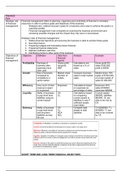
Strategic role Financial management refers to planning, organising and controlling of financial or monetary
of financial resources in order to achieve goals and objectives of the business.
management Strategic plan: outlines long term goals for a business and a plan to achieve the goals (i.e.
maximise profits)
Financial management must constantly be scanning the business environment and
accessing possible changes and the impact they may have on businesses.
Strategic roles of financial management:
1. Setting financial objectives and ensuring the business is able to achieve these goals
2. Sourcing finance
3. Preparing budgets and forecasting future finances
4. Preparing financial statements
5. Maintain sufficient cash flow
6. Distributing funds to other parts of the business
Objectives of Objective Definition Data from Analysis Example
financial financial
management reports
Profitability Earnings of Gross profit, Calculations are Gross profit 5%,
business after net profit, based as a % of sales $100,000,
expenses have EBIT sales profit is $5000
been paid
Growth Size of business Market share Compare business Market share 15%
compared to Number of sales to total market (sales of $150,000)
competitors in outlets sales of a total market of
same market sales $1,000,000
Efficiency How much of total Expenses Calculations based Expenses 25%,
revenue is spent on expenses as sales $100000,
on expenses percentage of sales expenses $25000
Liquidity Ability of business CA Calculations based Current assets
to pay short term CL on comparing $50000, liabilities
liabilities using its current assets to $40000. CL are
current assets liabilities to see if able to be met by
sufficient assets CA
meet debts
Solvency Ability of business CA Compare total T.A $250000, T.L
to pay both short CL assets to total $190000. TL are
and long term NCA liabilities able to be covered
liabilities as they NCL by TA.
fall due
SHORT TERM AND LONG TERM FINANCIAL OBJECTIVES
, SHORT TERM LONG TERM
Tactical (one to two years) and Determined for a set period of time.
operational (day-to-day) plans of a Tend to be broad goals such as
business. increasing profit or market share, and
Reviewed regularly to see if targets are each will require a series of short-term
being met and if resources are being goals to assist in its achievement.
used to the best advantage to achieve
objectives.
E.g. If management has a goal to achieve a Increase market share by 20%
15% increase in profit for the next 10
years, the tactical plans might involve
purchasing additional machinery,
updating old equipment with new
technologies, expanding into new
markets and providing new services.
Inter- Mutual dependence on other business functions (finance, HR, operations)
dependence The marketing, operations and HR departments rely on financial mergers to allocate
with other key adequate funds. i.e. marketing department requires funds to undertake the various forms
business of promotion.
functions Finance (funding) flows to each functional area within a business, which enables it to
achieve its goals.
Funds are needed for marketing so that they can develop new plans for promoting,
operations needs funding for the development of the product, and human resources needs
funding so that new employees with necessary skills can be recruited and selected, and
trained/retrained.
Finance
, Influences on financial management
Internal A business cannot establish itself and thrive without funds to enable it to pursue its activities.
sources of
finance – In the establishment of a business, owners and/or
retained shareholders contribute funds. When a business is
profits considering growth and development in later years,
internal and external sources of funds can be used.
Internal finance: Business’s owners (equity or capital)
or from outcome of business’s activities (retained
profit).
Owner’s Equity: Funds contributed by owners or
partners to establish and build the business.
Retained Profits: Most common source of internal finance – all profits are not distributed, but kept in
the business as a cheap and accessible source of finance for future activities.
External
sources of
finance
Debt
Equity
External Sources: Funds provided by sources outside of business (banks, financial institutions,
government, suppliers or financial intermediaries). Finance provided from external sources through
creditors or lenders is debt finance. The increased funds for the business means increased
earnings (profit). Regular repayments on borrowings must be made so firms can generate sufficient
earnings to make the payments.
DEBT
Short-term borrowing: used to finance temporary shortages in cash flow or finance for working
capital
Bank overdraft Commercial bills Factoring
Allows a business to Commercial bills are a type Factoring enables a business to
overdraw its account to of bill exchange issued by raise funds immediately by selling
an agreed limit – assists institutions (other than bank) accounts receivable at a discount to
businesses with short- and are given for larger a firm that specialises in collecting
term liquidity problems amounts, usually over accounts receivable.
(e.g. seasonal decrease $100,000. May offer with or without
in sales). Borrower receives recourse. (without means
Costs are the money bus. Transfers responsibility
minimal, and immediately and for noncollection to factoring
interest rates are promises to pay sum company. With recourse’
lower than other of money and interest means bad debts will still be
Role
Strategic role Financial management refers to planning, organising and controlling of financial or monetary
of financial resources in order to achieve goals and objectives of the business.
management Strategic plan: outlines long term goals for a business and a plan to achieve the goals (i.e.
maximise profits)
Financial management must constantly be scanning the business environment and
accessing possible changes and the impact they may have on businesses.
Strategic roles of financial management:
1. Setting financial objectives and ensuring the business is able to achieve these goals
2. Sourcing finance
3. Preparing budgets and forecasting future finances
4. Preparing financial statements
5. Maintain sufficient cash flow
6. Distributing funds to other parts of the business
Objectives of Objective Definition Data from Analysis Example
financial financial
management reports
Profitability Earnings of Gross profit, Calculations are Gross profit 5%,
business after net profit, based as a % of sales $100,000,
expenses have EBIT sales profit is $5000
been paid
Growth Size of business Market share Compare business Market share 15%
compared to Number of sales to total market (sales of $150,000)
competitors in outlets sales of a total market of
same market sales $1,000,000
Efficiency How much of total Expenses Calculations based Expenses 25%,
revenue is spent on expenses as sales $100000,
on expenses percentage of sales expenses $25000
Liquidity Ability of business CA Calculations based Current assets
to pay short term CL on comparing $50000, liabilities
liabilities using its current assets to $40000. CL are
current assets liabilities to see if able to be met by
sufficient assets CA
meet debts
Solvency Ability of business CA Compare total T.A $250000, T.L
to pay both short CL assets to total $190000. TL are
and long term NCA liabilities able to be covered
liabilities as they NCL by TA.
fall due
SHORT TERM AND LONG TERM FINANCIAL OBJECTIVES
, SHORT TERM LONG TERM
Tactical (one to two years) and Determined for a set period of time.
operational (day-to-day) plans of a Tend to be broad goals such as
business. increasing profit or market share, and
Reviewed regularly to see if targets are each will require a series of short-term
being met and if resources are being goals to assist in its achievement.
used to the best advantage to achieve
objectives.
E.g. If management has a goal to achieve a Increase market share by 20%
15% increase in profit for the next 10
years, the tactical plans might involve
purchasing additional machinery,
updating old equipment with new
technologies, expanding into new
markets and providing new services.
Inter- Mutual dependence on other business functions (finance, HR, operations)
dependence The marketing, operations and HR departments rely on financial mergers to allocate
with other key adequate funds. i.e. marketing department requires funds to undertake the various forms
business of promotion.
functions Finance (funding) flows to each functional area within a business, which enables it to
achieve its goals.
Funds are needed for marketing so that they can develop new plans for promoting,
operations needs funding for the development of the product, and human resources needs
funding so that new employees with necessary skills can be recruited and selected, and
trained/retrained.
Finance
, Influences on financial management
Internal A business cannot establish itself and thrive without funds to enable it to pursue its activities.
sources of
finance – In the establishment of a business, owners and/or
retained shareholders contribute funds. When a business is
profits considering growth and development in later years,
internal and external sources of funds can be used.
Internal finance: Business’s owners (equity or capital)
or from outcome of business’s activities (retained
profit).
Owner’s Equity: Funds contributed by owners or
partners to establish and build the business.
Retained Profits: Most common source of internal finance – all profits are not distributed, but kept in
the business as a cheap and accessible source of finance for future activities.
External
sources of
finance
Debt
Equity
External Sources: Funds provided by sources outside of business (banks, financial institutions,
government, suppliers or financial intermediaries). Finance provided from external sources through
creditors or lenders is debt finance. The increased funds for the business means increased
earnings (profit). Regular repayments on borrowings must be made so firms can generate sufficient
earnings to make the payments.
DEBT
Short-term borrowing: used to finance temporary shortages in cash flow or finance for working
capital
Bank overdraft Commercial bills Factoring
Allows a business to Commercial bills are a type Factoring enables a business to
overdraw its account to of bill exchange issued by raise funds immediately by selling
an agreed limit – assists institutions (other than bank) accounts receivable at a discount to
businesses with short- and are given for larger a firm that specialises in collecting
term liquidity problems amounts, usually over accounts receivable.
(e.g. seasonal decrease $100,000. May offer with or without
in sales). Borrower receives recourse. (without means
Costs are the money bus. Transfers responsibility
minimal, and immediately and for noncollection to factoring
interest rates are promises to pay sum company. With recourse’
lower than other of money and interest means bad debts will still be


