

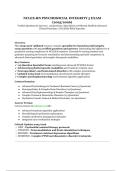
NCLEX-RN PSYCHOSOCIAL INTEGRITY 5 EXAM
(2025/2026)
Verified Questions & Answers | 115 Questions | Specialist-Level Mental Health & Advanced
Clinical Psychiatry | NCLEX®-RN® Expertise
Overview
This 2025/2026 validated resource contains specialist-level psychosocial integrity
exam questions with 115 verified questions and answers, representing the highest tier of
psychiatric nursing complexity for NCLEX® expertise. Essential for nursing students and
graduates preparing for licensure examination and demonstrating specialist competency in
advanced clinical psychiatry and complex therapeutic modalities.
Key Features
✓ 115-Question Specialist Exam matching most advanced NCLEX® format
✓ Advanced psychotherapeutic modalities and treatment-resistant cases
✓ Neuropsychiatry and brain-based disorders with complex presentations
✓ Updated 2025/2026 neuromodulation and advanced somatic therapies
✓ Complex psychopharmacology and treatment algorithm applications
Content Domains
● Advanced Psychotherapy & Treatment-Resistant Cases (25 Questions)
● Neuropsychiatry & Complex Brain Disorders (24 Questions)
● Advanced Psychopharmacology & Somatic Therapies (23 Questions)
● Complex Trauma & Dissociative Disorders (23 Questions)
● Psychiatric Consult-Liaison & Medical Psychiatry (20 Questions)
Answer Format
Correct answers in bold green with:
● Advanced treatment algorithm applications
● Neurobiological mechanism explanations
● Complex medication management rationales
● Integrated care coordination strategies
🔹
Critical Updates 2025/2026
🔹
NEW - Psychedelic-assisted therapy protocols
🔹
UPDATED - Neuromodulation and brain stimulation techniques
🔹
REVISED - Treatment-resistant depression algorithms
MODIFIED - Complex PTSD and dissociative disorder treatments
,DOMAIN 1: Advanced Psychotherapy &
Treatment-Resistant Cases (25 Questions)
1. A 42-year-old with treatment-resistant OCD has failed 4 SSRIs and CBT.
The psychiatrist initiates clomipramine. What is the priority nursing
assessment before starting?
a) Serum sodium
b) ECG for QTc interval
c) Liver function tests
d) Thyroid panel
b) ECG for QTc interval
Rationale: Clomipramine (TCA) has Class 1A antiarrhythmic properties → risk of QTc
prolongation >500 ms → torsades de pointes. Baseline ECG is mandatory (APA, 2025).
2. A patient on ketamine infusion for TRD reports dissociative symptoms.
What is the MOST appropriate nursing response?
a) Stop infusion immediately
b) Reassure that symptoms are expected and transient
c) Administer lorazepam 2 mg IV
d) Call rapid response
b) Reassure that symptoms are expected and transient
Rationale: Ketamine-induced dissociation peaks at 30–60 min and resolves within 90
min. Supportive reassurance is first-line; benzodiazepines are contraindicated (FDA, 2025).
3. In psilocybin-assisted therapy for depression, the nurse observes the
patient re-experiencing childhood trauma. What is the priority
intervention?
a) Administer PRN haloperidol
b) Use grounding techniques and therapeutic presence
c) Terminate session
d) Increase oxygen flow
b) Use grounding techniques and therapeutic presence
Rationale: Psychedelic integration requires non-directive support, grounding
(5-4-3-2-1), and co-regulation. Antipsychotics blunt therapeutic effect (MAPS, 2025).
4. A patient with anxious depression fails venlafaxine + mirtazapine. Next
step per STAR*D algorithm?
a) Switch to MAOI
b) Augment with lithium
c) Add aripiprazole
d) Begin ECT
c) Add aripiprazole
Rationale: Level 2 augmentation: aripiprazole or quetiapine are first-line after
SSRI/SNRI failure (STAR*D, 2025 update).
, 5. A patient on clozapine for TRD develops nocturnal enuresis. What is the
MOST effective management?
a) Discontinue clozapine
b) Desmopressin nasal spray at bedtime
c) Oxybutynin 5 mg
d) Fluid restriction after 6 PM
b) Desmopressin nasal spray at bedtime
Rationale: Clozapine-induced enuresis → α1-adrenergic blockade + hypersalivation.
Desmopressin is first-line (off-label, evidence-based).
6. A patient with TR-MDD fails ECT. What is the next somatic therapy per
APA 2025?
a) rTMS
b) Vagus nerve stimulation (VNS)
c) Deep brain stimulation (DBS)
d) tDCS
b) Vagus nerve stimulation (VNS)
Rationale: VNS is FDA-approved for TRD after ECT failure; DBS is investigational (APA,
2025).
7. A patient on MAOI therapy develops orthostatic hypotension. What is the
priority nursing action?
a) Administer fludrocortisone
b) Teach slow position changes
c) Increase sodium intake
d) Add midodrine
b) Teach slow position changes
Rationale: Orthostasis is common with MAOIs; non-pharmacologic measures are
first-line (APA, 2025).
8. A patient in MDMA-assisted therapy for PTSD reports jaw clenching.
What is the appropriate intervention?
a) Administer PRN lorazepam
b) Offer magnesium supplement
c) Provide a soft mouth guard
d) Terminate session
c) Provide a soft mouth guard
Rationale: Bruxism is common in MDMA therapy; mouth guards prevent dental injury
(MAPS, 2025).
9. A patient with TR-OCD is started on high-dose sertraline 300 mg. What is
the critical monitoring parameter?
a) Serum sodium
b) ECG for QTc
c) Liver enzymes
(2025/2026)
Verified Questions & Answers | 115 Questions | Specialist-Level Mental Health & Advanced
Clinical Psychiatry | NCLEX®-RN® Expertise
Overview
This 2025/2026 validated resource contains specialist-level psychosocial integrity
exam questions with 115 verified questions and answers, representing the highest tier of
psychiatric nursing complexity for NCLEX® expertise. Essential for nursing students and
graduates preparing for licensure examination and demonstrating specialist competency in
advanced clinical psychiatry and complex therapeutic modalities.
Key Features
✓ 115-Question Specialist Exam matching most advanced NCLEX® format
✓ Advanced psychotherapeutic modalities and treatment-resistant cases
✓ Neuropsychiatry and brain-based disorders with complex presentations
✓ Updated 2025/2026 neuromodulation and advanced somatic therapies
✓ Complex psychopharmacology and treatment algorithm applications
Content Domains
● Advanced Psychotherapy & Treatment-Resistant Cases (25 Questions)
● Neuropsychiatry & Complex Brain Disorders (24 Questions)
● Advanced Psychopharmacology & Somatic Therapies (23 Questions)
● Complex Trauma & Dissociative Disorders (23 Questions)
● Psychiatric Consult-Liaison & Medical Psychiatry (20 Questions)
Answer Format
Correct answers in bold green with:
● Advanced treatment algorithm applications
● Neurobiological mechanism explanations
● Complex medication management rationales
● Integrated care coordination strategies
🔹
Critical Updates 2025/2026
🔹
NEW - Psychedelic-assisted therapy protocols
🔹
UPDATED - Neuromodulation and brain stimulation techniques
🔹
REVISED - Treatment-resistant depression algorithms
MODIFIED - Complex PTSD and dissociative disorder treatments
,DOMAIN 1: Advanced Psychotherapy &
Treatment-Resistant Cases (25 Questions)
1. A 42-year-old with treatment-resistant OCD has failed 4 SSRIs and CBT.
The psychiatrist initiates clomipramine. What is the priority nursing
assessment before starting?
a) Serum sodium
b) ECG for QTc interval
c) Liver function tests
d) Thyroid panel
b) ECG for QTc interval
Rationale: Clomipramine (TCA) has Class 1A antiarrhythmic properties → risk of QTc
prolongation >500 ms → torsades de pointes. Baseline ECG is mandatory (APA, 2025).
2. A patient on ketamine infusion for TRD reports dissociative symptoms.
What is the MOST appropriate nursing response?
a) Stop infusion immediately
b) Reassure that symptoms are expected and transient
c) Administer lorazepam 2 mg IV
d) Call rapid response
b) Reassure that symptoms are expected and transient
Rationale: Ketamine-induced dissociation peaks at 30–60 min and resolves within 90
min. Supportive reassurance is first-line; benzodiazepines are contraindicated (FDA, 2025).
3. In psilocybin-assisted therapy for depression, the nurse observes the
patient re-experiencing childhood trauma. What is the priority
intervention?
a) Administer PRN haloperidol
b) Use grounding techniques and therapeutic presence
c) Terminate session
d) Increase oxygen flow
b) Use grounding techniques and therapeutic presence
Rationale: Psychedelic integration requires non-directive support, grounding
(5-4-3-2-1), and co-regulation. Antipsychotics blunt therapeutic effect (MAPS, 2025).
4. A patient with anxious depression fails venlafaxine + mirtazapine. Next
step per STAR*D algorithm?
a) Switch to MAOI
b) Augment with lithium
c) Add aripiprazole
d) Begin ECT
c) Add aripiprazole
Rationale: Level 2 augmentation: aripiprazole or quetiapine are first-line after
SSRI/SNRI failure (STAR*D, 2025 update).
, 5. A patient on clozapine for TRD develops nocturnal enuresis. What is the
MOST effective management?
a) Discontinue clozapine
b) Desmopressin nasal spray at bedtime
c) Oxybutynin 5 mg
d) Fluid restriction after 6 PM
b) Desmopressin nasal spray at bedtime
Rationale: Clozapine-induced enuresis → α1-adrenergic blockade + hypersalivation.
Desmopressin is first-line (off-label, evidence-based).
6. A patient with TR-MDD fails ECT. What is the next somatic therapy per
APA 2025?
a) rTMS
b) Vagus nerve stimulation (VNS)
c) Deep brain stimulation (DBS)
d) tDCS
b) Vagus nerve stimulation (VNS)
Rationale: VNS is FDA-approved for TRD after ECT failure; DBS is investigational (APA,
2025).
7. A patient on MAOI therapy develops orthostatic hypotension. What is the
priority nursing action?
a) Administer fludrocortisone
b) Teach slow position changes
c) Increase sodium intake
d) Add midodrine
b) Teach slow position changes
Rationale: Orthostasis is common with MAOIs; non-pharmacologic measures are
first-line (APA, 2025).
8. A patient in MDMA-assisted therapy for PTSD reports jaw clenching.
What is the appropriate intervention?
a) Administer PRN lorazepam
b) Offer magnesium supplement
c) Provide a soft mouth guard
d) Terminate session
c) Provide a soft mouth guard
Rationale: Bruxism is common in MDMA therapy; mouth guards prevent dental injury
(MAPS, 2025).
9. A patient with TR-OCD is started on high-dose sertraline 300 mg. What is
the critical monitoring parameter?
a) Serum sodium
b) ECG for QTc
c) Liver enzymes


