

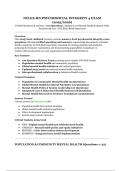
NCLEX-RN PSYCHOSOCIAL INTEGRITY 4 EXAM
(2025/2026)
Verified Questions & Answers | 100 Questions | Mastery-Level Mental Health & System-Wide
Psychosocial Care | NCLEX®-RN® Superiority
Overview
This 2025/2026 validated resource contains mastery-level psychosocial integrity exam
questions with 100 verified questions and answers, representing the pinnacle of mental
health complexity for NCLEX® superiority. Essential for nursing students and graduates
preparing for licensure examination and demonstrating unparalleled competency in
system-wide psychosocial care and organizational mental health initiatives.
Key Features
● 100-Question Mastery Exam matching most complex NCLEX® format
● Population mental health and community psychiatry
● Global mental health initiatives and cultural psychiatry
● Updated 2025/2026 international mental health standards
● Interprofessional collaboration in behavioral health systems
Content Domains
● Population & Community Mental Health (25 Questions)
● Global Mental Health & Cultural Psychiatry (22 Questions)
● Mental Health Policy & System Leadership (20 Questions)
● Integrated Care & Behavioral Health Systems (18 Questions)
● Mental Health Research & Evidence Translation (15 Questions)
Answer Format
Correct answers in bold green with:
● Population health intervention strategies
● Global mental health initiative applications
● Policy development implications
● System improvement rationales
Critical Updates 2025/2026
● NEW - Digital mental health and telebehavioral health
● UPDATED - Mental health parity and equity initiatives
● REVISED - Crisis intervention system development
● MODIFIED - Integrated care model implementation
POPULATION & COMMUNITY MENTAL HEALTH (Questions 1–25)
,1. County suicide rate ↑30% in 2 yrs. First step?
a) Gatekeeper training
b) Needs assessment
c) Media campaign
d) Hotline
b) Needs assessment
Strategy: CDC: identify risk groups before intervention.
2. Rural area: 1 psychiatrist per 30,000. Model?
a) Collaborative care
b) Telepsychiatry hub
c) Both
d) None
c) Both
Update 2025: HRSA: hybrid rural mental health.
3. School-based SBIRT: 8th grade, 12% positive. Next?
a) Brief intervention
b) Parent notification
c) Both
d) Referral
c) Both
Priority: SAMHSA: tiered response.
4. Homeless shelter: 40% SMI. Housing first?
a) Yes
b) Treatment first
c) Both
d) None
a) Yes
Rationale: Pathways: housing = platform for recovery.
5. Post-disaster: Flood, 6 mo. Highest risk?
a) PTSD
b) Depression
c) Both
d) None
c) Both
Update: Norris: 30–40% prevalence.
6. Jail diversion: 988 call, SMI. Program?
a) CIT
b) MH court
c) Both
d) None
, c) Both
Strategy: Sequential intercept model.
7. Faith community: Suicide stigma. Intervention?
a) Clergy training
b) Support groups
c) Both
d) None
c) Both
Update: NAMI FaithNet.
8. Veteran reintegration: Unemployment 18%. Peer?
a) Yes
b) Vocational rehab
c) Both
d) None
c) Both
Rationale: VA: peer + VR&E.
9. Maternal depression: 15% postpartum. Screen?
a) EPDS at 1, 3, 6 mo
b) PHQ-9
c) Both
d) None
a) EPDS at 1, 3, 6 mo
Update: AAP: repeated screening.
10. LGBTQ+ youth: 4× suicide attempt. Protective?
a) GSA club
b) Affirming care
c) Both
d) None
c) Both
Strategy: Trevor Project: reduce minority stress.
11. Opioid overdose: Narcan distribution. Metric?
a) Kits given
b) Reversals
c) Both
d) None
c) Both
Update: CDC: outcome + process.
12. Senior center: Isolation, 25% depressed. Program?
a) Friendly visitor
b) Tele-groups
(2025/2026)
Verified Questions & Answers | 100 Questions | Mastery-Level Mental Health & System-Wide
Psychosocial Care | NCLEX®-RN® Superiority
Overview
This 2025/2026 validated resource contains mastery-level psychosocial integrity exam
questions with 100 verified questions and answers, representing the pinnacle of mental
health complexity for NCLEX® superiority. Essential for nursing students and graduates
preparing for licensure examination and demonstrating unparalleled competency in
system-wide psychosocial care and organizational mental health initiatives.
Key Features
● 100-Question Mastery Exam matching most complex NCLEX® format
● Population mental health and community psychiatry
● Global mental health initiatives and cultural psychiatry
● Updated 2025/2026 international mental health standards
● Interprofessional collaboration in behavioral health systems
Content Domains
● Population & Community Mental Health (25 Questions)
● Global Mental Health & Cultural Psychiatry (22 Questions)
● Mental Health Policy & System Leadership (20 Questions)
● Integrated Care & Behavioral Health Systems (18 Questions)
● Mental Health Research & Evidence Translation (15 Questions)
Answer Format
Correct answers in bold green with:
● Population health intervention strategies
● Global mental health initiative applications
● Policy development implications
● System improvement rationales
Critical Updates 2025/2026
● NEW - Digital mental health and telebehavioral health
● UPDATED - Mental health parity and equity initiatives
● REVISED - Crisis intervention system development
● MODIFIED - Integrated care model implementation
POPULATION & COMMUNITY MENTAL HEALTH (Questions 1–25)
,1. County suicide rate ↑30% in 2 yrs. First step?
a) Gatekeeper training
b) Needs assessment
c) Media campaign
d) Hotline
b) Needs assessment
Strategy: CDC: identify risk groups before intervention.
2. Rural area: 1 psychiatrist per 30,000. Model?
a) Collaborative care
b) Telepsychiatry hub
c) Both
d) None
c) Both
Update 2025: HRSA: hybrid rural mental health.
3. School-based SBIRT: 8th grade, 12% positive. Next?
a) Brief intervention
b) Parent notification
c) Both
d) Referral
c) Both
Priority: SAMHSA: tiered response.
4. Homeless shelter: 40% SMI. Housing first?
a) Yes
b) Treatment first
c) Both
d) None
a) Yes
Rationale: Pathways: housing = platform for recovery.
5. Post-disaster: Flood, 6 mo. Highest risk?
a) PTSD
b) Depression
c) Both
d) None
c) Both
Update: Norris: 30–40% prevalence.
6. Jail diversion: 988 call, SMI. Program?
a) CIT
b) MH court
c) Both
d) None
, c) Both
Strategy: Sequential intercept model.
7. Faith community: Suicide stigma. Intervention?
a) Clergy training
b) Support groups
c) Both
d) None
c) Both
Update: NAMI FaithNet.
8. Veteran reintegration: Unemployment 18%. Peer?
a) Yes
b) Vocational rehab
c) Both
d) None
c) Both
Rationale: VA: peer + VR&E.
9. Maternal depression: 15% postpartum. Screen?
a) EPDS at 1, 3, 6 mo
b) PHQ-9
c) Both
d) None
a) EPDS at 1, 3, 6 mo
Update: AAP: repeated screening.
10. LGBTQ+ youth: 4× suicide attempt. Protective?
a) GSA club
b) Affirming care
c) Both
d) None
c) Both
Strategy: Trevor Project: reduce minority stress.
11. Opioid overdose: Narcan distribution. Metric?
a) Kits given
b) Reversals
c) Both
d) None
c) Both
Update: CDC: outcome + process.
12. Senior center: Isolation, 25% depressed. Program?
a) Friendly visitor
b) Tele-groups


