
Environmental Management Unit 1.1 - 1.2 - 1.3
UNIT 1.1
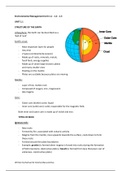
STRUCTURE OF THE EARTH
Lithosphere: the Earth can be described as a
‘ball of rock’
Earth’s crust:
- Most important layer for people
- Very thin
- 2 types (continental & oceanic)
- Made up of rocks, minerals, metals,
fossil fuels, energy supplies
- Made up of seven large tectonic plates
and many smaller ones
- Floating on the mantle
- Plates are unstable because plates are moving
Mantle:
- Layer of hot, molten rock
- Composed of oxygen, iron, magnesium
- Aka magma
Core:
- Outer core (molten core): liquid
- Inner core (solid core): solid, responsible for the magnetic field.
Both inner and outer core is made up of nickel and iron.
TYPES OF ROCK
Igneous rock:
- New rocks
- Formed by fire, associated with volcanic activity
- Magma from the mantle, rises upwards towards the surface, cools down to form
these rocks
- Formed around the plate boundaries
- Example: granite (is formed when magma is forced into rocks during the formation
of fold mountains- destructive plate) / basalt (is formed from lava that pours out of
volcanoes- constructive plate)
Written by Rachael & Tanisha Mascarenhas
,Sedimentary rock:
- Second hand rocks
- Made of sediments & old materials
- Formed at low lands
- Sediments are small particles of rock broken off from rocks. Most of these particles
eventually reach the sea bed, accumulate in layers and get compressed to form
these rocks
- Example: clay (formed from the accumulation and compression of deposits of mud) /
sandstone (formed from compressed sand) / limestone (formed from remains of
plants and animals( masses of shells and creatures))
Metamorphic rock:
- Old igneous rocks and sedimentary rocks
- Associated with old plateau blocks
- changed by heat and pressure( and stress from movement of plate boundaries)
- Example: limestone is changed to marble/ clay is changed is turned into slate
MINERALS
- Mineral is a substance obtained by mining
Metallic minerals:
- Ferrous (iron )
- Non-ferrous (lead, bauxite)
- Precious metals (gold, silver)
Non-metallic minerals:
- Minerals used for industry (sulphur, salt)
- Minerals used for farming (potash, phosphates)
- Minerals used for energy supplies (oil, coal)
- Precious gemstones (diamonds, emeralds)
Metallic minerals are usually found in:
1) Areas of very old igneous rocks: Baltic and Canadian shields
2) Areas of young fold mountains where there have been great Earth movements:
Andes and Rockies
- A reserve is a known source of the mineral, which has not yet been mined
- The life expectancy of a mineral is the number of years reserves are expected to last
at present rates of use. It is calculated by dividing the amount of reserves known to
exist with the amount used each year
Written by Rachael & Tanisha Mascarenhas
, OPEN CAST MINING:
- Clear vegetation and remove top soil
- Break up and loosen the rock by using explosives
- Use diggers to remove the loose rock
- Tip the rock into trucks or railway wagons
DEEPCAST MINING:
- Sink a vertical shaft down to the rock layer containing minerals
- Make a horizontal tunnel following the mineral layer
- Extract the minerals by digging
- Bring the loose rock and minerals up and pile it in waste heaps
- Transport away in trucks
- The deeper the mineral lies, the difficult and more expensive it is to discover and
mine
- The first stage is to undertake geological discovery to know the types of rock and
their arrangement underground. From this the depth and position of minerals can be
estimated.
USES OF ROCKS & MINERALS
- Chalk ( cement)
- Gravel (concrete)
- Clay (bricks)
- Sand ( glass)
- Industrial revolution was based upon coal as the fuel and iron ore as the raw
material. Without iron, industrial and economic growth was not possible. Steel is
needed for manufacture of machinery and aluminium is lighter and less liable to
corrosion.
USES OF LIMESTONE
- Road building
- Building stone
- Cement and concrete
- Steel works and power stations
- Limestone is the raw material for making cement and concrete. In steel furnaces and
power stations, it acts as a cleaner by taking out the impurities.
Written by Rachael & Tanisha Mascarenhas


