
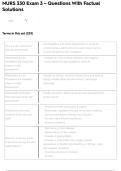
NURS 330 Exam 3 – Questions With Factual
Solutions
Save
Terms in this set (333)
It is integrated with other assessments or could be
How is a skin assessment
conducted as a stand-alone focused clinical visit (i.e.,
typically performed?
concerned about a skin condition).
What elements are - Inspect for color, texture, moisture, and integrity.
included in the inspection - Color should be appropriate for ethnicity.
phase of a skin
assessment?
What elements are Palpate for texture, moisture, temperature (use back of
included in the palpation hand), mobility (does the skin move?), and turgor
phase of a skin (elasticity).
assessment?
What health promotion Health promotion about skin & nail care and prevention
topics are part of the skin of skin cancer.
assessment?
- Protect the inner body parts & organs.
What are the five main - Body temp regulation through shivering & sweating.
functions of the skin and - Sensory perception of temp, touch, & pain.
nails? - Excrete waste & toxic substances.
- Produce vitamin D.
- Past history of skin disease.
- Family history of skin cancer.
- Change in pigmentation.
What are some key points
- Change in mole (color, size, shape, sudden
to ask about during the skin
appearance of tenderness, bleeding, or itching - signs
health history?
that suggest neoplasm).
- Excessive dryness or moisture.
- pruritis.
, - Pruritis is itching.
What is pruritis and what - It occurs with dry skin, aging, drug reaction, allergy,
can it occur with? uremia, or lice.
- Can cause excoriation.
Excoriation is skin breakdown that occurs when the top
What is excoriation?
surface of the skin is scratched off.
What is important to inquire - Various stages of healing.
about regarding excessive - Inquire about how the bruise happened.
bruising?
- Stage 1: Reddish.
What are the four stages of
- Stage 2: Purple.
a Haematoma/Bruise color
- Stage 3: Blueish.
change?
- Stage 4: Yellowish.
- Location (gives a clue to possible cause).
- Is the rash raised or flat? Is it tender, warm? Does it
What key questions should crust? Or have an odor?
be asked about a rash or - Have you had this rash before?
lesions? - Exposure to new environmental agents, such as a new
pet, food, drug, soap, shampoo, etc.?
- Is it pruritic (itchy)?
- Medication.
What other health history - Change in Nails (e.g., brittleness).
items are important for the - Environmental or occupational hazards:
skin assessment? - People at risk: farmers, sailors, construction workers.
- use of sunscreen when out in the sun?
What does patient- Inquiring about self-care—skin care routine, nails and
centered care include in hair care?
the skin assessment?
- you grow so accustomed to seeing the skin that you
are likely to ignore it as you assess the organ systems
Why should a nurse
underneath.
consciously attend to skin
- The skin holds information about the body's circulation
characteristics during an
(cyanosis, discoloration, blanching), nutritional status
assessment?
(iron deficiencies - bruise easier or pallor), and signs of
systemic diseases ( jaundice).
What three external Emotions, Environment, and Physical state.
variables can influence skin
color?
,What is the first step in Start by knowing the person's normal skin color.
assessing skin color?
What is the expected Color is even and consistent with genetic background.
finding for skin color?
What is Vitiligo? patches of non-pigmented skin
Small, flat macules of brown melanin pigment that occur
What are Freckles?
on sun-exposed skin.
What are some other Birthmarks and old scars.
expected variations in skin
color?
- pallor (white)
- Erythema (red)
skin color unexpected
- cyanosis (blue)
findings
- jaundice (yellow)
- ecchymosis
Where should Pallor be Inspect the color of the lips, mucous membranes (mm),
inspected? and nail beds.
- Erythema is a red color caused by inflammation; the
What is Erythema and how
skin appears flushed.
does it appear in dark skin
- It may appear as a purplish-tinge in dark skin tones.
tones?
- Blanchable vs. Non-blanchable
- Blanchable: When you press down, the color goes
Differentiate between
away.
Blanchable and Non-
- Non-blanchable: When you press down, the color
blanchable color changes.
doesn't go away (usually more serious)
- Cyanosis is a blue color.
What is Cyanosis and how - It is difficult to detect in dark skin tones and will
is it assessed in clients with present as darker skin with dull undertones.
dark skin? - Assess the oral mucosa & nail beds for cyanosis in
clients with dark skin.
- Jaundice is a yellow color.
What is Jaundice and where - It will be seen in the sclera and hard palate.
can it be seen? - In dark-toned skin, it can be noted on the palms &
soles.
Ecchymosis refers to color changes in different stages
What is Ecchymosis?
of healing, kind of like stages of bruising.
, What is the expected Skin should be smooth & uniformly dry.
finding for skin texture and
moisture?
- Amount of oil on skin - xerosis (abnormally dry skin) or
seborrhea (excess oil)
What are some expected - Acne.
variations in skin texture? - Wrinkles.
- Scars; stretch marks; keloid (abnormal growth of scar
tissue).
What are some unexpected - Velvety skin (suggests DM or thyroid disease).
findings for skin texture and - Roughness, dryness, flakiness (suggests thyroid
moisture, and what disease or dehydration).
conditions can they - Diaphoresis (sweating, especially without exertion).
suggest?
What is the expected Skin should be smooth & intact.
finding for skin integrity?
- Color
What should be noted - Height
when an unexpected - Shape
finding of skin lesions is - Size
present? - Location
- Presence of drainage (color, odor, amount)
- A clump of melanocytes, tan-to-brown color, flat, or
Describe a normal mole raised.
(nevus). - Acquired nevi have symmetry, small size (6mm or less),
smooth borders, and single uniform pigmentation.
- Asymmetry.
- Border irregularity.
What is the ABCDEF
- Color Variation.
mnemonic for the warning
- Diameter greater than 6mm.
signs of malignant lesions?
- Elevation.
- Funny looking
What is the expected Skin is warm.
finding for skin
temperature?
What are the unexpected - Hyperthermia (abnormally warm, possibility of fever).
findings for skin - Hypothermia (abnormally cool).
temperature?
Solutions
Save
Terms in this set (333)
It is integrated with other assessments or could be
How is a skin assessment
conducted as a stand-alone focused clinical visit (i.e.,
typically performed?
concerned about a skin condition).
What elements are - Inspect for color, texture, moisture, and integrity.
included in the inspection - Color should be appropriate for ethnicity.
phase of a skin
assessment?
What elements are Palpate for texture, moisture, temperature (use back of
included in the palpation hand), mobility (does the skin move?), and turgor
phase of a skin (elasticity).
assessment?
What health promotion Health promotion about skin & nail care and prevention
topics are part of the skin of skin cancer.
assessment?
- Protect the inner body parts & organs.
What are the five main - Body temp regulation through shivering & sweating.
functions of the skin and - Sensory perception of temp, touch, & pain.
nails? - Excrete waste & toxic substances.
- Produce vitamin D.
- Past history of skin disease.
- Family history of skin cancer.
- Change in pigmentation.
What are some key points
- Change in mole (color, size, shape, sudden
to ask about during the skin
appearance of tenderness, bleeding, or itching - signs
health history?
that suggest neoplasm).
- Excessive dryness or moisture.
- pruritis.
, - Pruritis is itching.
What is pruritis and what - It occurs with dry skin, aging, drug reaction, allergy,
can it occur with? uremia, or lice.
- Can cause excoriation.
Excoriation is skin breakdown that occurs when the top
What is excoriation?
surface of the skin is scratched off.
What is important to inquire - Various stages of healing.
about regarding excessive - Inquire about how the bruise happened.
bruising?
- Stage 1: Reddish.
What are the four stages of
- Stage 2: Purple.
a Haematoma/Bruise color
- Stage 3: Blueish.
change?
- Stage 4: Yellowish.
- Location (gives a clue to possible cause).
- Is the rash raised or flat? Is it tender, warm? Does it
What key questions should crust? Or have an odor?
be asked about a rash or - Have you had this rash before?
lesions? - Exposure to new environmental agents, such as a new
pet, food, drug, soap, shampoo, etc.?
- Is it pruritic (itchy)?
- Medication.
What other health history - Change in Nails (e.g., brittleness).
items are important for the - Environmental or occupational hazards:
skin assessment? - People at risk: farmers, sailors, construction workers.
- use of sunscreen when out in the sun?
What does patient- Inquiring about self-care—skin care routine, nails and
centered care include in hair care?
the skin assessment?
- you grow so accustomed to seeing the skin that you
are likely to ignore it as you assess the organ systems
Why should a nurse
underneath.
consciously attend to skin
- The skin holds information about the body's circulation
characteristics during an
(cyanosis, discoloration, blanching), nutritional status
assessment?
(iron deficiencies - bruise easier or pallor), and signs of
systemic diseases ( jaundice).
What three external Emotions, Environment, and Physical state.
variables can influence skin
color?
,What is the first step in Start by knowing the person's normal skin color.
assessing skin color?
What is the expected Color is even and consistent with genetic background.
finding for skin color?
What is Vitiligo? patches of non-pigmented skin
Small, flat macules of brown melanin pigment that occur
What are Freckles?
on sun-exposed skin.
What are some other Birthmarks and old scars.
expected variations in skin
color?
- pallor (white)
- Erythema (red)
skin color unexpected
- cyanosis (blue)
findings
- jaundice (yellow)
- ecchymosis
Where should Pallor be Inspect the color of the lips, mucous membranes (mm),
inspected? and nail beds.
- Erythema is a red color caused by inflammation; the
What is Erythema and how
skin appears flushed.
does it appear in dark skin
- It may appear as a purplish-tinge in dark skin tones.
tones?
- Blanchable vs. Non-blanchable
- Blanchable: When you press down, the color goes
Differentiate between
away.
Blanchable and Non-
- Non-blanchable: When you press down, the color
blanchable color changes.
doesn't go away (usually more serious)
- Cyanosis is a blue color.
What is Cyanosis and how - It is difficult to detect in dark skin tones and will
is it assessed in clients with present as darker skin with dull undertones.
dark skin? - Assess the oral mucosa & nail beds for cyanosis in
clients with dark skin.
- Jaundice is a yellow color.
What is Jaundice and where - It will be seen in the sclera and hard palate.
can it be seen? - In dark-toned skin, it can be noted on the palms &
soles.
Ecchymosis refers to color changes in different stages
What is Ecchymosis?
of healing, kind of like stages of bruising.
, What is the expected Skin should be smooth & uniformly dry.
finding for skin texture and
moisture?
- Amount of oil on skin - xerosis (abnormally dry skin) or
seborrhea (excess oil)
What are some expected - Acne.
variations in skin texture? - Wrinkles.
- Scars; stretch marks; keloid (abnormal growth of scar
tissue).
What are some unexpected - Velvety skin (suggests DM or thyroid disease).
findings for skin texture and - Roughness, dryness, flakiness (suggests thyroid
moisture, and what disease or dehydration).
conditions can they - Diaphoresis (sweating, especially without exertion).
suggest?
What is the expected Skin should be smooth & intact.
finding for skin integrity?
- Color
What should be noted - Height
when an unexpected - Shape
finding of skin lesions is - Size
present? - Location
- Presence of drainage (color, odor, amount)
- A clump of melanocytes, tan-to-brown color, flat, or
Describe a normal mole raised.
(nevus). - Acquired nevi have symmetry, small size (6mm or less),
smooth borders, and single uniform pigmentation.
- Asymmetry.
- Border irregularity.
What is the ABCDEF
- Color Variation.
mnemonic for the warning
- Diameter greater than 6mm.
signs of malignant lesions?
- Elevation.
- Funny looking
What is the expected Skin is warm.
finding for skin
temperature?
What are the unexpected - Hyperthermia (abnormally warm, possibility of fever).
findings for skin - Hypothermia (abnormally cool).
temperature?


