
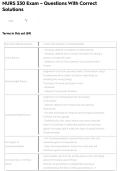
NURS 330 Exam – Questions With Correct
Solutions
Save
Terms in this set (69)
big three ethical theories virtue, deontologist, consequentialist
• Develop, defend conception of ideal person
• Develop, defend list of virtues necessary for being a
virtue theory person of a specific type
• Defend a view of how a person can possess these
virtues
judgments of actions are most basic (Greek deon= duty);
Fundamental ethical task: doing the right thing (or
avoiding the wrong thing)
deontologist theory
Two types of moral principles/ rules:
• Absolute
• Subject to particular situation
judgment of consequences are most basic
Three goals:
• Specify, defend some things that are good in
themselves
• Provide technique to measure and compare quantities
consequentialist theory
of these intrinsic goods
• Defend policy for cases where one cannot decide
which of a number of alternate actions will maximize
good; two types (act & rule); two type of good (intrinsic
& instrumental)
• Act Consequentialism: perform the action that will
Two types of maximize good consequences
consequentialism • Rule Consequentialism: follow the rules that will
maximize good consequences
Instrumental: good so far as they play a role in bringing
Instrumental vs. Intrinsic about intrinsically good things
Good Intrinsic: its goodness is independent because
constituted by the kind of thing good thing is...?
, Clinical pragmatism democratic model of moral problem solving
1. assessment of medical facts, Contextual factors;
patient's capacity; patient's preferences, needs;
surrogate decision-makers; competing interests;
institutional factors; power
Clinical pragmatism
2. Moral Diagnosis of the problems posed by case,
framework
options
3. Goal-Setting, Decision-Making, Implementation of a
shared plan of action (shared decision-making process)
4. Evaluation of results
what is considered good or right
What ought I to do in this situation? What is the right
morality course?
Tells us what the right/ good action is
Customary morality: widely shared beliefs
analysis, study, or consideration of morality
Why should I act in a specific manner? What justifies my
action?
Ethics Considers WHY an action is right/ good and/or why
another action may be indicated
Reflective and critical judgments about acts and beliefs;
To understand and critique particular moralities
1) Respect the patient's privacy and maintain a process
that protects patient's confidentiality
four basic ethical 2) Communicate honestly about all aspects of patient's
obligations that pertain to care: diagnosis, treatment, prognosis
the clinician-patient 3) Determine whether the patient is capable of sharing
relationship in decision making
4) Conduct an ethically valid process of informed
consent throughout relationship
why it is important not to add to this
divorce ethical reasoning
from clinical reasoning
Solutions
Save
Terms in this set (69)
big three ethical theories virtue, deontologist, consequentialist
• Develop, defend conception of ideal person
• Develop, defend list of virtues necessary for being a
virtue theory person of a specific type
• Defend a view of how a person can possess these
virtues
judgments of actions are most basic (Greek deon= duty);
Fundamental ethical task: doing the right thing (or
avoiding the wrong thing)
deontologist theory
Two types of moral principles/ rules:
• Absolute
• Subject to particular situation
judgment of consequences are most basic
Three goals:
• Specify, defend some things that are good in
themselves
• Provide technique to measure and compare quantities
consequentialist theory
of these intrinsic goods
• Defend policy for cases where one cannot decide
which of a number of alternate actions will maximize
good; two types (act & rule); two type of good (intrinsic
& instrumental)
• Act Consequentialism: perform the action that will
Two types of maximize good consequences
consequentialism • Rule Consequentialism: follow the rules that will
maximize good consequences
Instrumental: good so far as they play a role in bringing
Instrumental vs. Intrinsic about intrinsically good things
Good Intrinsic: its goodness is independent because
constituted by the kind of thing good thing is...?
, Clinical pragmatism democratic model of moral problem solving
1. assessment of medical facts, Contextual factors;
patient's capacity; patient's preferences, needs;
surrogate decision-makers; competing interests;
institutional factors; power
Clinical pragmatism
2. Moral Diagnosis of the problems posed by case,
framework
options
3. Goal-Setting, Decision-Making, Implementation of a
shared plan of action (shared decision-making process)
4. Evaluation of results
what is considered good or right
What ought I to do in this situation? What is the right
morality course?
Tells us what the right/ good action is
Customary morality: widely shared beliefs
analysis, study, or consideration of morality
Why should I act in a specific manner? What justifies my
action?
Ethics Considers WHY an action is right/ good and/or why
another action may be indicated
Reflective and critical judgments about acts and beliefs;
To understand and critique particular moralities
1) Respect the patient's privacy and maintain a process
that protects patient's confidentiality
four basic ethical 2) Communicate honestly about all aspects of patient's
obligations that pertain to care: diagnosis, treatment, prognosis
the clinician-patient 3) Determine whether the patient is capable of sharing
relationship in decision making
4) Conduct an ethically valid process of informed
consent throughout relationship
why it is important not to add to this
divorce ethical reasoning
from clinical reasoning


