
NURS 330 Exam – Questions With Quality Solutions
Save
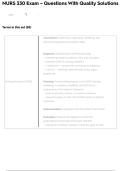
Terms in this set (83)
Assessment: Collecting, organizing, validating, and
documenting patient assessment data
Diagnosis: Analyzing and synthesizing data
→ identifying health problems, risks, and strengths
→ develop a list of nursing problems
→ "related to" — causes that contribute to diagnosis
→ "due to" — defining characteristics (cues, signs,
symptoms)
Nursing Process (ADPIE) Planning: Priority setting based on 1st ABCD (airway,
breathing, circulation, disability), 2nd H2T/focus
assessments, 3rd Maslow's Hierarchy
→ plan to prevent, reduce, or resolve problems
→ develop a plan of care with SMART goals vs desired
outcomes
Implementation: Implement and document intervention
Evaluation: Measure the degree to which the
goals/desired outcomes have been reached
→ decide to continue, change or stop the plan of care
, Systematic method of collecting data to determine:
1. Patient's current and ongoing health status
2. Predict risks to health
3. Identify health-promoting activities
What are health
Data gathered includes:
assessments
1. Wellness behaviours
2. Illness and injury signs/symptoms
3. Patient strengths and weaknesses
4. Health history
5. Risk factors
Head to Toe (H2T): comprehensive assessment that
includes a health history and physical assessment
When is it done: 1st interaction with patient, when
patient returns to unit, if condition changes
Purpose: To establish a baseline for problem
identification, reference, and future comparisons
Types of health
assessments
Focused Assessments: abbreviated assessment based
on problems, diagnoses, or abnormal findings in H2T
When is it done: Abnormal findings in H2T; when rapid
issues arise
Purpose: To determine status of specific problem
identified
Objective data (Signs)
→ can be measured or tested
→ use the senses (can be seen, heard, felt, smelled)
→ collected through physical examination and
observation
→ validates subjective data to complete the health
Types of assessment data
assessment
Subjective data (symptoms)
→ feelings and perceptions described by patient
→ patient's sensations, feelings, beliefs, values, attitudes,
perceptions of personal health status/condition
, What does it measure: number of times heart beats in 1
minute
→ should be done at apex of heart
Vital sign - Heart rate
Normal adult values:
(pulse)
60-100bpm
→ <60bpm = bradycardia (normal for athletes)
→ >100bpm = tachycardia (normal for anxiety and
exercise)
What does it measure: force of blood against the walls
of your blood vessels (arteries)
systole: blood leaving heart into artery
→ max pressure on arteries
→ amount of pressure it takes to pump blood out of the
heart against systemic vascular resistance
→ occurs after heart contractions
diastole: relaxation of arteries
Vital sign - Blood pressure
→ minimum pressure on arteries
(BP)
→ occurs during heart relaxation
Normal adult values:
100/80
→ <120/80 + signs of hypoperfusion = hypotension
→ <90 systolic = hypotension
→ >140/90 = hypertension
→ >200/100 = hypertensive crisis
*Systolic is more important than diastolic
What is measures: body core temperature
→ should be taken orally
→ can be taken temporally, axilla
→ require an order for rectal temperature
Vital sign - Temperature
Normal adult values: 36.5-37.5 C
→ <35 = hypothermia
→ >37.5 = hyperthermia
→ >38 = fever
, What is measures: Measures the amount (percentage) of
oxygen bound to hemoglobin in the blood
Vital sign - Oxygen
saturations (SpO₂) Normal adult values: >95%
→ <95% = hypoxemia (perfusion issues, not enough
oxygen in cells)
Changes:
→ decreased speed of neural conduction
→ decrease in brain size
→ decreased cerebral function
Clinical manifestations:
→ decrease reaction and response time
→ deterioration of short term memory
Neurological age related
→ postural hypotension
changes
→ impaired balance and vertigo
Age related disease:
→ dementia,
→ Alzheimer's
→ Parkinson's
→ stroke
→ depression
Changes:
→ weakened heart muscle
→ decreased contractility (insensitive to inotropes)
→ thickening of ventricle walls
→ decreased blood flow to organs
increased atherosclerotic plaques
Clinical manifestations:
Cardiovascular age related
→ increased BP
changes
→ slower HR
→ cold feet/hands
→ coronary artery disease
Age related disease:
→ hypertension
→ atherosclerosis
→ heart failure
Save
Terms in this set (83)
Assessment: Collecting, organizing, validating, and
documenting patient assessment data
Diagnosis: Analyzing and synthesizing data
→ identifying health problems, risks, and strengths
→ develop a list of nursing problems
→ "related to" — causes that contribute to diagnosis
→ "due to" — defining characteristics (cues, signs,
symptoms)
Nursing Process (ADPIE) Planning: Priority setting based on 1st ABCD (airway,
breathing, circulation, disability), 2nd H2T/focus
assessments, 3rd Maslow's Hierarchy
→ plan to prevent, reduce, or resolve problems
→ develop a plan of care with SMART goals vs desired
outcomes
Implementation: Implement and document intervention
Evaluation: Measure the degree to which the
goals/desired outcomes have been reached
→ decide to continue, change or stop the plan of care
, Systematic method of collecting data to determine:
1. Patient's current and ongoing health status
2. Predict risks to health
3. Identify health-promoting activities
What are health
Data gathered includes:
assessments
1. Wellness behaviours
2. Illness and injury signs/symptoms
3. Patient strengths and weaknesses
4. Health history
5. Risk factors
Head to Toe (H2T): comprehensive assessment that
includes a health history and physical assessment
When is it done: 1st interaction with patient, when
patient returns to unit, if condition changes
Purpose: To establish a baseline for problem
identification, reference, and future comparisons
Types of health
assessments
Focused Assessments: abbreviated assessment based
on problems, diagnoses, or abnormal findings in H2T
When is it done: Abnormal findings in H2T; when rapid
issues arise
Purpose: To determine status of specific problem
identified
Objective data (Signs)
→ can be measured or tested
→ use the senses (can be seen, heard, felt, smelled)
→ collected through physical examination and
observation
→ validates subjective data to complete the health
Types of assessment data
assessment
Subjective data (symptoms)
→ feelings and perceptions described by patient
→ patient's sensations, feelings, beliefs, values, attitudes,
perceptions of personal health status/condition
, What does it measure: number of times heart beats in 1
minute
→ should be done at apex of heart
Vital sign - Heart rate
Normal adult values:
(pulse)
60-100bpm
→ <60bpm = bradycardia (normal for athletes)
→ >100bpm = tachycardia (normal for anxiety and
exercise)
What does it measure: force of blood against the walls
of your blood vessels (arteries)
systole: blood leaving heart into artery
→ max pressure on arteries
→ amount of pressure it takes to pump blood out of the
heart against systemic vascular resistance
→ occurs after heart contractions
diastole: relaxation of arteries
Vital sign - Blood pressure
→ minimum pressure on arteries
(BP)
→ occurs during heart relaxation
Normal adult values:
100/80
→ <120/80 + signs of hypoperfusion = hypotension
→ <90 systolic = hypotension
→ >140/90 = hypertension
→ >200/100 = hypertensive crisis
*Systolic is more important than diastolic
What is measures: body core temperature
→ should be taken orally
→ can be taken temporally, axilla
→ require an order for rectal temperature
Vital sign - Temperature
Normal adult values: 36.5-37.5 C
→ <35 = hypothermia
→ >37.5 = hyperthermia
→ >38 = fever
, What is measures: Measures the amount (percentage) of
oxygen bound to hemoglobin in the blood
Vital sign - Oxygen
saturations (SpO₂) Normal adult values: >95%
→ <95% = hypoxemia (perfusion issues, not enough
oxygen in cells)
Changes:
→ decreased speed of neural conduction
→ decrease in brain size
→ decreased cerebral function
Clinical manifestations:
→ decrease reaction and response time
→ deterioration of short term memory
Neurological age related
→ postural hypotension
changes
→ impaired balance and vertigo
Age related disease:
→ dementia,
→ Alzheimer's
→ Parkinson's
→ stroke
→ depression
Changes:
→ weakened heart muscle
→ decreased contractility (insensitive to inotropes)
→ thickening of ventricle walls
→ decreased blood flow to organs
increased atherosclerotic plaques
Clinical manifestations:
Cardiovascular age related
→ increased BP
changes
→ slower HR
→ cold feet/hands
→ coronary artery disease
Age related disease:
→ hypertension
→ atherosclerosis
→ heart failure


