

11/1/25, 2:40 PM NUR 1010 Final Exam Questions and answers Flashcards | Quizlet
NUR 1010 Final Exam Questions and answers
Save
Terms in this set (80)
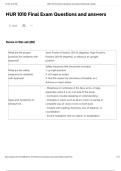
What are the proper Semi-Fowler's Position (30-45 degrees), High-Fowler's
positions for residents with Position (60-90 degrees), or sitting in an upright
dyspnea? position
Safety measures that should be included;
What are the safety 1. up-right position
measures for residents 2. o2 (need an order)
with dyspnea? 3. find the reason for shortness of breathe. ex.)
Asthma or Heart Attack
• Weakness or numbness in the face, arms, or legs,
especially when it is on one side of the body
• Confusion, trouble speaking or understanding
Signs and symptoms of • Changes in vision, such as blurry vision or partial or
Stroke/CVA complete loss of vision in one or both eyes
• Trouble with walking, dizziness, loss of balance, or
coordination
• Severe headache with no reason or explanation
https://quizlet.com/1101629047/nur-1010-final-exam-questions-and-answers-flash-cards/?new 1/18
,11/1/25, 2:40 PM NUR 1010 Final Exam Questions and answers Flashcards | Quizlet
Memory Loss; forgetting important dates/events or
recently learned information
Problems Planning; losing ability to follow a familiar
plan (recipe) or work w/ numbers (bills)
Losing Track; difficulty performing familiar tasks
(cannot drive to familiar locations)
Confusing Time & Place; losing correct date, season,
or passage of time (not knowing how you got
somewhere)
Trouble seeing; cannot understand visual images
which leads to balance & reading problems
Signs and symptoms of
Trouble speaking or writing; trouble following a
Alzheimer's Disease
conversation, trouble with finding words, stopping in
the middle
Losing things; putting things in strange places
Using poor judgement; lost attention to cleanliness or
wearing inappropriate clothing for the weather.
Growing passive; social withdrawal from friends,
hobbies, sleeping more than usual, sitting in-front of
the TV for hours
Changing personality; mood may change
dramatically: become confused, fearful, suspicious,
dependent on a family member
Aortic Valve; Second right interspace.
Pulmonic Valve; Second left interspace.
Describe sites on the
Tricuspid Valve; Left lower sternal border. Fourth
chest to auscultate heart
intercostal space.
(4) valves
Mitral Valve; Fifth interspace at around left
midclavicular line.
- Medical asepsis, including hand hygiene.
- Surgical asepsis (clean tools)
Measures to reduce the
- Standard Precautions.
spread of infection
- Transmission-Based Precautions.
- The Bloodborne Pathogen Standard.
https://quizlet.com/1101629047/nur-1010-final-exam-questions-and-answers-flash-cards/?new 2/18
, 11/1/25, 2:40 PM NUR 1010 Final Exam Questions and answers Flashcards | Quizlet
Arterial Stiffening, Atherosclerosis, Reduced Blood
Flow, The valves in veins that prevent back-flow of
Normal physiological blood can become less effective, Venous Dilation, The
changes occurring in the number of capillaries in tissues can decrease with age,
older adult in the Slower Capillary Refill, Reduced Lymphatic Flow,
Peripheral Vascular Fibrosis, The size and number of lymph nodes can
System and Lymphatic decrease with age, The remaining lymph nodes may
System function less effectively, leading to a slower immune
response, Reduced Immune Response, and Chronic
Inflammation
Normal physiological
changes occurring in the
older adult in the
Musculoskeletal System
Normal value for Blood systolic pressure of less than 120 and a diastolic
Pressure pressure of less than 80
Normal value for heart 60-100 bpm
rate
12-20 breaths per minute
Normal value for
respirations
Pulse-ox; 95% or higher (under 93 tell doctor)
98.6°F (37°C) is considered the average normal
Normal value for
temperature, but normal ranges can be from 97°F
temperature
(36.1°C) to 99°F (37.2°C).
https://quizlet.com/1101629047/nur-1010-final-exam-questions-and-answers-flash-cards/?new 3/18
NUR 1010 Final Exam Questions and answers
Save
Terms in this set (80)
What are the proper Semi-Fowler's Position (30-45 degrees), High-Fowler's
positions for residents with Position (60-90 degrees), or sitting in an upright
dyspnea? position
Safety measures that should be included;
What are the safety 1. up-right position
measures for residents 2. o2 (need an order)
with dyspnea? 3. find the reason for shortness of breathe. ex.)
Asthma or Heart Attack
• Weakness or numbness in the face, arms, or legs,
especially when it is on one side of the body
• Confusion, trouble speaking or understanding
Signs and symptoms of • Changes in vision, such as blurry vision or partial or
Stroke/CVA complete loss of vision in one or both eyes
• Trouble with walking, dizziness, loss of balance, or
coordination
• Severe headache with no reason or explanation
https://quizlet.com/1101629047/nur-1010-final-exam-questions-and-answers-flash-cards/?new 1/18
,11/1/25, 2:40 PM NUR 1010 Final Exam Questions and answers Flashcards | Quizlet
Memory Loss; forgetting important dates/events or
recently learned information
Problems Planning; losing ability to follow a familiar
plan (recipe) or work w/ numbers (bills)
Losing Track; difficulty performing familiar tasks
(cannot drive to familiar locations)
Confusing Time & Place; losing correct date, season,
or passage of time (not knowing how you got
somewhere)
Trouble seeing; cannot understand visual images
which leads to balance & reading problems
Signs and symptoms of
Trouble speaking or writing; trouble following a
Alzheimer's Disease
conversation, trouble with finding words, stopping in
the middle
Losing things; putting things in strange places
Using poor judgement; lost attention to cleanliness or
wearing inappropriate clothing for the weather.
Growing passive; social withdrawal from friends,
hobbies, sleeping more than usual, sitting in-front of
the TV for hours
Changing personality; mood may change
dramatically: become confused, fearful, suspicious,
dependent on a family member
Aortic Valve; Second right interspace.
Pulmonic Valve; Second left interspace.
Describe sites on the
Tricuspid Valve; Left lower sternal border. Fourth
chest to auscultate heart
intercostal space.
(4) valves
Mitral Valve; Fifth interspace at around left
midclavicular line.
- Medical asepsis, including hand hygiene.
- Surgical asepsis (clean tools)
Measures to reduce the
- Standard Precautions.
spread of infection
- Transmission-Based Precautions.
- The Bloodborne Pathogen Standard.
https://quizlet.com/1101629047/nur-1010-final-exam-questions-and-answers-flash-cards/?new 2/18
, 11/1/25, 2:40 PM NUR 1010 Final Exam Questions and answers Flashcards | Quizlet
Arterial Stiffening, Atherosclerosis, Reduced Blood
Flow, The valves in veins that prevent back-flow of
Normal physiological blood can become less effective, Venous Dilation, The
changes occurring in the number of capillaries in tissues can decrease with age,
older adult in the Slower Capillary Refill, Reduced Lymphatic Flow,
Peripheral Vascular Fibrosis, The size and number of lymph nodes can
System and Lymphatic decrease with age, The remaining lymph nodes may
System function less effectively, leading to a slower immune
response, Reduced Immune Response, and Chronic
Inflammation
Normal physiological
changes occurring in the
older adult in the
Musculoskeletal System
Normal value for Blood systolic pressure of less than 120 and a diastolic
Pressure pressure of less than 80
Normal value for heart 60-100 bpm
rate
12-20 breaths per minute
Normal value for
respirations
Pulse-ox; 95% or higher (under 93 tell doctor)
98.6°F (37°C) is considered the average normal
Normal value for
temperature, but normal ranges can be from 97°F
temperature
(36.1°C) to 99°F (37.2°C).
https://quizlet.com/1101629047/nur-1010-final-exam-questions-and-answers-flash-cards/?new 3/18


