
• Wrong document? Swap it for free
  • Written by students who passed
  • Immediately available after payment
  • Read online or as PDF
Sell
Where do you study
Your language
Document preview thumbnail
Preview 4 out of 111 pages
Exam (elaborations)

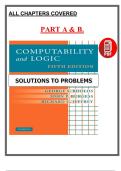
Computability and Logic (5th Edition, 2007) – Solutions to Problems (Part A & B) – Boolos

Document preview thumbnail
Preview 4 out of 111 pages

INSTANT PDF DOWNLOAD — Complete Solutions to Problems for Computability and Logic (5th Edition, 2007) by George S. Boolos, John P. Burgess, and Richard C. Jeffrey. Includes Part A & Part B, covering all key topics: computability, formal proofs, Gödel’s theorems, and recursion theory. Ideal for philosophy, mathematics, and computer science students mastering logic and theoretical computation. computability and logic solutions manual, Boolos computability answers, Burgess logic textbook problems solved, recursion theory exercises solutions, Gödel incompleteness theorem manual, formal proof logic answers, theoretical computer science solutions, mathematical logic solved examples, computability exercises PDF, logic theory textbook solutions, predicate logic problem set solved, proof systems and logic answers, philosophical logic workbook, discrete math logic manual, recursion and decidability solutions, proof theory textbook answers, algorithmic logic examples solved, Church Turing thesis problems, logic and computation manual, mathematical reasoning solutions

Content preview

ALL CHAPTERS COVERED


PART A & B.

, INSTRUCTOR’S
MANUAL
FOR
COMPUTABILITY
AND LOGIC
FIFTH EDITION

PART A.
FOR ALL READERS

JOHN P. BURGESS
Professor of Philosophy
Princeton University


Note
This work is subject to copyright,
but instructors who adopt Computability & Logic as a textbook
are hereby authorized to copy and distribute the present Part A.
This permission does not extend to Part B.


Contents
Dependence of Chapters (Leitfaden) 2
General Remarks on Problems (for Students) 3
Hints for Odd-Numbered Problems Computability Theory 4
Hints for Odd-Numbered Problems Basic Metalogic 11
Errata 20

,2

, 3


Dependence of Chapters

1 & 2 Preliminaries


3-4 Turing machines 6 & 7 Recursiveness 9 & 10 First-order logic


5 Abacus computability 12-14 Metatheory of first-order logic


8 Turing’s theorem 19-21 Topics in metalogic


11.1 Church’s theorem, proof #1

11.2 Church’s theorem, proof #2


15 Arithmetization 16 Representability


17 First Incompleteness Theorem


22-26 Topics in arithmetic
18 Second Incompleteness Theorem


27 Provability logic

Document information

Uploaded on
November 5, 2025
Number of pages
111
Written in
2025/2026
Type
Exam (elaborations)
Contains
Questions & answers
$20.99

Wrong document? Swap it for free Within 14 days of purchase and before downloading, you can choose a different document. You can simply spend the amount again.
Written by students who passed
Immediately available after payment
Read online or as PDF

Seller avatar
Reputation scores are based on the amount of documents a seller has sold for a fee and the reviews they have received for those documents. There are three levels: Bronze, Silver and Gold. The better the reputation, the more your can rely on the quality of the sellers work.
TestBanksStuvia
3.9
(331)
Sold
3246
Followers
1210
Items
2232
Last sold
2 hours ago


Why students choose Stuvia

Created by fellow students, verified by reviews

Quality you can trust: written by students who passed their tests and reviewed by others who've used these notes.

Didn't get what you expected? Choose another document

No worries! You can instantly pick a different document that better fits what you're looking for.

Pay as you like, start learning right away

No subscription, no commitments. Pay the way you're used to via credit card and download your PDF document instantly.

Student with book image

“Bought, downloaded, and aced it. It really can be that simple.”

Alisha Student

Working on your references?

Create accurate citations in APA, MLA and Harvard with our free citation generator.

Working on your references?

Frequently asked questions

