PSYC 406 Midterm 2 Review Psychological 2025-2026
complete update for upcoming exam McGill University
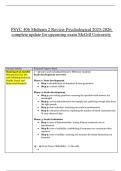
Journal Articles Required Pages to Read
Boateng et al. (2018): 1 – 10 (up to and excluding Distractor Efficiency Analysis)
Best practices for Dev Scale development overview
and Validating Scales for
Health, Social, and Phase 1: Item development
Behavioral Research ● Step 1: identification of domain(s) & item generation
● Step 2: content validity
Phase 2: Scale development
● Step 3: pre-testing questions: ensuring the questions and answers are
meaningful
● Step 4: survey administration and sample size: gathering enough data from
the right people
● Step 5: item reduction: ensuring your scale is parsimonious
● Step 6: extraction of factors: exploring the number of latent constructs that
fit your observed data
Phase 3: Scale Evaluation
● Step 7: tests of dimensionality: testing if latent constructs are as
hypothesized
● Step 8: tests of reliability: establishing if responses are consistent when
repeated
● Step 9: tests of validity: ensuring you measure the latent dimension you
intended
13 – 15 (from Tests of Reliability – to the end)
●
, Holden & Troister 120 – 122 (up to and excluding Ancillaries to Self-Report)
(2009): Developments
in the Self-Report Strategies of Test Construction
Assessment of ● Rational approach
Personality and ○ Dominant in first few decades of 20th C
Psychopathology in ○ Intuitive & largely atheoretical (logic + reason)
Adults ○ Advocating one-to-one rel between verbal reports & internal states
○ Concerns: validity and susceptibility to stylistic responding
● Projective approach
○ Inkblots; Rorschach
○ Prominent btwn 1920s and 1980s
○ Theoretical perspective (private self as covert and guarded bcuz of
psyc. defences → elicited thru ambiguous stimuli)
○ Responses as signs rather than samples of behav
○ Free association phase (1) and inquiry phase (2)
complete update for upcoming exam McGill University
Journal Articles Required Pages to Read
Boateng et al. (2018): 1 – 10 (up to and excluding Distractor Efficiency Analysis)
Best practices for Dev Scale development overview
and Validating Scales for
Health, Social, and Phase 1: Item development
Behavioral Research ● Step 1: identification of domain(s) & item generation
● Step 2: content validity
Phase 2: Scale development
● Step 3: pre-testing questions: ensuring the questions and answers are
meaningful
● Step 4: survey administration and sample size: gathering enough data from
the right people
● Step 5: item reduction: ensuring your scale is parsimonious
● Step 6: extraction of factors: exploring the number of latent constructs that
fit your observed data
Phase 3: Scale Evaluation
● Step 7: tests of dimensionality: testing if latent constructs are as
hypothesized
● Step 8: tests of reliability: establishing if responses are consistent when
repeated
● Step 9: tests of validity: ensuring you measure the latent dimension you
intended
13 – 15 (from Tests of Reliability – to the end)
●
, Holden & Troister 120 – 122 (up to and excluding Ancillaries to Self-Report)
(2009): Developments
in the Self-Report Strategies of Test Construction
Assessment of ● Rational approach
Personality and ○ Dominant in first few decades of 20th C
Psychopathology in ○ Intuitive & largely atheoretical (logic + reason)
Adults ○ Advocating one-to-one rel between verbal reports & internal states
○ Concerns: validity and susceptibility to stylistic responding
● Projective approach
○ Inkblots; Rorschach
○ Prominent btwn 1920s and 1980s
○ Theoretical perspective (private self as covert and guarded bcuz of
psyc. defences → elicited thru ambiguous stimuli)
○ Responses as signs rather than samples of behav
○ Free association phase (1) and inquiry phase (2)