

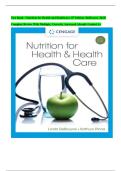
Test Bank - Nutrition for Health and Healthcare, 8th Edition (DeBruyne, 2025)
Complete Review With Multiple, Correctly Answered Already Graded A+
,1. Overview of Nutrition and Health.
2. Digestion and Absorption.
3. Carbohydrates.
4. Lipids.
5. Protein.
6. Energy Balance and Body Composition.
7. Weight Management.
8. The Vitamins.
9. Water and the Minerals.
10. Nutrition through the Life Span: Pregnancy and Lactation.
11. Nutrition through the Life Span: Infancy, Childhood, and Adolescence.
12. Nutrition through the Life Span: Later Adulthood.
13. Nutrition Care and Assessment.
14. Nutrition Intervention and Diet–Drug Interactions.
15. Enteral and Parenteral Nutrition Support.
16. Nutrition in Metabolic and Respiratory Stress.
17. Nutrition and Upper Gastrointestinal Disorders.
18. Nutrition and Lower Gastrointestinal Disorders.
19. Nutrition and Liver Diseases.
20. Nutrition and Diabetes Mellitus.
21. Nutrition and Cardiovascular Diseases.
22. Nutrition and Renal Diseases.
,23. Nutrition, Cancer, and HIV Infection.
Test Bank - Nutrition for Health and Healthcare, 8th Edition (DeBruyne, 2024)
Complete Review With Multiple, Correctly Answered Already Graded A+
Chapter 01 Overview of Nutrition and Health
True / False
1. Minerals and water are organic and yield energy in the human body.
a. True
b. False
ANSWER: False
REFERENCES: 1.2 The Nutrients
LEARNING OBJECTIVES: NHHC.DEBR.17.1.2 - Identify which of the major
classes of nutrients are organic and which yield energy.
KEYWORDS: Bloom's: Remember
2. An excess intake of protein will never lead to weight gain.
a. True
, b. False
ANSWER: False
REFERENCES: 1.2 The Nutrients
LEARNING OBJECTIVES: NHHC.DEBR.17.1.2 - Identify which of the major
classes of nutrients are organic and which yield energy.
KEYWORDS: Bloom's: Understand
3. The Dietary Reference Intakes (DRI) reflect the collaborative efforts of
scientists to produce a set of standards for the amount of energy, nutrients, and
other dietary components that best support health.
a. True
b. False
ANSWER: True
REFERENCES: 1.3 Nutrient Recommendations
LEARNING OBJECTIVES: NHHC.DEBR.17.1.3 - Describe the four categories of
the Dietary Reference Intakes (DRI), the Estimated Energy Requirement (EER), and
the Acceptable
Macronutrient Distribution Ranges (AMDR).
KEYWORDS: Bloom's: Remember
Complete Review With Multiple, Correctly Answered Already Graded A+
,1. Overview of Nutrition and Health.
2. Digestion and Absorption.
3. Carbohydrates.
4. Lipids.
5. Protein.
6. Energy Balance and Body Composition.
7. Weight Management.
8. The Vitamins.
9. Water and the Minerals.
10. Nutrition through the Life Span: Pregnancy and Lactation.
11. Nutrition through the Life Span: Infancy, Childhood, and Adolescence.
12. Nutrition through the Life Span: Later Adulthood.
13. Nutrition Care and Assessment.
14. Nutrition Intervention and Diet–Drug Interactions.
15. Enteral and Parenteral Nutrition Support.
16. Nutrition in Metabolic and Respiratory Stress.
17. Nutrition and Upper Gastrointestinal Disorders.
18. Nutrition and Lower Gastrointestinal Disorders.
19. Nutrition and Liver Diseases.
20. Nutrition and Diabetes Mellitus.
21. Nutrition and Cardiovascular Diseases.
22. Nutrition and Renal Diseases.
,23. Nutrition, Cancer, and HIV Infection.
Test Bank - Nutrition for Health and Healthcare, 8th Edition (DeBruyne, 2024)
Complete Review With Multiple, Correctly Answered Already Graded A+
Chapter 01 Overview of Nutrition and Health
True / False
1. Minerals and water are organic and yield energy in the human body.
a. True
b. False
ANSWER: False
REFERENCES: 1.2 The Nutrients
LEARNING OBJECTIVES: NHHC.DEBR.17.1.2 - Identify which of the major
classes of nutrients are organic and which yield energy.
KEYWORDS: Bloom's: Remember
2. An excess intake of protein will never lead to weight gain.
a. True
, b. False
ANSWER: False
REFERENCES: 1.2 The Nutrients
LEARNING OBJECTIVES: NHHC.DEBR.17.1.2 - Identify which of the major
classes of nutrients are organic and which yield energy.
KEYWORDS: Bloom's: Understand
3. The Dietary Reference Intakes (DRI) reflect the collaborative efforts of
scientists to produce a set of standards for the amount of energy, nutrients, and
other dietary components that best support health.
a. True
b. False
ANSWER: True
REFERENCES: 1.3 Nutrient Recommendations
LEARNING OBJECTIVES: NHHC.DEBR.17.1.3 - Describe the four categories of
the Dietary Reference Intakes (DRI), the Estimated Energy Requirement (EER), and
the Acceptable
Macronutrient Distribution Ranges (AMDR).
KEYWORDS: Bloom's: Remember


