
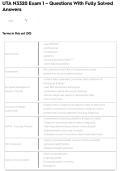
UTA N3320 Exam 1 – Questions With Fully Solved
Answers
Save
Terms in this set (30)
-pay attention
-professional
-compassion
Good Nurse
-patience
-strong assessment skills ***
-client teaching abilities
the collection by the RN of comprehensive data
Assessment
pertinent to the pt's health/situation
-collect data: systematic, prioritizes data collection, &
involves pt & family
Scrope & Standards of -uses EBP assessment techniques
Practice: The RN -synthesizes data & documents findings
-derives diagnoses based on assessment data
-form a care plan
Collect holistic subjective & objective data to determine
Purpose of Health
a client's overall level of functioning in order to make a
Assessment
professional clinical judgement (nursing diagnosis)
-Assessment (collecting subjective & objective data)
-Diagnosis (analyzing data to make a diagnosis)
ADPIE - Nursing Process -Planning (determining outcome criteria & plan)
-Implementation (carrying out plan)
-Evaluation (check if outcome criteria have been met)
-history of present health concern (chief complaint)
HA Framework -personal health history
-lifestyle & health practices
Initial Comprehensive
Ongoing/partial
Types of Assessments
Focused/problem-oriented
Emergency
, Collection of
subjective data about the client's perception of health
Initial Comprehensive
of all body parts or systems, past medical history, family
Assessment
history, and lifestyle and health practices (admission to
facility)
Data collection that
Ongoing/Partial
occurs after the comprehensive database is established.
Assessment
(reassessment, shift assessment
assessment of a
Focus/problem-oriented
particular client problem, which does not cover areas
Assessment
not related to the problem.(pain assessment)
Very rapid assessment
Emergency Assessment performed in life-threatening situations.( rapid response,
chest pain, ABC)
-collect subjective data
-collect objective data
Steps of Assessment
-validation of accuracy
-documentation
-review pt's record
-educate yourself about diagnosis, tests
Preparing for Assessment -avoid premature judgements (chronic dz, drug/alcohol
use, lifestyle)
-gather supplies
-biographical info
-history of present health concern (physical, emotional
Collection of Subjective symptoms)
Data -personal health history
-family history
-health & lifestyle practices
-physical characteristics
-body functions (VS)
Collection of Objective -appearance
Data -behavior
measurements
results of lab/diagnostic tests
Answers
Save
Terms in this set (30)
-pay attention
-professional
-compassion
Good Nurse
-patience
-strong assessment skills ***
-client teaching abilities
the collection by the RN of comprehensive data
Assessment
pertinent to the pt's health/situation
-collect data: systematic, prioritizes data collection, &
involves pt & family
Scrope & Standards of -uses EBP assessment techniques
Practice: The RN -synthesizes data & documents findings
-derives diagnoses based on assessment data
-form a care plan
Collect holistic subjective & objective data to determine
Purpose of Health
a client's overall level of functioning in order to make a
Assessment
professional clinical judgement (nursing diagnosis)
-Assessment (collecting subjective & objective data)
-Diagnosis (analyzing data to make a diagnosis)
ADPIE - Nursing Process -Planning (determining outcome criteria & plan)
-Implementation (carrying out plan)
-Evaluation (check if outcome criteria have been met)
-history of present health concern (chief complaint)
HA Framework -personal health history
-lifestyle & health practices
Initial Comprehensive
Ongoing/partial
Types of Assessments
Focused/problem-oriented
Emergency
, Collection of
subjective data about the client's perception of health
Initial Comprehensive
of all body parts or systems, past medical history, family
Assessment
history, and lifestyle and health practices (admission to
facility)
Data collection that
Ongoing/Partial
occurs after the comprehensive database is established.
Assessment
(reassessment, shift assessment
assessment of a
Focus/problem-oriented
particular client problem, which does not cover areas
Assessment
not related to the problem.(pain assessment)
Very rapid assessment
Emergency Assessment performed in life-threatening situations.( rapid response,
chest pain, ABC)
-collect subjective data
-collect objective data
Steps of Assessment
-validation of accuracy
-documentation
-review pt's record
-educate yourself about diagnosis, tests
Preparing for Assessment -avoid premature judgements (chronic dz, drug/alcohol
use, lifestyle)
-gather supplies
-biographical info
-history of present health concern (physical, emotional
Collection of Subjective symptoms)
Data -personal health history
-family history
-health & lifestyle practices
-physical characteristics
-body functions (VS)
Collection of Objective -appearance
Data -behavior
measurements
results of lab/diagnostic tests


