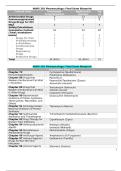
NURS 301 Pharmacology: Final Exam Blueprint
Content Area Knowledge/ Application/ Tot
Comprehension Analysis al
Antimicrobial Drugs 9 13 22
Immunosuppressant 3 5 8
Drugs/Drugs for HIV
Med 2 3 5
Safety/Calculations
Cumulative Content 16 24 40
(Total; breakdown
below) 3 5 8
- Drugs for Pain 3 5 8
- Fluid/Electrolyte 5 7 12
& Acid/Base 3 3 6
- Cardiovascular 2 4 6
Drugs
- Respiratory
Drugs
- Endocrine Drugs
Total 30 (40%) 45 (60%) 75
NURS 301 Pharmacology: Final Exam Blueprint
Cumulative Drug List
Chapter 72 - Cyclosporine (Sandimmune)
Immunosuppressants - Prednisone (Deltasone)
Chapter 88 Drugs that - Penicillin G
Weaken the Bacterial Cell Wall - Piperacillin/Tazobactam (Zosyn)
I: Penicillins - Amoxicillin (Amoxil)
Chapter 89 Drugs that - Vancomycin (Vancocin)
Weaken the Bacterial Cell Wall - Cefzolin (Ancef)
II: Other Drugs - Imipenem (Primaxin)
Chapter 90 Bacteriostatic - Doxycycline (Vibramycin)
Inhibitors of Protein Synthesis:
Tetracyclines, Macrolides, and
Others
Chapter 91 Aminoglycosides: - Tobramycin (Nebcin)
Bacterial Inhibitors of Protein
Synthesis
Chapter 92 Sulfonamide - Trimethoprim/ Sulfamethoxazole (Bactrim)
Antibiotics and Trimethoprim
Chapter 93 Drug Therapy for - Ciprofloxacin (Cipro)
Urinary Tract Infections
Chapter 94 Antimycobacterial - Rifampin (Rifadin)
Agents - Isoniazid (Nidrazid)
Chapter 95 Miscellaneous - Metronizadole (Flagyl)
Antibacterial Drugs
Chapter 96 Antifungal Agents - Amphotericin B (Fungizone)
Chapter 97 Antiviral Agents I: - Oseltamivir (Tamiflu)
Drugs for Non-HIV Viral
Infections
Chapter 98 Antiviral Agents - Efavirenz (Sustiva)
1
,II: Drugs for HIV Infection and - Ritonavir (Norvir)
Related Opportunistic
Infections
NURS 301 Pharmacology: Final Exam Blueprint
Cumulative Drug List
Drugs for Pain Morphine
1. A hospice nurse is caring for a client with terminal cancer taking
oral Morphine for pain relief. The client is reporting that he had to
increase the dose of morphine to obtain pain relief. Which of the
following scenarios explain this phenomenon?
a. The client has become addicted to this medication.
b. The client has developed a tolerance to the medication.
c. The client is experiencing mental status changes and episodes of
confusion.
d. The client has not been taking the medication properly.
Rationale: Over time, patients taking opioids like morphine can
develop tolerance, requiring higher doses to achieve the same level of
pain relief. This is a common effect and does not imply addiction or
improper use.
2. The nurse is preparing to administer Morphine 4 mg IV bolus to a
client with pain. Available is morphine 10 mg/mL. Which of the
following actions should the nurse take?
Save the extra medication for a later dose.
Have another nurse witness the disposal of the extra
medication.
Discard the extra medication in the sharps container.
Send the waste amount to the pharmacy.
Rationale: To prevent misuse or diversion of controlled substances, it's
necessary for another nurse to witness and document the disposal of any
unused portion of the medication.
Morphine – reduce pain, improve hemodynamics (reduces preload, some
afterload)
Opioids any natural or synthetic drug that has a SIMILAR action to
morphine
Controlled Substance Act
o Regulates drugs that have potential ABUSE RISK
Lower the “Schedule Rating” = LOWER risk for potential
drug abuse
o Morphine / Fentanyl schedule II drug = HIGH RISK for
potential abuse
Drug Classifications:
Drug Mu Kappa
Morphine agonist agonist
Talwin (pentazocine) antagonist agonist
Narcan (naloxone) antagonist antagonist
o *Morphine agonist Morpheus, the Greek God of Dreams
Agonist WITH Mu & Kappa Receptors
Agonist is going to INHIBIT response
2
,o *Morphine agonist Morpheus, the Greek God of
Dreams
STRONG opioid analgesic / agonist
Natural Source seedpod of the poppy
Uses:
Relief of moderate – severe pain
Mimics actions of endogenous opioid peptides at
the Mu receptors
Produces
o Analgesia
o Sedation or Euphoria
o Respiratory depression
o Cough suppression
o Reduces GI motility stool softeners /
laxatives given
Adverse Effects
Respiratory depression
Constipation or Urinary retention cath / pure
wick may be needed
Orthostatic hypotension small dilation of
arterials & veins
Cough suppression
Emesis Zofran / antinausea may be needed
Miosis small pupils
Route: *PO, IM, *IV, SubQ, epidural, intrathecal (spinal
cord)
Pharmacokinetics
Hepatic metabolism (in liver) 1st pass effect for
oral doses is REALLY HIGH
o HIGHER oral doses to get the same effects
as if it was given IV
Precautions USE CAUTION WITH THESE Pts
o Pts with decreased respiratory reserve
lung disorder (asthma, COPD)
o Head injuries
o Infants & elderly
o Pts with inflammatory bowel disease b/c
opioids SLOW GI
o Liver impairment
o Prostatic hypertrophy urinary retention
Equi-Analgesic Doses doses that are different amts for
the same med that give the SAME RESPONSE
Morphine PO = 30mg takes 15-60 minutes to
kick in
Morphine IV = 10mg takes 2-3 minutes to kick
in
3
, Morphine IM = 10mg takes 10-30 minutes to
kick in
Morphine interactions
Adverse
o Other CNS depressants
o Anticholinergic drugs dry Pts out
o Hypotensive drugs
Beneficial
o Amphetamines increases analgesic effect
o Phenothiazine nausea med to reduce the
nausea with morphine
o Dextromethorphan enhance the pain
relief
Morphine Nursing Care
Pain is subjective experience listen to your Pts &
watch their VS
o Understanding cultural differences
Is Pt opioid naïve someone who hasn’t taken
opioid meds before, tolerant this Pt gets pain
meds often
Type of pain chronic or acute
Pain can worsen with anxiety, fear, & anger
Asses respiratory rate, BP, Pulse, Pain Level PRIOR
& POST administration
Be aware of those who are sensitive to respiratory
depression
o Preexisting lung disorder Pts
Encouraging physical activity, fiber diet
Cough & deep breath to reduce pneumonia &
atelectasis (lung collapse)
Slowly move from sitting to standing assess for
lightheadedness & dizziness
Check bladder distention monitor I&O
encourage voiding Q4H
Avoid drugs that can worsen Sx of urinary
retention & constipation
Avoid hazardous activities that require metal
clarity like driving
Use non-pharmacologic methods ice, heat,
repositioning
PRIMARY receptor stimulated by opioids Mu receptor
Causes euphoria, sedation, & decreased
respiratory depression
SERIOUS adverse effect with opioids respiratory
depression
Morphine Toxicity
4
Content Area Knowledge/ Application/ Tot
Comprehension Analysis al
Antimicrobial Drugs 9 13 22
Immunosuppressant 3 5 8
Drugs/Drugs for HIV
Med 2 3 5
Safety/Calculations
Cumulative Content 16 24 40
(Total; breakdown
below) 3 5 8
- Drugs for Pain 3 5 8
- Fluid/Electrolyte 5 7 12
& Acid/Base 3 3 6
- Cardiovascular 2 4 6
Drugs
- Respiratory
Drugs
- Endocrine Drugs
Total 30 (40%) 45 (60%) 75
NURS 301 Pharmacology: Final Exam Blueprint
Cumulative Drug List
Chapter 72 - Cyclosporine (Sandimmune)
Immunosuppressants - Prednisone (Deltasone)
Chapter 88 Drugs that - Penicillin G
Weaken the Bacterial Cell Wall - Piperacillin/Tazobactam (Zosyn)
I: Penicillins - Amoxicillin (Amoxil)
Chapter 89 Drugs that - Vancomycin (Vancocin)
Weaken the Bacterial Cell Wall - Cefzolin (Ancef)
II: Other Drugs - Imipenem (Primaxin)
Chapter 90 Bacteriostatic - Doxycycline (Vibramycin)
Inhibitors of Protein Synthesis:
Tetracyclines, Macrolides, and
Others
Chapter 91 Aminoglycosides: - Tobramycin (Nebcin)
Bacterial Inhibitors of Protein
Synthesis
Chapter 92 Sulfonamide - Trimethoprim/ Sulfamethoxazole (Bactrim)
Antibiotics and Trimethoprim
Chapter 93 Drug Therapy for - Ciprofloxacin (Cipro)
Urinary Tract Infections
Chapter 94 Antimycobacterial - Rifampin (Rifadin)
Agents - Isoniazid (Nidrazid)
Chapter 95 Miscellaneous - Metronizadole (Flagyl)
Antibacterial Drugs
Chapter 96 Antifungal Agents - Amphotericin B (Fungizone)
Chapter 97 Antiviral Agents I: - Oseltamivir (Tamiflu)
Drugs for Non-HIV Viral
Infections
Chapter 98 Antiviral Agents - Efavirenz (Sustiva)
1
,II: Drugs for HIV Infection and - Ritonavir (Norvir)
Related Opportunistic
Infections
NURS 301 Pharmacology: Final Exam Blueprint
Cumulative Drug List
Drugs for Pain Morphine
1. A hospice nurse is caring for a client with terminal cancer taking
oral Morphine for pain relief. The client is reporting that he had to
increase the dose of morphine to obtain pain relief. Which of the
following scenarios explain this phenomenon?
a. The client has become addicted to this medication.
b. The client has developed a tolerance to the medication.
c. The client is experiencing mental status changes and episodes of
confusion.
d. The client has not been taking the medication properly.
Rationale: Over time, patients taking opioids like morphine can
develop tolerance, requiring higher doses to achieve the same level of
pain relief. This is a common effect and does not imply addiction or
improper use.
2. The nurse is preparing to administer Morphine 4 mg IV bolus to a
client with pain. Available is morphine 10 mg/mL. Which of the
following actions should the nurse take?
Save the extra medication for a later dose.
Have another nurse witness the disposal of the extra
medication.
Discard the extra medication in the sharps container.
Send the waste amount to the pharmacy.
Rationale: To prevent misuse or diversion of controlled substances, it's
necessary for another nurse to witness and document the disposal of any
unused portion of the medication.
Morphine – reduce pain, improve hemodynamics (reduces preload, some
afterload)
Opioids any natural or synthetic drug that has a SIMILAR action to
morphine
Controlled Substance Act
o Regulates drugs that have potential ABUSE RISK
Lower the “Schedule Rating” = LOWER risk for potential
drug abuse
o Morphine / Fentanyl schedule II drug = HIGH RISK for
potential abuse
Drug Classifications:
Drug Mu Kappa
Morphine agonist agonist
Talwin (pentazocine) antagonist agonist
Narcan (naloxone) antagonist antagonist
o *Morphine agonist Morpheus, the Greek God of Dreams
Agonist WITH Mu & Kappa Receptors
Agonist is going to INHIBIT response
2
,o *Morphine agonist Morpheus, the Greek God of
Dreams
STRONG opioid analgesic / agonist
Natural Source seedpod of the poppy
Uses:
Relief of moderate – severe pain
Mimics actions of endogenous opioid peptides at
the Mu receptors
Produces
o Analgesia
o Sedation or Euphoria
o Respiratory depression
o Cough suppression
o Reduces GI motility stool softeners /
laxatives given
Adverse Effects
Respiratory depression
Constipation or Urinary retention cath / pure
wick may be needed
Orthostatic hypotension small dilation of
arterials & veins
Cough suppression
Emesis Zofran / antinausea may be needed
Miosis small pupils
Route: *PO, IM, *IV, SubQ, epidural, intrathecal (spinal
cord)
Pharmacokinetics
Hepatic metabolism (in liver) 1st pass effect for
oral doses is REALLY HIGH
o HIGHER oral doses to get the same effects
as if it was given IV
Precautions USE CAUTION WITH THESE Pts
o Pts with decreased respiratory reserve
lung disorder (asthma, COPD)
o Head injuries
o Infants & elderly
o Pts with inflammatory bowel disease b/c
opioids SLOW GI
o Liver impairment
o Prostatic hypertrophy urinary retention
Equi-Analgesic Doses doses that are different amts for
the same med that give the SAME RESPONSE
Morphine PO = 30mg takes 15-60 minutes to
kick in
Morphine IV = 10mg takes 2-3 minutes to kick
in
3
, Morphine IM = 10mg takes 10-30 minutes to
kick in
Morphine interactions
Adverse
o Other CNS depressants
o Anticholinergic drugs dry Pts out
o Hypotensive drugs
Beneficial
o Amphetamines increases analgesic effect
o Phenothiazine nausea med to reduce the
nausea with morphine
o Dextromethorphan enhance the pain
relief
Morphine Nursing Care
Pain is subjective experience listen to your Pts &
watch their VS
o Understanding cultural differences
Is Pt opioid naïve someone who hasn’t taken
opioid meds before, tolerant this Pt gets pain
meds often
Type of pain chronic or acute
Pain can worsen with anxiety, fear, & anger
Asses respiratory rate, BP, Pulse, Pain Level PRIOR
& POST administration
Be aware of those who are sensitive to respiratory
depression
o Preexisting lung disorder Pts
Encouraging physical activity, fiber diet
Cough & deep breath to reduce pneumonia &
atelectasis (lung collapse)
Slowly move from sitting to standing assess for
lightheadedness & dizziness
Check bladder distention monitor I&O
encourage voiding Q4H
Avoid drugs that can worsen Sx of urinary
retention & constipation
Avoid hazardous activities that require metal
clarity like driving
Use non-pharmacologic methods ice, heat,
repositioning
PRIMARY receptor stimulated by opioids Mu receptor
Causes euphoria, sedation, & decreased
respiratory depression
SERIOUS adverse effect with opioids respiratory
depression
Morphine Toxicity
4