

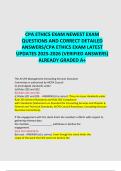
CPA ETHICS EXAM NEWEST EXAM
QUESTIONS AND CORRECT DETAILED
ANSWERS/CPA ETHICS EXAM LATEST
UPDATES 2025-2026 (VERIFIED ANSWERS)
ALREADY GRADED A+
The AI CPA Management Consulting Services Executive
Committee is authorized by AICPA Council
to promulgate standards under
(a) Rules 202 and 203.
(b) Rules 201 and 202.
(c) Rules 201 and 203. - ANSWER-(b) is correct. They can issue standards under
Rule 201 General Standards and Rule 202 Compliance
with Standards (Statements on Standard for Consulting Services and Chapter 6,
General and Technical Standards, AICPA Council Resolution, Consulting Services
Executive Committee).
If the engagement with the client limits the member's efforts with respect to
gathering relevant data
the member ________________ withdraw or decline the
engagement.
(a) is not required to
(b) must - ANSWER-(a) is correct. Even though the client limits the
scope of the work the CPA need not decline the
,engagement (Statement on Standards for Consulting Services, Standards for
Consulting Services 8).
A member could be tried and convicted by a trial
board on a charge of violating one of the Statements
on Standards for Tax Services. The preceding statement
is
(a) true.
(b) false. - ANSWER-(a) is correct. Statements on Standards for Tax Services
are enforceable under the Code of Professional
Conduct (History).
Olson, a member, has been preparing Walker's
income tax return. Walker is the sole owner of a
manufacturing plant. He insists that Olson take a
position with respect to a material item on his tax
return that Olson does not agree with. In fact, Olson
believes that the position Walker is insisting on
cannot be sustained if challenged on review either
administratively or judicially. What action would
Olson take?
(a) He should finish preparing the return but refuse
to sign it.
(b) He should not prepare or sign the return.
( c) He should finish preparing the return and he
should sign it. The return is Walker 's responsibility
and Olson has told Walker his opinion on
the item. - ANSWER-(b) is correct. The member should not prepare or
sign the return. The statements say that if a member believes a position does not
have a realistic possibility of being sustained judicially or administratively, the
member should not prepare or sign the return. Thus (a) and (c) are incorrect
(Statement No. 1, Statement 5 a and 5 b).
Milano, a member, prepares the tax returns for
the owners and various executives of a company.
The owners are all related. The owners and other
executives are in various other ventures. Ownership
,percentages vary and not all are in each investment.
Provided it does not break any law or the Code of
Professional Conduct, may Milano consider the
information from one or more of these people in
preparing the returns of others in this group?
(a) No, he may not consider information from one
client in preparing another client's return.
(b) Yes, he may consider it but is not required to do
so.
(c) Yes, he should consider such information. - ANSWER-( c) is correct. Milano
should consider the information. Statements say that he should consider
information known to him from the tax returns of others. Thus (a) and (b) are
incorrect (Statement No.3, Statement 4).
Macke, a member, is preparing Jacobs' tax return
from information submitted by Jacobs. The information
appears to be correct and complete. How much
verification of the information should Macke do?
(a) He must spot check some of the data.
(b) He is not required to verify any of the information. - ANSWER-(b) is correct.
Macke is not required to verify any of
the information. Many members however believe
that some review and verification should be done
(Signatures on Tax Returns and Statement No. 3,
Statement 2).
Kanter, a tax client of Zeman, a member, received
an unfavorable court decision some five years ago
on a tax position he had taken with respect to some
business expenses. Kanter wants to once more take
the same position on business expenses that he did
five years ago. Must Zeman insist that the earlier
court decision be followed in filing this year's tax
return?
(a) Yes.
(b) No. - ANSWER-(b) is correct. Kanter need not follow the earlier
, court decision and Zeman may prepare and sign the return if he believes there is a
realistic possibility the expenses would be allowed this time. (Statement No. 5,
Statement)
Which category contains the ethical standards, a
violation of which makes a member liable to disciplinary
action?
(a) Ethics Rulings.
(b) Interpretations of the Rules.
(c) Rules. - ANSWER-(c) is the conect answer. Code of Professional
Conduct, Strncture, says that infraction of any of the rules makes a member liable
to disciplinary action.
(a) is wrong since members who depart from the
guidance in ethical rulings in similar circumstances
will be asked to justify such departure. They cannot
however be charged with violating a ruling.
(b) is also wrong since a member cannot be
charged with violating an interpretation. In a disciplina1y
hearing where the member was charged with
violating a rnle, the member would have the burden of justifying any departure
from interpretations ofthat rule.
The Trial Board may, after a hearing, do two of the
three things listed below. Mark the one that the Trial
Board cannot do.
(a) Suspend a member.
(b) Suspend the member's CPA certificate.
( c) Expel a member. - ANSWER-(b) is the correct answer. Code of Professional
Conduct, Enforcement, says a Trial Board may
admonish, suspend or expel a member. The Trial
Board has no jurisdiction over a member's CPA
certificate.
Which of the following requires that any changes in
them be approved by the members of the AICPA?
(a) Rules and interpretations of the rules.
(b) Principles and rules.
QUESTIONS AND CORRECT DETAILED
ANSWERS/CPA ETHICS EXAM LATEST
UPDATES 2025-2026 (VERIFIED ANSWERS)
ALREADY GRADED A+
The AI CPA Management Consulting Services Executive
Committee is authorized by AICPA Council
to promulgate standards under
(a) Rules 202 and 203.
(b) Rules 201 and 202.
(c) Rules 201 and 203. - ANSWER-(b) is correct. They can issue standards under
Rule 201 General Standards and Rule 202 Compliance
with Standards (Statements on Standard for Consulting Services and Chapter 6,
General and Technical Standards, AICPA Council Resolution, Consulting Services
Executive Committee).
If the engagement with the client limits the member's efforts with respect to
gathering relevant data
the member ________________ withdraw or decline the
engagement.
(a) is not required to
(b) must - ANSWER-(a) is correct. Even though the client limits the
scope of the work the CPA need not decline the
,engagement (Statement on Standards for Consulting Services, Standards for
Consulting Services 8).
A member could be tried and convicted by a trial
board on a charge of violating one of the Statements
on Standards for Tax Services. The preceding statement
is
(a) true.
(b) false. - ANSWER-(a) is correct. Statements on Standards for Tax Services
are enforceable under the Code of Professional
Conduct (History).
Olson, a member, has been preparing Walker's
income tax return. Walker is the sole owner of a
manufacturing plant. He insists that Olson take a
position with respect to a material item on his tax
return that Olson does not agree with. In fact, Olson
believes that the position Walker is insisting on
cannot be sustained if challenged on review either
administratively or judicially. What action would
Olson take?
(a) He should finish preparing the return but refuse
to sign it.
(b) He should not prepare or sign the return.
( c) He should finish preparing the return and he
should sign it. The return is Walker 's responsibility
and Olson has told Walker his opinion on
the item. - ANSWER-(b) is correct. The member should not prepare or
sign the return. The statements say that if a member believes a position does not
have a realistic possibility of being sustained judicially or administratively, the
member should not prepare or sign the return. Thus (a) and (c) are incorrect
(Statement No. 1, Statement 5 a and 5 b).
Milano, a member, prepares the tax returns for
the owners and various executives of a company.
The owners are all related. The owners and other
executives are in various other ventures. Ownership
,percentages vary and not all are in each investment.
Provided it does not break any law or the Code of
Professional Conduct, may Milano consider the
information from one or more of these people in
preparing the returns of others in this group?
(a) No, he may not consider information from one
client in preparing another client's return.
(b) Yes, he may consider it but is not required to do
so.
(c) Yes, he should consider such information. - ANSWER-( c) is correct. Milano
should consider the information. Statements say that he should consider
information known to him from the tax returns of others. Thus (a) and (b) are
incorrect (Statement No.3, Statement 4).
Macke, a member, is preparing Jacobs' tax return
from information submitted by Jacobs. The information
appears to be correct and complete. How much
verification of the information should Macke do?
(a) He must spot check some of the data.
(b) He is not required to verify any of the information. - ANSWER-(b) is correct.
Macke is not required to verify any of
the information. Many members however believe
that some review and verification should be done
(Signatures on Tax Returns and Statement No. 3,
Statement 2).
Kanter, a tax client of Zeman, a member, received
an unfavorable court decision some five years ago
on a tax position he had taken with respect to some
business expenses. Kanter wants to once more take
the same position on business expenses that he did
five years ago. Must Zeman insist that the earlier
court decision be followed in filing this year's tax
return?
(a) Yes.
(b) No. - ANSWER-(b) is correct. Kanter need not follow the earlier
, court decision and Zeman may prepare and sign the return if he believes there is a
realistic possibility the expenses would be allowed this time. (Statement No. 5,
Statement)
Which category contains the ethical standards, a
violation of which makes a member liable to disciplinary
action?
(a) Ethics Rulings.
(b) Interpretations of the Rules.
(c) Rules. - ANSWER-(c) is the conect answer. Code of Professional
Conduct, Strncture, says that infraction of any of the rules makes a member liable
to disciplinary action.
(a) is wrong since members who depart from the
guidance in ethical rulings in similar circumstances
will be asked to justify such departure. They cannot
however be charged with violating a ruling.
(b) is also wrong since a member cannot be
charged with violating an interpretation. In a disciplina1y
hearing where the member was charged with
violating a rnle, the member would have the burden of justifying any departure
from interpretations ofthat rule.
The Trial Board may, after a hearing, do two of the
three things listed below. Mark the one that the Trial
Board cannot do.
(a) Suspend a member.
(b) Suspend the member's CPA certificate.
( c) Expel a member. - ANSWER-(b) is the correct answer. Code of Professional
Conduct, Enforcement, says a Trial Board may
admonish, suspend or expel a member. The Trial
Board has no jurisdiction over a member's CPA
certificate.
Which of the following requires that any changes in
them be approved by the members of the AICPA?
(a) Rules and interpretations of the rules.
(b) Principles and rules.


