
KEY OBJECTIVES
1. Recognize the historical developments of mass communication theories.
2. Define Gatekeeping, Agenda-Setting, and Framing theories.
3. Identify the differences between framing, misinformation, and disinformation.
4. Apply Framing theory to recent news events.
3.2. Mass communication theories: Historical perspective
• Question: Why was the Mass Society Theory developed? Describe the media during the 19th century? Why was media
negatively viewed?
▪ Magic bullet theory: This theory posits that the media can directly influence and manipulate audiences,
establishing a straightforward stimulus-response relationship, where viewers passively receive media content
without the ability to critically engage with or reject it, particularly in the context of propaganda used during World
War I. People are marionettes that have messages “injected” in their heads.
• Four Phases of Mass Communication Theory Development:
◦ Phase 1: Mass Society Theory (Late 19th century): Views media as a powerful force, audiences as passive and
gullible, and has a pessimistic view of media.
◦ Newspapers during the 19th century were relatively cheap and could reach thousands of people. Also consider the
effects of the Industrial Revolution, as this period marked an increase in urbanization.
▪ Cause + Effect: Urbanization has led to fears of modernization, war propaganda, magic bullet theory
▪ Pessimistic view of the media, media is blamed for all negatives of city life.
▪ People move from agrarian villages to industrialized cities
◦ Phase 2: Limited-Effects Theory (Late 1940s – mid 1950s): Believes media effects are limited and people can resist
persuasion.
◦ Questions: Why are people not always gullible to the media?
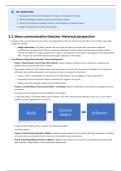
◦ 2-step flow theory: The media affects opinion leaders, who then influence their followers, which can, in turn, affect
families, friends, acquaintances, and so on.
▪
◦ People are NOT gullible and are capable of resisting persuasion
◦ Scientists believe
◦ Phase 3: Critical Cultural Studies (1960s): Considers media a powerful force directly affecting audiences, promoting
dominant culture, and preserving the status quo, but audiences are not passive.
◦ Phase 4: Meaning-Making Theories (1980s): Suggests media effects are long-term, and audiences are active and
goal-oriented, using media to create meaningful experiences.
1. Recognize the historical developments of mass communication theories.
2. Define Gatekeeping, Agenda-Setting, and Framing theories.
3. Identify the differences between framing, misinformation, and disinformation.
4. Apply Framing theory to recent news events.
3.2. Mass communication theories: Historical perspective
• Question: Why was the Mass Society Theory developed? Describe the media during the 19th century? Why was media
negatively viewed?
▪ Magic bullet theory: This theory posits that the media can directly influence and manipulate audiences,
establishing a straightforward stimulus-response relationship, where viewers passively receive media content
without the ability to critically engage with or reject it, particularly in the context of propaganda used during World
War I. People are marionettes that have messages “injected” in their heads.
• Four Phases of Mass Communication Theory Development:
◦ Phase 1: Mass Society Theory (Late 19th century): Views media as a powerful force, audiences as passive and
gullible, and has a pessimistic view of media.
◦ Newspapers during the 19th century were relatively cheap and could reach thousands of people. Also consider the
effects of the Industrial Revolution, as this period marked an increase in urbanization.
▪ Cause + Effect: Urbanization has led to fears of modernization, war propaganda, magic bullet theory
▪ Pessimistic view of the media, media is blamed for all negatives of city life.
▪ People move from agrarian villages to industrialized cities
◦ Phase 2: Limited-Effects Theory (Late 1940s – mid 1950s): Believes media effects are limited and people can resist
persuasion.
◦ Questions: Why are people not always gullible to the media?
◦ 2-step flow theory: The media affects opinion leaders, who then influence their followers, which can, in turn, affect
families, friends, acquaintances, and so on.
▪
◦ People are NOT gullible and are capable of resisting persuasion
◦ Scientists believe
◦ Phase 3: Critical Cultural Studies (1960s): Considers media a powerful force directly affecting audiences, promoting
dominant culture, and preserving the status quo, but audiences are not passive.
◦ Phase 4: Meaning-Making Theories (1980s): Suggests media effects are long-term, and audiences are active and
goal-oriented, using media to create meaningful experiences.


