

Lecture 17- Cell cycle control and
cancer
© 2021 Pearson Education, Inc.
, Today’s lesson: Cell cycle control mechanisms and can
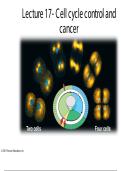
Andy Moore, HHMI Janelia Research campus.
Actin filaments of a cell are shown in red and black.
• How does a cell monitor its progression through the cell cycle?
• What happens when normal cell cycle controls fail?
https://www.hhmi.org/beautifulbiology/media-detail/cell-division-going-rails#content-details
, Learning objectives
• Be able to describe the relative DNA content and mass of a cell at each st
of the cell cycle.
• Explain the roles of checkpoints, cyclins, and cyclin-dependent kinases
(C DKs) in cell cycle control.
• Describe how the cell regulates the activity of C DKs.
• Describe how cell cycle control mechanisms respond to internal and exte
signals and give examples of these signals.
• Explain how loss of cell cycle control can result in cancer.
• Understand what oncogenes and tumor suppressors are.
, Recap of the cell cycle
Unduplicated INTERPHASE
chromosomes Duplicated
chromosomes
S phase: Metabolic
G 0 phase: G1 phase: Metabolic activity, growth,
Nondividing, activity and growth and DNA synthesis
quiescent state G2 phase:
Metabolic activity,
growth, and preparation for
cell division
• Interphase accounts for ~90% of the cell cycle, while the mitotic phase takes ~
• Many cells sit in a quiescent state called G 0 for extended periods. These cells c
‘reawakened’ to enter back into G 1 with appropriate signals.
© 2021 Pearson Education, Inc.
cancer
© 2021 Pearson Education, Inc.
, Today’s lesson: Cell cycle control mechanisms and can
Andy Moore, HHMI Janelia Research campus.
Actin filaments of a cell are shown in red and black.
• How does a cell monitor its progression through the cell cycle?
• What happens when normal cell cycle controls fail?
https://www.hhmi.org/beautifulbiology/media-detail/cell-division-going-rails#content-details
, Learning objectives
• Be able to describe the relative DNA content and mass of a cell at each st
of the cell cycle.
• Explain the roles of checkpoints, cyclins, and cyclin-dependent kinases
(C DKs) in cell cycle control.
• Describe how the cell regulates the activity of C DKs.
• Describe how cell cycle control mechanisms respond to internal and exte
signals and give examples of these signals.
• Explain how loss of cell cycle control can result in cancer.
• Understand what oncogenes and tumor suppressors are.
, Recap of the cell cycle
Unduplicated INTERPHASE
chromosomes Duplicated
chromosomes
S phase: Metabolic
G 0 phase: G1 phase: Metabolic activity, growth,
Nondividing, activity and growth and DNA synthesis
quiescent state G2 phase:
Metabolic activity,
growth, and preparation for
cell division
• Interphase accounts for ~90% of the cell cycle, while the mitotic phase takes ~
• Many cells sit in a quiescent state called G 0 for extended periods. These cells c
‘reawakened’ to enter back into G 1 with appropriate signals.
© 2021 Pearson Education, Inc.


