
• Wrong document? Swap it for free
  • Written by students who passed
  • Immediately available after payment
  • Read online or as PDF
Sell
Where do you study
Your language
Document preview thumbnail
Preview 2 out of 12 pages
Exam (elaborations)

Mt(Aab) Basic Knowledge Practice Questions: Clinical Chemistry For The Mt(Aab) Basic Knowledge Exam 1

Document preview thumbnail
Preview 2 out of 12 pages

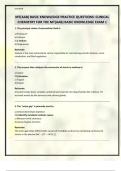
MT(AAB) BASIC KNOWLEDGE PRACTICE QUESTIONS: CLINICAL CHEMISTRY FOR THE MT(AAB) BASIC KNOWLEDGE EXAM 1

Content preview

ESTUDYR


MT(AAB) BASIC KNOWLEDGE PRACTICE QUESTIONS: CLINICAL
CHEMISTRY FOR THE MT(AAB) BASIC KNOWLEDGE EXAM 1
1. The principal cation of extracellular fluid is:

a) Potassium
b) Calcium
✅c) Sodium
d) Magnesium

Rationale:
Sodium is the main extracellular cation responsible for maintaining osmotic balance, nerve
conduction, and fluid regulation.


2. The enzyme that catalyzes the conversion of starch to maltose is:

a) Lipase
✅b) Amylase
c) Trypsin
d) Pepsin

Rationale:
Amylase breaks down complex carbohydrates (starch) into disaccharides like maltose. It’s
secreted mainly by the pancreas and salivary glands.


3. The "anion gap" is primarily used to:

a) Detect electrolyte depletion
✅b) Identify metabolic acidosis causes
c) Measure renal clearance
d) Assess hepatic function

Rationale:
The anion gap helps differentiate causes of metabolic acidosis by calculating unmeasured
anions in the plasma (Na⁺ – *Cl⁻ + HCO₃⁻+).

, ESTUDYR


4. The colorimetric method commonly used to measure glucose involves:

a) Biuret reaction
✅b) Glucose oxidase
c) Jaffe reaction
d) Ninhydrin reaction

Rationale:
The glucose oxidase method specifically measures glucose by converting it to gluconic acid and
hydrogen peroxide, which reacts with a chromogen for color change.


5. A fasting blood glucose level of 130 mg/dL indicates:

a) Normal
b) Impaired fasting glucose
✅c) Diabetes mellitus
d) Hypoglycemia

Rationale:
Fasting glucose ≥126 mg/dL (on two occasions) confirms diabetes mellitus according to ADA
criteria.


6. Which hormone increases blood glucose concentration?

a) Insulin
b) Calcitonin
✅c) Glucagon
d) Somatostatin

Rationale:
Glucagon, secreted by pancreatic alpha cells, promotes glycogenolysis and gluconeogenesis,
raising blood glucose.


7. The Jaffe reaction is used to measure:

✅a) Creatinine
b) Urea

Document information

Uploaded on
October 21, 2025
Number of pages
12
Written in
2025/2026
Type
Exam (elaborations)
Contains
Questions & answers
$14.99

Wrong document? Swap it for free Within 14 days of purchase and before downloading, you can choose a different document. You can simply spend the amount again.
Written by students who passed
Immediately available after payment
Read online or as PDF

Seller avatar
Reputation scores are based on the amount of documents a seller has sold for a fee and the reviews they have received for those documents. There are three levels: Bronze, Silver and Gold. The better the reputation, the more your can rely on the quality of the sellers work.
Estudyr
3.8
(222)
Sold
1229
Followers
830
Items
11326
Last sold
3 days ago


Why students choose Stuvia

Created by fellow students, verified by reviews

Quality you can trust: written by students who passed their tests and reviewed by others who've used these notes.

Didn't get what you expected? Choose another document

No worries! You can instantly pick a different document that better fits what you're looking for.

Pay as you like, start learning right away

No subscription, no commitments. Pay the way you're used to via credit card and download your PDF document instantly.

Student with book image

“Bought, downloaded, and aced it. It really can be that simple.”

Alisha Student

Working on your references?

Create accurate citations in APA, MLA and Harvard with our free citation generator.

Working on your references?

Frequently asked questions

