
NUR 257 Exam 2 Review
Study online at https://quizlet.com/_h1pvmi
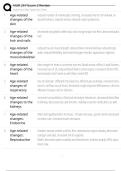
1. Age-related reduced number of melanocytes, thinning, increased time for cell renewal, re-
changes of the duced thickness, reduced elastin, reduced sebum production.
skin
2. Age-related decreased nail growth, brittle nails, nails change shape, hair thins, decreased pubic
changes of the hair.
hair and nails
3. Age-related reduced muscle mass/strength, reduced bone mineral density, reduced body
changes of the water, reduced flexibility, decreased estrogen=shorten appearance, kyphosis.
musculoskeletal
4. Age-related takes longer for heart to accelerate and rest, blood vessels stiffen, LV wall thickens,
changes of the increased size of LA, reduced blood flow to some organs, increased risk for HTN,
heart baroreceptors don't work as well (help control BP).
5. Age-related loss of elasticity= stiffened chest wall, less efficient gas exchange, increased resis-
changes of tance to air flow; loss of recoil, decreased cough response/effectiveness, cilia less
respiratory effective=increase risk for infection
6. Age-related increased susceptibility to fluid and electrolyte imbalances, decreased blood flow
changes to the to kidneys, decreased size and function, inability to excrete medications as well.
kidneys
7. Age-related DM2 and hypothyroidism increases, T3 levels decrease, glands shrink, decreased
changes: secretion rate, increased insulin resistance.
Endocrine
8. Age-related Females: breasts smaller and less firm, reproductive organs atrophy, decreased
changes: estrogen and lube, increased risk for vaginitis.
Reproductive Males: decreased sperm mobility and testosterone, testicles atrophy, BPH, ejacu-
lation slow.
, NUR 257 Exam 2 Review
Study online at https://quizlet.com/_h1pvmi
9. Age-related Mouth: wear and tear of teeth = increased risk for decay; gums recede and increase
changes: GI r/f oral and cardiac dz.
Esophagus: sluggish/erratic movement of muscles = increased r/f GERD
Stomach: decreased motility, reduced bicarb and gastric mucus = early sensation
of fullness, increased r/f pernicious anemia and peptic ulcer dz
Intestines: reduced function of intestinal villi = reduced ability to absorb nutrients
Liver: reduced blood flow = increased half-life of fat-soluble meds
10. FANCAPES F - Fluids
A - Aeration
N - Nutrition
C - Communication
A - Activity
P - Pain
E - Elimination
S - Socialization
11. SPICES S: sleep disorders
P: problems with eating
I: incontinence
C: confusion
E: evidence of falls
S: skin breakdown
12. The Mini-Cog screening tool for short term memory. More sensitive to dementia.
Name 3 objects, administer the clock drawing test, ask the person to repeat the
objects back to you.
1 point for each object recalled, 2 points for a normal clock, and 0 points for an
abnormal clock.
13. Clock Drawing Do NOT use if pt is blind, has tremors, or affected from stroke.
14.
Study online at https://quizlet.com/_h1pvmi
1. Age-related reduced number of melanocytes, thinning, increased time for cell renewal, re-
changes of the duced thickness, reduced elastin, reduced sebum production.
skin
2. Age-related decreased nail growth, brittle nails, nails change shape, hair thins, decreased pubic
changes of the hair.
hair and nails
3. Age-related reduced muscle mass/strength, reduced bone mineral density, reduced body
changes of the water, reduced flexibility, decreased estrogen=shorten appearance, kyphosis.
musculoskeletal
4. Age-related takes longer for heart to accelerate and rest, blood vessels stiffen, LV wall thickens,
changes of the increased size of LA, reduced blood flow to some organs, increased risk for HTN,
heart baroreceptors don't work as well (help control BP).
5. Age-related loss of elasticity= stiffened chest wall, less efficient gas exchange, increased resis-
changes of tance to air flow; loss of recoil, decreased cough response/effectiveness, cilia less
respiratory effective=increase risk for infection
6. Age-related increased susceptibility to fluid and electrolyte imbalances, decreased blood flow
changes to the to kidneys, decreased size and function, inability to excrete medications as well.
kidneys
7. Age-related DM2 and hypothyroidism increases, T3 levels decrease, glands shrink, decreased
changes: secretion rate, increased insulin resistance.
Endocrine
8. Age-related Females: breasts smaller and less firm, reproductive organs atrophy, decreased
changes: estrogen and lube, increased risk for vaginitis.
Reproductive Males: decreased sperm mobility and testosterone, testicles atrophy, BPH, ejacu-
lation slow.
, NUR 257 Exam 2 Review
Study online at https://quizlet.com/_h1pvmi
9. Age-related Mouth: wear and tear of teeth = increased risk for decay; gums recede and increase
changes: GI r/f oral and cardiac dz.
Esophagus: sluggish/erratic movement of muscles = increased r/f GERD
Stomach: decreased motility, reduced bicarb and gastric mucus = early sensation
of fullness, increased r/f pernicious anemia and peptic ulcer dz
Intestines: reduced function of intestinal villi = reduced ability to absorb nutrients
Liver: reduced blood flow = increased half-life of fat-soluble meds
10. FANCAPES F - Fluids
A - Aeration
N - Nutrition
C - Communication
A - Activity
P - Pain
E - Elimination
S - Socialization
11. SPICES S: sleep disorders
P: problems with eating
I: incontinence
C: confusion
E: evidence of falls
S: skin breakdown
12. The Mini-Cog screening tool for short term memory. More sensitive to dementia.
Name 3 objects, administer the clock drawing test, ask the person to repeat the
objects back to you.
1 point for each object recalled, 2 points for a normal clock, and 0 points for an
abnormal clock.
13. Clock Drawing Do NOT use if pt is blind, has tremors, or affected from stroke.
14.


