
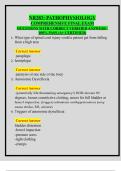
Nr283: Pathophysiology Comprehensive Final Exam Questions With Correct Verified Answers | 100% Pass (A+ Certified
NR283: PATHOPHYSIOLOGY COMPREHENSIVE FINAL EXAM QUESTIONS WITH CORRECT VERIFIED ANSWERS | 100% PASS (A+ CERTIFIED 1. What type of spinal cord injury could a patient get from falling from a high area Correct Answer paraplegic 2. hemiplegia Correct Answer paralysis of one side of the body 3. Autonomic Dysreflexia Correct Answer (potentially life threatening emergency!) HOB elevate 90 degrees, loosen constrictive clothing, assess for full bladder or bowel impaction, (trigger) administer antihypertensives (may cause stroke, MI, seizure) 4. Triggers of autonomic dysreflexia Correct Answer bladder distention -bowel impaction -pressure sores -tight clothing -cramps 5. X linked recessive disorders Correct Answer color blindness, duchenne muscular dystrophy, hemophilia 6. cominuted fracture Correct Answer bone breaks into many fragments 7. Pathophysiology of osteoporosis Correct Answer Bone resorption exceeds formation. Results in loss of compact bone Diagnosed with bone density scans Can cause compression fractures of vertebrae, wrist, or hip Can lead to kyphosis and scoliosis 8. Compression fractures Correct Answer a fracture in which the bone is pressed together on itself 9. Pathophysiology of osteoarthritis Correct Answer •Articular cartilage breaks down, leading to progressive damage to the underlying bone and eventual formation of osteophytes (bone spurs) that protrude into the joint space •Joint space is narrowed, leading to decreased joint movement and the potential for more damage •Joint can progressively degenerate •Previously thought of as simply "wear and tear" related to aging 10. How to treat a sprained ankle Correct Answer rice 11. RICE Correct Answer rest, ice, compression, elevation 12. Complications of immobility Correct Answer Blood clots Pneumonia Bone demineralization Kidney stones Constipation Pressure ulcers Urinary retention Depression 13. Clinical manifestations of immobility Correct Answer Musculoskeletal: Loss of muscle strength and endurance, contractures, soft tissue changes, disuse osteoporosis, and degenerative joint disease Cardiovascular: Increased heart rate, decreased cardiac reserve, orthostatic hypotension, and venous thromboembolism Respiratory: Reduced PO2 and pneumonia Gastrointestinal: Constipation Skin: Pressure ulcers and weak skin Other: Sleep disorders, sensory distortions, renal stones, and altered insulin and fat 14
Document information
- Uploaded on
- October 19, 2025
- Number of pages
- 35
- Written in
- 2025/2026
- Type
- Exam (elaborations)
- Contains
- Questions & answers


