
Nr 546 Psychopharmacology Midterm Exam Review Questions With Correct Verified Answers | 100% Pass (A+ Certified)
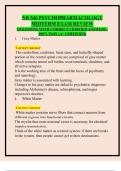
NR 546 PSYCHOPHARMACOLOGY MIDTERM EXAM REVIEW QUESTIONS WITH CORRECT VERIFIED ANSWERS | 100% PASS (A+ CERTIFIED) 1. Gray Matter Correct Answer The cerebellum, cerebrum, brain stem, and butterfly-shaped portion of the central spinal cord are comprised of gray matter which contains neural cell bodies, axon terminals, dendrites, and all nerve synapses. It is the working area of the brain and the focus of psychiatry and neurology. Gray matter is associated with learning. Changes in the gray matter are linked to psychiatric diagnoses including Alzheimer's disease, schizophrenia, and major depressive disorder. 2. White Matter Correct Answer White matter contains nerve fibers that connect neurons from different regions into functional circuits. The myelin that coats neuronal axons is necessary for electrical impulse transmission. Think of the white matter as a transit system. If there are breaks in the system, then people cannot get to their destinations. Within the brain, these breaks affect neural communication, affecting behavior. Damage to the myelin can impair transmission which can impact not only sensory and motor function, but also cognition. White matter abnormalities are associated with autism and vascular dementia. 3. Frontal lobes Correct Answer The frontal lobes are associated with movement, intelligence, abstract thinking, the ability to organize, personality, behavior, and emotional control. Traumatic brain injuries can result in personality changes, difficulty controlling emotions, and other cognitive functions. 4. Parietal lobe Correct Answer The middle part of the brain, responsible for proprioception, is the home of the somatic senses. This part of the brain helps a person to identify spatial relationships, interpret pain and touch in the body, and identify and give meaning to objects. Damage to the anterior portion of the parietal lobe may cause asterogenesis, the loss of ability to recognize objects via the sense of touch. This may be experienced by patients with post cerebral vascular accidents. 5. Temporal lobe Correct Answer The temporal lobe is located on the side of the brain and involved in short-term memory, speech, auditory signals, and smell recognition. It identifies "what" things are - object identification. It contains the limbic system, amygdala, and hippocampus. There are multiple pathways within the temporal lobe which affect object identification and language comprehension, including the ability to understand semantics. A dominant temporal lobe lesion can present as Wernicke's a
Document information
- Uploaded on
- October 19, 2025
- Number of pages
- 104
- Written in
- 2025/2026
- Type
- Exam (elaborations)
- Contains
- Questions & answers


