

CFP - Insurance Planning UPDATED ACTUAL Questions and CORRECT Answers
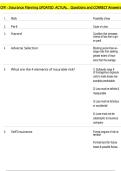
1. Risk Possibility of loss
2. Peril Cause of a loss
3. Hazard Condition that increases
chance of loss from a giv-
en peril
4. Adverse Selection Blocking poorer-than-av-
erage risks from seeking
greater extent of insur-
ance than the average
5. What are the 4 elements of insurable risk? 1) Suflciently large #
of homogenous exposure
units to make losses rea-
sonable predictable
2) Loss must be definite &
measurable
3) Loss must be fortuitous
or accidental
4) Loss must not be
catastrophic to insurance
company
6. Self Insurance Formal program of risk re-
tention
Formal fund for future
losses & possible fluctua-
, tions
Primarily used by large
companies
7. Reinsurance Mitigating risk of cata-
strophic loss by self-insur-
ing up to certain amount
and acquiring insurance
for rest
"Stop loss"
8. What are the 5 responses to risk? 1) Avoidance
2) Diversification
3) Reduction
4) Retention
5) Transfer/Sharing
9. is more important that Severity; probability
.
10. What is proper risk response for: High Severity | Low Transfer
Frequency?
11. What is proper risk response for: High Severity | High Avoidance
Frequency?
12. What is proper risk response for: Low Severity | High Retention/Reduction
Frequency?
,13. What is proper risk response for: Low Severity | Low Retention
Frequency?
14. Principle of Indemnity Insurer seeks to reim-
burse insured for exact
amount of loss
15. Insurable Interest must exist at time of for Loss
property & casualty.
Issue
Insurable Interest must exist at time of for
life.
16. Is insurance contract unilateral or bilateral? Unilateral
Only 1 party makes bind-
ing promise that if broken
breaches contract
Contract is accepted as is
17. Adhesion
or not at all
Courts are likely to rule in favor of . Insured
18. Waiver of Provision (who can alter contract) Neither agent nor insured
may alter contract
Only president, VP, secre-
tary, etc.
19. Aleatory Outcome attected by
chance & amount given of
$ given up is unequal
, 20. Recission Contract is null from be-
ginning due to fraud, mis-
representation, conceal-
ment, or mutual mistakes
as to material fact
21. Reformation Contract can be amended
if it fails to express original
intent of both parties
22. Collateral Source Rule Plaintitt's measure of
damage is not mitigat-
ed by payments received
from sources other than
tortfeaser
23. Subrogation Insurer takes over legal
rights insured has against
responsible 3rd party
24. HSAs are examples of which risk responses Risk retention
Risk transfer (HDHP)
25. What is Medicare Part A? Hospital Insurance Pro-
tection
26. What is Medicare Part B? Medical Insurance Protec-
tion
27. What is Medicare Part C? Medicare Advantage
28. What is Medicare Part D? Prescription Drug Cover-
age
1. Risk Possibility of loss
2. Peril Cause of a loss
3. Hazard Condition that increases
chance of loss from a giv-
en peril
4. Adverse Selection Blocking poorer-than-av-
erage risks from seeking
greater extent of insur-
ance than the average
5. What are the 4 elements of insurable risk? 1) Suflciently large #
of homogenous exposure
units to make losses rea-
sonable predictable
2) Loss must be definite &
measurable
3) Loss must be fortuitous
or accidental
4) Loss must not be
catastrophic to insurance
company
6. Self Insurance Formal program of risk re-
tention
Formal fund for future
losses & possible fluctua-
, tions
Primarily used by large
companies
7. Reinsurance Mitigating risk of cata-
strophic loss by self-insur-
ing up to certain amount
and acquiring insurance
for rest
"Stop loss"
8. What are the 5 responses to risk? 1) Avoidance
2) Diversification
3) Reduction
4) Retention
5) Transfer/Sharing
9. is more important that Severity; probability
.
10. What is proper risk response for: High Severity | Low Transfer
Frequency?
11. What is proper risk response for: High Severity | High Avoidance
Frequency?
12. What is proper risk response for: Low Severity | High Retention/Reduction
Frequency?
,13. What is proper risk response for: Low Severity | Low Retention
Frequency?
14. Principle of Indemnity Insurer seeks to reim-
burse insured for exact
amount of loss
15. Insurable Interest must exist at time of for Loss
property & casualty.
Issue
Insurable Interest must exist at time of for
life.
16. Is insurance contract unilateral or bilateral? Unilateral
Only 1 party makes bind-
ing promise that if broken
breaches contract
Contract is accepted as is
17. Adhesion
or not at all
Courts are likely to rule in favor of . Insured
18. Waiver of Provision (who can alter contract) Neither agent nor insured
may alter contract
Only president, VP, secre-
tary, etc.
19. Aleatory Outcome attected by
chance & amount given of
$ given up is unequal
, 20. Recission Contract is null from be-
ginning due to fraud, mis-
representation, conceal-
ment, or mutual mistakes
as to material fact
21. Reformation Contract can be amended
if it fails to express original
intent of both parties
22. Collateral Source Rule Plaintitt's measure of
damage is not mitigat-
ed by payments received
from sources other than
tortfeaser
23. Subrogation Insurer takes over legal
rights insured has against
responsible 3rd party
24. HSAs are examples of which risk responses Risk retention
Risk transfer (HDHP)
25. What is Medicare Part A? Hospital Insurance Pro-
tection
26. What is Medicare Part B? Medical Insurance Protec-
tion
27. What is Medicare Part C? Medicare Advantage
28. What is Medicare Part D? Prescription Drug Cover-
age


