

CFP FP512 Review Set UPDATED ACTUAL Questions and CORRECT Answers
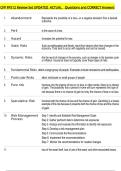
1. Abandonment Represents the possibility of a loss—or a negative deviation from a desired
outcome.
2. Peril is the cause of a loss
3. Hazard Increases the potential for loss
4. Static Risks Such as earthquakes and floods, result from factors other than changes in the
economy. They tend to occur with regularity and can be insured.
5. Dynamic Risks Are the result of changes in the economy, such as changes in the business cycle
or inflation. Insurance does not typically cover these types of risks.
6. Fundamental Risks attect a large group of people. Examples include recessions and earthquakes.
7. Particular Risks attect individuals or small groups of people
8. Pure risk Involves only the chance of loss or no loss; in other words, there is no chance
of gain. The possibility that a person's home will burn represents this type of
risk because there is no chance of gain but only the chance of loss or no loss.
9. Speculative Risk Involves both the chance of loss and the chance of gain. Gambling is a classic
example of this risk because it presents both the chance of loss and the chance
of gain.
10. Risk Management Step 1: Identify and Establish Risk Management Goals
Process Step 2: Gather pertinent data to determine risk exposures
Step 3: Analyze and evaluate the information to identify risk exposures
Step 4: Develop a risk management plan
Step 5: Communicate the Recommendations
Step 6: Implement the recommendations
Step 7: Monitor the recommendations for needed changes
11. loss of the asset itself, loss of use of the asset, and other associated losses.
, Asset related risk
exposure
12. Contract Law the risk of liability in acquisition of an asset based on law: acquisition of an
asset resulting in liability to a lender, a club membership contract putting
certain responsibilities on the client, etc.
13. Tort Law Liability for a loss resulting from the use of an asset or from an activity—a
boating accident, practicing one's profession, etc.
14. Risk Control Is a risk management technique that seeks to minimize the risk of loss.
15. Risk Avoidance If a business wants to ensure that it will not have windows broken by vandals,
it can avoid the risk by not having windows... What kind of risk method does
this describe?
16. Risk Reduction If the same business wants windows but is still concerned about vandals, it
may choose to have windows made of a material that is very diflcult to break...
What kind of risk method does this describe?
17. Risk Financing is a risk management technique that pays the costs of losses incurred
18. Risk Retention There are situations where the potential loss is small and the business or
individual believes any losses that occur can be covered out of pocket.
19. Risk Transfer This is primarily insurance, but can also be accomplished through waivers
or subcontracting. This describes giving risk to an insurance company in
exchange for a relatively small cost, the premium. Health, life, disability, and
liability risks are examples
20. Risk Retention A strategy in which an entity sets aside a sum as a protection against a probable
loss, instead of transferring the risk by purchasing an insurance policy.
21. Self Insurance
, A form of risk management whereby a part of the firm's earnings is earmarked
as a contingency fund for possible future losses, specifically for individual loss
categories such as property, medical, or worker's compensation.
22. Insurable risk a pure risk that is faced by a large number of people and for which the amount
of the loss can be predicted
23. Law of large num- There must be a large number of similar potential losses so that the insurer
bers can reasonably apportion the expected financial loss.
24. Insurable interest Any financial interest in life or property such that, if the life or property were
lost or harmed, the insured would sutter financially
25. Actual Cash Value replacement cost minus depreciation
26. Other Insurance This provision states that when a loss occurs, and there is more than one
insurance policy covering the same loss, the insured will not profit from the
loss.
27. Coinsurance may be a splitting of costs, or it may refer to a minimum percentage of
insurance that is required to avoid being penalized for inadequate property
insurance when there are partial losses.
28. Deductible is a retained risk. It is the portion of insured losses that the insured is expected
to pay before the insurance company pays anything.
29. Subrogation is the right of an insurance company that has paid for a loss to recover its
payments if it is determined that a ditterent insurance company or person is
responsible for the loss and is required to pay for it. This prevents the insured
from collecting twice for the same loss.
30. Social Insurance is mandatory insurance administered by the government, with benefits man-
dated by law. The purpose of this insurance is to protect people from large
fundamental risks.
, 31. Public Insurance is designed to enhance public trust in financial institutions. Similar to so-
cial insurance, this insurance is usually mandatory and administered by the
government or by quasigovernmental institutions. The Federal Deposit Insur-
ance Corporation (FDIC), Pension Benefit Guaranty Corporation (PBGC), and
Securities Investor Protection Corporation (SIPC) all administer types of this
insurance.
32. Private Insurance Examples of this insurance include disability, health, long-term care insurance,
property insurance, liability insurance, and life insurance. Some of these types
of coverage may be mandatory as a result of state laws or lender requirements.
For example, states may require automobile liability insurance coverage if you
choose to register a motor vehicle.
33. Insurance Produc- licensed individuals representing and appointed by an insurance company
ers when transacting insurance business
34. Independent Insur- Generally represent several insurance companies doing business under the
American or independent agency insurance system. These independent
ance Agent agents decide where they will place their business, dividing the policies they
sell among those various companies they represent while, ideally, basing that
on the needs of the client and the suitability of the companies.
35. Captive Insurance
Agent an insurance agent who represents only one insurance company and who is,
in ettect, an employee of that company
36. Career Insurance
Agent Are usually life insurance agents in a general agency or a
company-owned oflce under the agency management or the branch oflce
systems. In some cases, these agents are also captive agents, but in many
situations these agents maintain selling contracts with other companies to
better serve their clients. These agents often choose this form of operation
because of the support provided by the agency and the company. These
agents have production requirements in order to maintain their contracts.
1. Abandonment Represents the possibility of a loss—or a negative deviation from a desired
outcome.
2. Peril is the cause of a loss
3. Hazard Increases the potential for loss
4. Static Risks Such as earthquakes and floods, result from factors other than changes in the
economy. They tend to occur with regularity and can be insured.
5. Dynamic Risks Are the result of changes in the economy, such as changes in the business cycle
or inflation. Insurance does not typically cover these types of risks.
6. Fundamental Risks attect a large group of people. Examples include recessions and earthquakes.
7. Particular Risks attect individuals or small groups of people
8. Pure risk Involves only the chance of loss or no loss; in other words, there is no chance
of gain. The possibility that a person's home will burn represents this type of
risk because there is no chance of gain but only the chance of loss or no loss.
9. Speculative Risk Involves both the chance of loss and the chance of gain. Gambling is a classic
example of this risk because it presents both the chance of loss and the chance
of gain.
10. Risk Management Step 1: Identify and Establish Risk Management Goals
Process Step 2: Gather pertinent data to determine risk exposures
Step 3: Analyze and evaluate the information to identify risk exposures
Step 4: Develop a risk management plan
Step 5: Communicate the Recommendations
Step 6: Implement the recommendations
Step 7: Monitor the recommendations for needed changes
11. loss of the asset itself, loss of use of the asset, and other associated losses.
, Asset related risk
exposure
12. Contract Law the risk of liability in acquisition of an asset based on law: acquisition of an
asset resulting in liability to a lender, a club membership contract putting
certain responsibilities on the client, etc.
13. Tort Law Liability for a loss resulting from the use of an asset or from an activity—a
boating accident, practicing one's profession, etc.
14. Risk Control Is a risk management technique that seeks to minimize the risk of loss.
15. Risk Avoidance If a business wants to ensure that it will not have windows broken by vandals,
it can avoid the risk by not having windows... What kind of risk method does
this describe?
16. Risk Reduction If the same business wants windows but is still concerned about vandals, it
may choose to have windows made of a material that is very diflcult to break...
What kind of risk method does this describe?
17. Risk Financing is a risk management technique that pays the costs of losses incurred
18. Risk Retention There are situations where the potential loss is small and the business or
individual believes any losses that occur can be covered out of pocket.
19. Risk Transfer This is primarily insurance, but can also be accomplished through waivers
or subcontracting. This describes giving risk to an insurance company in
exchange for a relatively small cost, the premium. Health, life, disability, and
liability risks are examples
20. Risk Retention A strategy in which an entity sets aside a sum as a protection against a probable
loss, instead of transferring the risk by purchasing an insurance policy.
21. Self Insurance
, A form of risk management whereby a part of the firm's earnings is earmarked
as a contingency fund for possible future losses, specifically for individual loss
categories such as property, medical, or worker's compensation.
22. Insurable risk a pure risk that is faced by a large number of people and for which the amount
of the loss can be predicted
23. Law of large num- There must be a large number of similar potential losses so that the insurer
bers can reasonably apportion the expected financial loss.
24. Insurable interest Any financial interest in life or property such that, if the life or property were
lost or harmed, the insured would sutter financially
25. Actual Cash Value replacement cost minus depreciation
26. Other Insurance This provision states that when a loss occurs, and there is more than one
insurance policy covering the same loss, the insured will not profit from the
loss.
27. Coinsurance may be a splitting of costs, or it may refer to a minimum percentage of
insurance that is required to avoid being penalized for inadequate property
insurance when there are partial losses.
28. Deductible is a retained risk. It is the portion of insured losses that the insured is expected
to pay before the insurance company pays anything.
29. Subrogation is the right of an insurance company that has paid for a loss to recover its
payments if it is determined that a ditterent insurance company or person is
responsible for the loss and is required to pay for it. This prevents the insured
from collecting twice for the same loss.
30. Social Insurance is mandatory insurance administered by the government, with benefits man-
dated by law. The purpose of this insurance is to protect people from large
fundamental risks.
, 31. Public Insurance is designed to enhance public trust in financial institutions. Similar to so-
cial insurance, this insurance is usually mandatory and administered by the
government or by quasigovernmental institutions. The Federal Deposit Insur-
ance Corporation (FDIC), Pension Benefit Guaranty Corporation (PBGC), and
Securities Investor Protection Corporation (SIPC) all administer types of this
insurance.
32. Private Insurance Examples of this insurance include disability, health, long-term care insurance,
property insurance, liability insurance, and life insurance. Some of these types
of coverage may be mandatory as a result of state laws or lender requirements.
For example, states may require automobile liability insurance coverage if you
choose to register a motor vehicle.
33. Insurance Produc- licensed individuals representing and appointed by an insurance company
ers when transacting insurance business
34. Independent Insur- Generally represent several insurance companies doing business under the
American or independent agency insurance system. These independent
ance Agent agents decide where they will place their business, dividing the policies they
sell among those various companies they represent while, ideally, basing that
on the needs of the client and the suitability of the companies.
35. Captive Insurance
Agent an insurance agent who represents only one insurance company and who is,
in ettect, an employee of that company
36. Career Insurance
Agent Are usually life insurance agents in a general agency or a
company-owned oflce under the agency management or the branch oflce
systems. In some cases, these agents are also captive agents, but in many
situations these agents maintain selling contracts with other companies to
better serve their clients. These agents often choose this form of operation
because of the support provided by the agency and the company. These
agents have production requirements in order to maintain their contracts.


