

GAS EXCHANGE Key Terms
3.3 ORGANISMS EXCHANGING SUBSTANCES Adaptations
Surface area
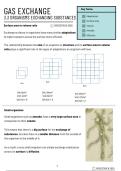
Surface area to volume ratio MISSESTRUCH 2020 Volume
Amoeba
Exchange surfaces in organisms have many similar adaptations
Diffusion
to make transport across the surface more efficient.
The relationship between the size of an organism or structure and its surface area to volume
ratio plays a significant role in the types of adaptations an organism will have.
Small organisms
Small organisms such as amoeba, have a very large surface area in
comparison to their volume.
This means that there is a big surface for the exchange of
substances, but also there is a smaller distance from the outside of
the organism to the middle of it.
As a result, a very small organism can simply exchange substances
across its surface by diffusion.
1
MISSESTRUCH 2020
,GAS EXCHANGE Key Terms
3.3 ORGANISMS EXCHANGING SUBSTANCES Adaptations
Surface area
Larger organisms MISSESTRUCH 2020 Volume
Metabolic rate
The larger an organism is, the smaller the surface area
Diffusion
compared to its volume and the larger the distance from the
middle to the outside.
Larger organisms will typically have a higher metabolic rate too, which demands efficient
transport of waste out of their cells and reactants into their cells.
As a result, they have adaptations that help make their exchange across surfaces more efficient.
Some examples of these adaptations are:
Villi and microvilli – for efficient absorption of digested food
Alveoli and bronchioles – for efficient gas exchange in mammals
Spiracles and tracheoles -for efficient gas exchange in terrestrial insects
Gill filaments and lamellae -for efficient gas exchange in fish
Thin wide leaves - for efficient gas exchange in plants
Many capillaries – for efficient exchange at tissues
2 MISSESTRUCH 2020
,GAS EXCHANGE Key Terms
3.3 ORGANISMS EXCHANGING SUBSTANCES Ventilation
Diaphragm
The human gas exchange system MISSESTRUCH 2020 Inhale
Exhale
The key structures you need to know are:
Antagonistic
alveoli
bronchioles
bronchi
trachea
lungs
For ventilation, you need to know,
the diaphragm, ribs
and the intercostal
muscles.
Pleural
membranes
Ventilation
Ventilation is inhaling and
exhaling in humans. This is
controlled by the diaphragm
muscle and the antagonistic
interaction between the
external and internal
intercostal muscles.
3
MISSESTRUCH 2020
, GAS EXCHANGE Key Terms
3.3 ORGANISMS EXCHANGING SUBSTANCES Ventilation
Diaphragm
Ventilation MISSESTRUCH 2020 Antagonistic
Alveoli
The table shows how the diaphragm and antagonistic external Capillary network
and internal intercostal muscles work to cause inspiration and
expiration.
Alveoli
Once the air has travelled down the trachea, bronchi
and bronchioles to the alveoli, gas exchange occurs
between the alveolar epithelium and the blood.
Alveoli are tiny air sacs, and there are 300 million in
each human lung which creates a very large surface
area for gas exchange (diffusion). The alveolar
epithelial cells are very thin, to minimise diffusion
distance.
Each alveolus is surrounded by a network of capillaries to remove exchanged gases, and therefore
maintain a concentration gradient.
4
MISSESTRUCH 2020
3.3 ORGANISMS EXCHANGING SUBSTANCES Adaptations
Surface area
Surface area to volume ratio MISSESTRUCH 2020 Volume
Amoeba
Exchange surfaces in organisms have many similar adaptations
Diffusion
to make transport across the surface more efficient.
The relationship between the size of an organism or structure and its surface area to volume
ratio plays a significant role in the types of adaptations an organism will have.
Small organisms
Small organisms such as amoeba, have a very large surface area in
comparison to their volume.
This means that there is a big surface for the exchange of
substances, but also there is a smaller distance from the outside of
the organism to the middle of it.
As a result, a very small organism can simply exchange substances
across its surface by diffusion.
1
MISSESTRUCH 2020
,GAS EXCHANGE Key Terms
3.3 ORGANISMS EXCHANGING SUBSTANCES Adaptations
Surface area
Larger organisms MISSESTRUCH 2020 Volume
Metabolic rate
The larger an organism is, the smaller the surface area
Diffusion
compared to its volume and the larger the distance from the
middle to the outside.
Larger organisms will typically have a higher metabolic rate too, which demands efficient
transport of waste out of their cells and reactants into their cells.
As a result, they have adaptations that help make their exchange across surfaces more efficient.
Some examples of these adaptations are:
Villi and microvilli – for efficient absorption of digested food
Alveoli and bronchioles – for efficient gas exchange in mammals
Spiracles and tracheoles -for efficient gas exchange in terrestrial insects
Gill filaments and lamellae -for efficient gas exchange in fish
Thin wide leaves - for efficient gas exchange in plants
Many capillaries – for efficient exchange at tissues
2 MISSESTRUCH 2020
,GAS EXCHANGE Key Terms
3.3 ORGANISMS EXCHANGING SUBSTANCES Ventilation
Diaphragm
The human gas exchange system MISSESTRUCH 2020 Inhale
Exhale
The key structures you need to know are:
Antagonistic
alveoli
bronchioles
bronchi
trachea
lungs
For ventilation, you need to know,
the diaphragm, ribs
and the intercostal
muscles.
Pleural
membranes
Ventilation
Ventilation is inhaling and
exhaling in humans. This is
controlled by the diaphragm
muscle and the antagonistic
interaction between the
external and internal
intercostal muscles.
3
MISSESTRUCH 2020
, GAS EXCHANGE Key Terms
3.3 ORGANISMS EXCHANGING SUBSTANCES Ventilation
Diaphragm
Ventilation MISSESTRUCH 2020 Antagonistic
Alveoli
The table shows how the diaphragm and antagonistic external Capillary network
and internal intercostal muscles work to cause inspiration and
expiration.
Alveoli
Once the air has travelled down the trachea, bronchi
and bronchioles to the alveoli, gas exchange occurs
between the alveolar epithelium and the blood.
Alveoli are tiny air sacs, and there are 300 million in
each human lung which creates a very large surface
area for gas exchange (diffusion). The alveolar
epithelial cells are very thin, to minimise diffusion
distance.
Each alveolus is surrounded by a network of capillaries to remove exchanged gases, and therefore
maintain a concentration gradient.
4
MISSESTRUCH 2020




