

11. Homeostasis, Drugs
#101 Homeostasis
Homeostasis is the maintenance of a constant internal environment,
which is vital for an organism to stay healthy. Fluctuations in temperature,
water levels and nutrient concentrations … could lead to death.
Temperature regulation is one homeostatic function. Mammals and birds
are warm-blooded – they maintain a constant body temperature despite
external environment changes.
Human maintain a body temperature of 370C – we have mechanisms to lose
heat when we get too hot, and ways of retaining heat when we get too cold.
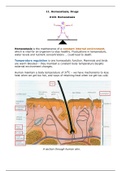
A section through human skin.
, The hypothalamus coordinates temperature control
The hypothalamus (part of
brain) acts like a thermostat.
It detects to of the blood
running through it.
If to > or < 370C, it sends
electrical impulses, along
nerves, to parts of the body
which function in regulating
body to.
When you are cold, body produces and saves heat
- shivering: muscles contract and relax spontaneously ---> produces heat --
-> warms blood
- vasoconstriction: arterioles near skin become narrower so little blood can
flow through them (the blood flows through the deep-lying capillaries
instead)---> conserve heat
- metabolism may increase ---> release energy
- hair stands up. In human, it just produces ‘goose pimples’. But in hair
animals (cat), it acts as an insulator: trap a thicker layer of warm air next to
the skin, prevent skin from loosing more warmth.
#101 Homeostasis
Homeostasis is the maintenance of a constant internal environment,
which is vital for an organism to stay healthy. Fluctuations in temperature,
water levels and nutrient concentrations … could lead to death.
Temperature regulation is one homeostatic function. Mammals and birds
are warm-blooded – they maintain a constant body temperature despite
external environment changes.
Human maintain a body temperature of 370C – we have mechanisms to lose
heat when we get too hot, and ways of retaining heat when we get too cold.
A section through human skin.
, The hypothalamus coordinates temperature control
The hypothalamus (part of
brain) acts like a thermostat.
It detects to of the blood
running through it.
If to > or < 370C, it sends
electrical impulses, along
nerves, to parts of the body
which function in regulating
body to.
When you are cold, body produces and saves heat
- shivering: muscles contract and relax spontaneously ---> produces heat --
-> warms blood
- vasoconstriction: arterioles near skin become narrower so little blood can
flow through them (the blood flows through the deep-lying capillaries
instead)---> conserve heat
- metabolism may increase ---> release energy
- hair stands up. In human, it just produces ‘goose pimples’. But in hair
animals (cat), it acts as an insulator: trap a thicker layer of warm air next to
the skin, prevent skin from loosing more warmth.


