
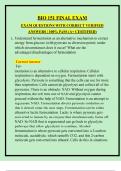
Bio 151 Final Exam Exam Questions With Correct Verified Answers | 100% Pass (A+ Certified)
BIO 151 FINAL EXAM EXAM QUESTIONS WITH CORRECT VERIFIED ANSWERS | 100% PASS (A+ CERTIFIED) 1. Understand fermentation as an alternative mechanism to extract energy from glucose (with pyruvate as diversion point): under which circumstances does it occur? What are the advantages/disadvantages of fermentation Correct Answer Fer- mentation is an alternative to cellular respiration. Cellular respiration is dependent on oxygen. Fermentation starts with glycolysis. Pyruvate is something that the cells can use for more than respiration. Cells cannot do glycolysis and collect all of the pyruvates. There is an obstacle: NAD. Without oxygen during respiration, the cell runs out of NAD and glycolysis cannot proceed without the help of NAD. Fermentation is an attempt to regenerate NAD. Fermentation diverts pyruvate oxidation so that it doesn't enter the next steps. Fermentation can be either ethanol or lactic fermentation. Lactic is where pyruvate gets converted to lactate by an enzyme that simultaneously burns off NAD. So NAD that is regenerated can go back to glycolytic pathways that allow glycolysis to continue. Alcohol fermentation is where pyruvate gets converted into a 2-carbon molecule, acetahlyde, which spinoffs CO2, and this 2-carbon molecule gets converted into ethanol. Cells do this in situations where there's no O2. Oxygen is supplying this power to pull electrons away from glucose and to oxidize it into low energy compounds. 2. Under cellular respiration both in terms of its overall chemical equation (C6H12O6 + 6O2, etc) as well as a stepwise conversion process that harvests energy in glucose and stores as ATP Correct Answer The primary function of cellular respiration is to convert the potential energy of glucose into the potential energy of ATP. Glucose is not directly fueling anything in the cell. Glucose is like a 100-dollar bill. It has so much power in it and it's not the right size to fuel smaller reactions in the cell. Rather ATP is more of the right size to fuel these smaller reactions. Cellular respiration is converting the energy of glucose to energy of ATP for more widespread use. 3. Understand photosynthesis as overall the reverse of cellular respiration, and foundation for most life on earth Correct Answer Carbon fixation is photosynthesis absorbing carbon. carbons are used for energy and ATP and it's also used for monomers like amino acids and nucleotides. all forms of life are harnessed by the power of photosynthesis, so taking carbon out of the air and bringing it into glucose where it can be used for all kinds of cellular things. carbons fixation is pulling carbon from unusable form into a useful form for cells which is glucose. glucose can either be respired to make ATP or diverted to make carbon compounds. taking carbon dioxide and converting it into glucose and oxygen also known as photosynthesis is endergonic. cells are experts in doing endergonic things using exergonic things to fuel them. in this case, the exergonic process fueling this process is sunlight. 4. Understand the molecular interactions that hold the plasma membrane together, as well as why it does not fall apart/dissolve in water. (principle of self-assembly) Understand how the structure of the plasma membrane contributes to its selective permeability (semipermeability) Correct Answer The lipid has two layers which is known as lipid bilayer. lipids are largely nonpolar. both prokaryotes and eukaryotes have phospholipid bilayers. lipid bilayers have hydrophilic heads and two hydrophobic tails. hydrophilic heads are on the outside and hydrophobic tails are on the inside. water is on both the inside and the outside of the lipid bilayer. cytoplasms are largely watery and the environment that the cells are in is watery. These hydrophobic tails are the reason why the membrane won't
Document information
- Uploaded on
- October 17, 2025
- Number of pages
- 55
- Written in
- 2025/2026
- Type
- Exam (elaborations)
- Contains
- Questions & answers


