

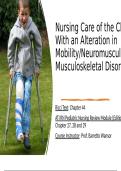
Nursing Care of the Ch
With an Alteration in
Mobility/Neuromuscula
Musculoskeletal Disord
Ricci Text: Chapter 44
ATI RN Pediatric Nursing Review Module (Editio
Chapter 27, 28 and 29
Course Instructor: Prof. Barretto Wansor
, Learning Objectives
• Compare differences between anatomy and physiology of the neuromu
and musculoskeletal systems in children vs. adults
• Identify nursing interventions related to common lab and diagnostic tes
used in the diagnosis and management of neuromuscular and musculo
conditions
• Identify appropriate nursing assessment and and interventions related
medications ang treatment used for childhood neuromuscular and
musculoskeletal conditions
• Develop individualized and family teaching plans for the child with a
neuromuscular and musculoskeletal conditions
• Describe the psychosocial impact of chronic neuromuscular and
musculoskeletal conditions on the growth and development of children
,Musculoskeletal Differences in
Children
Physiologic differences such as immaturity of systems place the child at in
increased risk of impaired development, effecting child’s growth and
movement
• Brain and spinal cord development
• Myelinization (in a cephalocaudal fashion)
• Muscular development
• Tone, reflexes, growth (born with same number as
adult, only length/circumference grow)
• Skeletal development
• Not fully ossified at birth
• Spine (kyphosis, lordosis)
• Epiphysis (end of long bones): where growth occurs
, Assessment of the
Musculoskeletal
Assessment Guidelines
System
Focus
Joints Are movements smooth & symmetric?
Are there any signs of tenderness, decreased ROM, inflammation, crepitus/grinding, o
Do the hips of newborns/infants manifest full ROM?
Were there recent events of trauma such as in sports or a fall?
Tendons & Do all joints move through full ROM?
Ligaments Is there any pain upon joint motion or palpation?
Are there feelings of grinding/crepitus as the joint moves?
Has there been a recent sports or other injury?
In what sport does the child participate?
Bones Are any masses noted?
Are arms & legs the same length?
Is there a recent decrease or change in mobility, such as limping?
Are bones in alignment, or are abnormalities noted such as bowing or knock-knees?
Upon spinal screening, is the spine properly aligned?
In what sports does the child participate? Is protective gear worn?
With an Alteration in
Mobility/Neuromuscula
Musculoskeletal Disord
Ricci Text: Chapter 44
ATI RN Pediatric Nursing Review Module (Editio
Chapter 27, 28 and 29
Course Instructor: Prof. Barretto Wansor
, Learning Objectives
• Compare differences between anatomy and physiology of the neuromu
and musculoskeletal systems in children vs. adults
• Identify nursing interventions related to common lab and diagnostic tes
used in the diagnosis and management of neuromuscular and musculo
conditions
• Identify appropriate nursing assessment and and interventions related
medications ang treatment used for childhood neuromuscular and
musculoskeletal conditions
• Develop individualized and family teaching plans for the child with a
neuromuscular and musculoskeletal conditions
• Describe the psychosocial impact of chronic neuromuscular and
musculoskeletal conditions on the growth and development of children
,Musculoskeletal Differences in
Children
Physiologic differences such as immaturity of systems place the child at in
increased risk of impaired development, effecting child’s growth and
movement
• Brain and spinal cord development
• Myelinization (in a cephalocaudal fashion)
• Muscular development
• Tone, reflexes, growth (born with same number as
adult, only length/circumference grow)
• Skeletal development
• Not fully ossified at birth
• Spine (kyphosis, lordosis)
• Epiphysis (end of long bones): where growth occurs
, Assessment of the
Musculoskeletal
Assessment Guidelines
System
Focus
Joints Are movements smooth & symmetric?
Are there any signs of tenderness, decreased ROM, inflammation, crepitus/grinding, o
Do the hips of newborns/infants manifest full ROM?
Were there recent events of trauma such as in sports or a fall?
Tendons & Do all joints move through full ROM?
Ligaments Is there any pain upon joint motion or palpation?
Are there feelings of grinding/crepitus as the joint moves?
Has there been a recent sports or other injury?
In what sport does the child participate?
Bones Are any masses noted?
Are arms & legs the same length?
Is there a recent decrease or change in mobility, such as limping?
Are bones in alignment, or are abnormalities noted such as bowing or knock-knees?
Upon spinal screening, is the spine properly aligned?
In what sports does the child participate? Is protective gear worn?


