

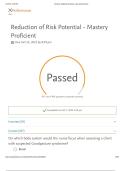
10/7/22, 4:35 PM Elsevier Adaptive Quizzing - Quiz performance
Performance
Exit
Reduction of Risk Potential - Mastery
Proficient
Due Oct 23, 2022 by 8:59 pm
Passed
457 out of 492 questions answered correctly
Completed on Oct 7, 2022 4:34 pm
Incorrect (35)
Correct (457)
On which body system would the nurse focus when assessing a client
with suspected Goodpasture syndrome?
Renal
https://eaqng.elsevier.com/#/quizPerformance/30258231 1/300
,10/7/22, 4:35 PM Elsevier Adaptive Quizzing - Quiz performance
Neurological
Cardiovascular
Musculoskeletal
Rationale
Goodpasture syndrome is an autoimmune disorder in which autoantibodies attack the
glomerular basement membrane and neutrophils. The organs with the most damage
are the kidneys. A person with the disorder may have kidney problems, which manifest
as glomerulonephritis that may rapidly progress to complete kidney failure.
Goodpasture syndrome does not affect the neurological, cardiovascular, or
musculoskeletal systems.
Which surgery is used as a prophylactic measure and as a palliative
treatment for clients with rheumatoid arthritis (RA)?
Osteotomy
Arthrodesis
Synovectomy
Debridement
Rationale
Synovectomy is a type of joint surgery that involves the removal of thickened synovial
membrane. It is used as a prophylactic measure and as a palliative treatment for
rheumatoid arthritis (RA) because it prevents the serious destruction of joint surfaces.
Osteotomy involves removing a wedge of bone to correct deformity and relieve pain.
Arthrodesis is the surgical fusion of a joint. Debridement involves the surgical removal
of degenerative debris from a joint.
Test-Taking Tip: Start by reading each of the answer options carefully. Usually at least
https://eaqng.elsevier.com/#/quizPerformance/30258231 2/300
,10/7/22, 4:35 PM Elsevier Adaptive Quizzing - Quiz performance
one of them will be clearly wrong. Eliminate this one from consideration. Now you
have reduced the number of response choices by one and improved the odds.
Continue to analyze the options. If you can eliminate one more choice in a four-option
question, you have reduced the odds to 50/50. While you are eliminating the wrong
choices, recall often occurs. One of the options may serve as a trigger that causes you
to remember what a few seconds ago had seemed completely forgotten.
The client can complete range of motion with gravity eliminated. Which
grade would the nurse assign to the client’s muscle strength?
1
2
3
4
Rationale
When rating muscle strength, grade 2 indicates complete range of motion with gravity
eliminated. Grade 1 indicates no joint motion and slight evidence of muscle
contractility. Grade 3 is indicated by complete range of motion against gravity only. If
there is complete range of motion against gravity with some resistance, then the grade
would be 4.
Which factors contribute to a client’s slow rate of healing? Select all that
apply. One, some, or all responses may be correct.
Diabetes
Cataract
Smoking
Dermatitis
Alcohol abuse
https://eaqng.elsevier.com/#/quizPerformance/30258231 3/300
, 10/7/22, 4:35 PM Elsevier Adaptive Quizzing - Quiz performance
Rationale
Diabetes causes narrowing of blood vessels, thereby causing diminished blood supply
to the affected organ or tissue; clients with diabetes have a slow healing rate. Intake of
tobacco through smoking may reduce the blood supply to the affected area, thereby
slowing down the healing process. Alcohol abuse reduces the amount of nutrients and
vitamins required for muscle growth, thereby affecting the healing process. Cataract is
a disease of the eye and does not affect the musculoskeletal system. Similarly,
dermatitis is a skin condition that does not affect the musculoskeletal system.
Which joint would be palpated by the nurse to identify genu valgum?
Hip
Knee
Temporomandibular
Metacarpophalangeal
Rationale
Also known as knock-knees, genu valgum is a condition in which the knees are poorly
aligned. The knee joint should be assessed for any abnormalities or the presence of
effusion. The hip joint is assessed to determine mobility and to find any hip pain
experienced in the groin or pain that radiates to the knees. The temporomandibular
joint is palpated to determine any weakness or pain in the face. The
metacarpophalangeal joint is palpated to assess hand function based on the range of
motion.
Test-Taking Tip: Identifying content and what is being asked about that content is
critical to your choosing the correct response. Be alert for words in the stem of the
item that are the same or similar in nature to those in one or two of the options.
Which diagnostic study is used to determine bone density?
Diskogram
https://eaqng.elsevier.com/#/quizPerformance/30258231 4/300
Performance
Exit
Reduction of Risk Potential - Mastery
Proficient
Due Oct 23, 2022 by 8:59 pm
Passed
457 out of 492 questions answered correctly
Completed on Oct 7, 2022 4:34 pm
Incorrect (35)
Correct (457)
On which body system would the nurse focus when assessing a client
with suspected Goodpasture syndrome?
Renal
https://eaqng.elsevier.com/#/quizPerformance/30258231 1/300
,10/7/22, 4:35 PM Elsevier Adaptive Quizzing - Quiz performance
Neurological
Cardiovascular
Musculoskeletal
Rationale
Goodpasture syndrome is an autoimmune disorder in which autoantibodies attack the
glomerular basement membrane and neutrophils. The organs with the most damage
are the kidneys. A person with the disorder may have kidney problems, which manifest
as glomerulonephritis that may rapidly progress to complete kidney failure.
Goodpasture syndrome does not affect the neurological, cardiovascular, or
musculoskeletal systems.
Which surgery is used as a prophylactic measure and as a palliative
treatment for clients with rheumatoid arthritis (RA)?
Osteotomy
Arthrodesis
Synovectomy
Debridement
Rationale
Synovectomy is a type of joint surgery that involves the removal of thickened synovial
membrane. It is used as a prophylactic measure and as a palliative treatment for
rheumatoid arthritis (RA) because it prevents the serious destruction of joint surfaces.
Osteotomy involves removing a wedge of bone to correct deformity and relieve pain.
Arthrodesis is the surgical fusion of a joint. Debridement involves the surgical removal
of degenerative debris from a joint.
Test-Taking Tip: Start by reading each of the answer options carefully. Usually at least
https://eaqng.elsevier.com/#/quizPerformance/30258231 2/300
,10/7/22, 4:35 PM Elsevier Adaptive Quizzing - Quiz performance
one of them will be clearly wrong. Eliminate this one from consideration. Now you
have reduced the number of response choices by one and improved the odds.
Continue to analyze the options. If you can eliminate one more choice in a four-option
question, you have reduced the odds to 50/50. While you are eliminating the wrong
choices, recall often occurs. One of the options may serve as a trigger that causes you
to remember what a few seconds ago had seemed completely forgotten.
The client can complete range of motion with gravity eliminated. Which
grade would the nurse assign to the client’s muscle strength?
1
2
3
4
Rationale
When rating muscle strength, grade 2 indicates complete range of motion with gravity
eliminated. Grade 1 indicates no joint motion and slight evidence of muscle
contractility. Grade 3 is indicated by complete range of motion against gravity only. If
there is complete range of motion against gravity with some resistance, then the grade
would be 4.
Which factors contribute to a client’s slow rate of healing? Select all that
apply. One, some, or all responses may be correct.
Diabetes
Cataract
Smoking
Dermatitis
Alcohol abuse
https://eaqng.elsevier.com/#/quizPerformance/30258231 3/300
, 10/7/22, 4:35 PM Elsevier Adaptive Quizzing - Quiz performance
Rationale
Diabetes causes narrowing of blood vessels, thereby causing diminished blood supply
to the affected organ or tissue; clients with diabetes have a slow healing rate. Intake of
tobacco through smoking may reduce the blood supply to the affected area, thereby
slowing down the healing process. Alcohol abuse reduces the amount of nutrients and
vitamins required for muscle growth, thereby affecting the healing process. Cataract is
a disease of the eye and does not affect the musculoskeletal system. Similarly,
dermatitis is a skin condition that does not affect the musculoskeletal system.
Which joint would be palpated by the nurse to identify genu valgum?
Hip
Knee
Temporomandibular
Metacarpophalangeal
Rationale
Also known as knock-knees, genu valgum is a condition in which the knees are poorly
aligned. The knee joint should be assessed for any abnormalities or the presence of
effusion. The hip joint is assessed to determine mobility and to find any hip pain
experienced in the groin or pain that radiates to the knees. The temporomandibular
joint is palpated to determine any weakness or pain in the face. The
metacarpophalangeal joint is palpated to assess hand function based on the range of
motion.
Test-Taking Tip: Identifying content and what is being asked about that content is
critical to your choosing the correct response. Be alert for words in the stem of the
item that are the same or similar in nature to those in one or two of the options.
Which diagnostic study is used to determine bone density?
Diskogram
https://eaqng.elsevier.com/#/quizPerformance/30258231 4/300


