
The government acted upon reducing the gender pay gap with policies
such as wage transparency, education and various anti-discrimination
laws. It is the legislation which is more crucial to reduce the pay gap.
Although, to some degree national minimum wage ensure equality, there
are greater limitations. Overall, legislation policies are more useful.
Legislation such as anti-discrimination policies are useful because it
ensures equal pay, thus, reducing the gender pay gap. Government’s
enaction of the Equal Pay Act ensured a reduced gap; prior to the act it
was common to find women getting paid less than men in similar work
however Extract E proves that recently the pay difference is just as little
as 0.8%. Before, the act the market wage rates were different for men and
women meaning that the market equilibrium for the wages of women
were lower than men. However, the law ensures that the wage rate must
be equal. Therefore, a cap is set evening the market equilibriums which
reduce the gender pay gap.
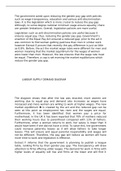
LABOUR SUPPLY DEMAND DIAGRAM
The diagram shows that after the law was enacted, more women are
working due to equal pay and demand also increases as wages have
increased and more women are willing to work at higher wages. The new
market equilibrium B is created by the act and the reduced gap can be
seen at this point as employment has risen and the wages are equal.
Furthermore, it has been identified that women pay a price for
motherhood. In the UK it has been reported that 70% of mothers reduced
their working hours due to parenthood compared with 11% of fathers.
Furthermore, when a woman returns to work, her salary is lower than it
would have been if she did not have a child. To solve this, the government
could increase paternity leaves as it will allow fathers to take longer
leaves. This will ensure and equal parental responsibility and wages will
not be different. Therefore, the pay gap will reduce as women will have
more time to work and legislation is effective.
Extract F informs that the government is planning to publish a league
table, ranking firms by their gender pay gap. The transparency will draw
attention to firms offering unfair wages. The demand for work in firms with
higher levels of equality will rise and firms at the lower end will find it
such as wage transparency, education and various anti-discrimination
laws. It is the legislation which is more crucial to reduce the pay gap.
Although, to some degree national minimum wage ensure equality, there
are greater limitations. Overall, legislation policies are more useful.
Legislation such as anti-discrimination policies are useful because it
ensures equal pay, thus, reducing the gender pay gap. Government’s
enaction of the Equal Pay Act ensured a reduced gap; prior to the act it
was common to find women getting paid less than men in similar work
however Extract E proves that recently the pay difference is just as little
as 0.8%. Before, the act the market wage rates were different for men and
women meaning that the market equilibrium for the wages of women
were lower than men. However, the law ensures that the wage rate must
be equal. Therefore, a cap is set evening the market equilibriums which
reduce the gender pay gap.
LABOUR SUPPLY DEMAND DIAGRAM
The diagram shows that after the law was enacted, more women are
working due to equal pay and demand also increases as wages have
increased and more women are willing to work at higher wages. The new
market equilibrium B is created by the act and the reduced gap can be
seen at this point as employment has risen and the wages are equal.
Furthermore, it has been identified that women pay a price for
motherhood. In the UK it has been reported that 70% of mothers reduced
their working hours due to parenthood compared with 11% of fathers.
Furthermore, when a woman returns to work, her salary is lower than it
would have been if she did not have a child. To solve this, the government
could increase paternity leaves as it will allow fathers to take longer
leaves. This will ensure and equal parental responsibility and wages will
not be different. Therefore, the pay gap will reduce as women will have
more time to work and legislation is effective.
Extract F informs that the government is planning to publish a league
table, ranking firms by their gender pay gap. The transparency will draw
attention to firms offering unfair wages. The demand for work in firms with
higher levels of equality will rise and firms at the lower end will find it



