
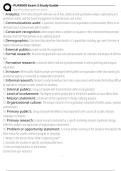
PUR3000 Exam 2 Study Guide
Study online at https://quizlet.com/_huhtmp
1. Analytics: A term describing the extensive use of data, statistical and quantitative analysis, explanatory and
predictive models, and fact-based management to drive decisions and actions.
2. Communications audit: a systematic documentation of an organizations communication efforts to un-
derstand how it communicates with its public's
3. Constraint recognition: when people detect a problem or situation in their environment but perceive
obstacles that limit their behavior to do anything about it
4. Demographics: Data describing objective characteristics of a population including age, level of income or
highest educational degree obtained
5. External publics: people outside the organization
6. Formal research: Research designed with clear rules and procedures for collection and analysis of informa-
tion
7. Formative research: conducted before and during implementation to inform planning and program
adjustment
8. In house: When public relations people are employed directly within an organization rather than working for
an external agency or contracted as independent consultants.
9. Informal research: Research conducted without clear rules or procedures, which makes the findings difficult
to replicate or compare to other research or situations
10. Internal publics: Groups of people with shared interests within an organization
11. Level of involvement: The degree to which people feel or think that a problem or issue affects them
12. Mission statement: a statement of the organization's steady, enduring purpose
13. Organizational culture: The unique character of an organization comprised of beliefs, values, symbols
and behaviors
14. Primary public's: Group of people identified as most important to the success of a public relations
campaign or program
15. Primary research: original research conducted for a specific marketing situation (systematic design,
collection, analysis and application of original data or observation
16. Problem or opportunity statement: A concise written summary of the situations that explains the
main reason for a public relations program or campaign.
1. Written in the present tense "what's happening now?"
2. Describes the situation in specific and measurable terms
3. Does not imply solutions or place blame
(Comes from your research)
, PUR3000 Exam 2 Study Guide
Study online at https://quizlet.com/_huhtmp
17. Problem recognition: When people detect a problem or situation in their environment and begin to think
about it
18. Psychographics: Data describing phychological characteristics of a population including interests, attitudes
and behaviors(groups of people who like to run or don't like to run, activists, ppl who use social media, people who
watch the news on TV)
19. Reliability: Consistency and precision of a particular research technique
20. Research: the systematic gathering of information to describe and understand situations, and to check out
assumptions about Publics and public relations consequences.
it's main purpose is to reduce uncertainty in decision making
21. Secondary publics: groups of people who are important to a public relations campaign or program
because of their relationship with primary publics
22. Secondary research: Collection, summary, analysis of application of previously reported research
23. Situation analysis: A report analyzing the internal and external environment of an organization and its
publics as it relates to the start of a campaign or program
All that is known about the situation including:
* it's history
* Forces impacting it
* Those involved or affected internally and externally
24. Summative research: conducted after the campaign or program to determine the extent that objectives
and goals were met
25. tertiary publics: groups of people who indirectly influence or are indirectly affected by a public relations
campaign or program
26. Utilitarianism: idea that the goal of society should be to bring about the greatest happiness for the greatest
number of people
27. Validity: the extent to which a test measures or predicts what it is supposed to (accuracy of a particular research
technique in measuring or observing what the researcher intends to measure or observe)
28. Vision Statement: expresses what the organization should become, where it wants to go strategically
(declaration of an organizations desired end-state)
29. RPIE cycle: Research, Planning, Implementation, Evaluation
30. SWOT analysis: a planning tool used to analyze an organization's internal strengths, weaknesses, and
external opportunities and threats
Study online at https://quizlet.com/_huhtmp
1. Analytics: A term describing the extensive use of data, statistical and quantitative analysis, explanatory and
predictive models, and fact-based management to drive decisions and actions.
2. Communications audit: a systematic documentation of an organizations communication efforts to un-
derstand how it communicates with its public's
3. Constraint recognition: when people detect a problem or situation in their environment but perceive
obstacles that limit their behavior to do anything about it
4. Demographics: Data describing objective characteristics of a population including age, level of income or
highest educational degree obtained
5. External publics: people outside the organization
6. Formal research: Research designed with clear rules and procedures for collection and analysis of informa-
tion
7. Formative research: conducted before and during implementation to inform planning and program
adjustment
8. In house: When public relations people are employed directly within an organization rather than working for
an external agency or contracted as independent consultants.
9. Informal research: Research conducted without clear rules or procedures, which makes the findings difficult
to replicate or compare to other research or situations
10. Internal publics: Groups of people with shared interests within an organization
11. Level of involvement: The degree to which people feel or think that a problem or issue affects them
12. Mission statement: a statement of the organization's steady, enduring purpose
13. Organizational culture: The unique character of an organization comprised of beliefs, values, symbols
and behaviors
14. Primary public's: Group of people identified as most important to the success of a public relations
campaign or program
15. Primary research: original research conducted for a specific marketing situation (systematic design,
collection, analysis and application of original data or observation
16. Problem or opportunity statement: A concise written summary of the situations that explains the
main reason for a public relations program or campaign.
1. Written in the present tense "what's happening now?"
2. Describes the situation in specific and measurable terms
3. Does not imply solutions or place blame
(Comes from your research)
, PUR3000 Exam 2 Study Guide
Study online at https://quizlet.com/_huhtmp
17. Problem recognition: When people detect a problem or situation in their environment and begin to think
about it
18. Psychographics: Data describing phychological characteristics of a population including interests, attitudes
and behaviors(groups of people who like to run or don't like to run, activists, ppl who use social media, people who
watch the news on TV)
19. Reliability: Consistency and precision of a particular research technique
20. Research: the systematic gathering of information to describe and understand situations, and to check out
assumptions about Publics and public relations consequences.
it's main purpose is to reduce uncertainty in decision making
21. Secondary publics: groups of people who are important to a public relations campaign or program
because of their relationship with primary publics
22. Secondary research: Collection, summary, analysis of application of previously reported research
23. Situation analysis: A report analyzing the internal and external environment of an organization and its
publics as it relates to the start of a campaign or program
All that is known about the situation including:
* it's history
* Forces impacting it
* Those involved or affected internally and externally
24. Summative research: conducted after the campaign or program to determine the extent that objectives
and goals were met
25. tertiary publics: groups of people who indirectly influence or are indirectly affected by a public relations
campaign or program
26. Utilitarianism: idea that the goal of society should be to bring about the greatest happiness for the greatest
number of people
27. Validity: the extent to which a test measures or predicts what it is supposed to (accuracy of a particular research
technique in measuring or observing what the researcher intends to measure or observe)
28. Vision Statement: expresses what the organization should become, where it wants to go strategically
(declaration of an organizations desired end-state)
29. RPIE cycle: Research, Planning, Implementation, Evaluation
30. SWOT analysis: a planning tool used to analyze an organization's internal strengths, weaknesses, and
external opportunities and threats


