NR 511 |NR 511 CEA Exam: Questions & Answers: Latest Updated Guide Solution
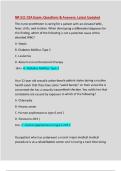
The nurse practitioner is caring for a patient with an elevated WBC, fever, chills, and malaise. When developing a differential diagnosis for this finding, which of the following is not a potential cause of the elevated WBC? A -Sepsis B -Diabetes Mellitus Type 2 C -Leukemia D -Recent oral corticosteroid therapy (Ans- B -Diabetes Mellitus Type 2 Your 21 year old sexually active female patient states during a routine health exam that they have some "weird bumps" on their vulva.She is concerned she has a sexually transmitted infection. You notify her that condyloma are caused by exposure to which of the following? A -Chlamydia B -Herpes zoster C -Human papilomavirus type 6 and 1 D -Parvovirus B19 ( Ans- C -Human papilomavirus type 6 and 1 Your patient who has underwent a recent major medical medical procedure is at a rehabilitation center and is having a hard time being motivated to do therapy. When you interview them as the nurse practitioner on staff for the subacute rehab center, they appeardespondent, and are having a hard time being wakeful during therapy sessions. They have stable vital signs, temperature, urine output, and are not ill-appearing. As a prudent nurse practitioner, you understand this may represent which of the following? A -Cushing syndrome B -Situation depression C -Addison's disease D -Untreated anxiety (Ans- B -Situation depression The 18 year old female patient who inappropriately exhibits fear of abandonment, intense interpersonal relationships, affective instability, and recurrent self-harm describes which of the following diagnoses: A -Borderline personality disorder B -Seasonal affective disorder C -Reactive attachment disorder D -Bipolar disorder (Ans- A -Borderline personality disorder You are treating a patient who has stopped taking their diuretic regimen against medical advice while they are on vacation since it made them urinate too frequently for their plans. Now they are 21 pounds heavier than their baseline weight, have respiratory crackles in bilateral bases, and have severe generalized lower extremity and truncal edema extending to the sacrum and abdomen. On your documentation, this is referred to as which of the following conditions? A -Nephrotic syndrome B -Syndrome of inappropriate antidiuretic hormone (SAIDH) C -Ascites D -Anasarca (Ans- D -Anasarca The 84 year old lethargic patient who lives alone accidentally overdosed their amlodipine (Norvasc) was found by their daughter and taken to your clinic for evaluation. On exam, you found her blood pressure of 80/42 which the daughter says was "about what she found on her home cuff for the last 6 hours before bringing her in to be evaluated". The patient was then transferred to the hospital for evaluation. During her hospitalization she was also evaluated with CBC, BMP, and a UA. The results reflect normal labs except the UA showed trace WBCs in urine and no leukocyte esterases or nitrites and the BMP showed a creatinine of 1.9 with her normal baseline of1.2 (normal range 0.5-1.2mg/dL) and BUN of 34, with a baseline of 20 (normal range 10-20 mg/dL). What si likely to cause which of her renal issues? A -Pyelonephritis B -Chronic kidney disease C -Acute tubular necrosis D -Glomerulonephritis (Ans- C -Acute tubular necrosis Your 52 year old male patient Gus has a diagnosis of heart failure with a low ejection fraction (HFrEF) (EF 30%) following a recent myocardial infarction and has been started on optimal medical therapy. Assuming he tolerates all the following medicines without side effects or contraindications, which one of the following agents should be avoided for optimal medical therapy specifically aimed at optimizing his HFrEF? A -Amlodipine (Norvasc) B -Entresto (Sacubitril/Valsartan) C -Furosemide (Lasix) D -Carvedilol (Coreg) (Ans- A -Amlodipine (Norvasc) Your 19 year old otherwise healthy male patient Vivek has been monitoring their peak flow at home after a recent visit at which time his symptoms suggest a new diagnosis of asthma. Which of the following is the most likely drug to be the first prescription? A -fluticasone/salmeterol (Advair diskus) 250/50 BID PRN for shortness of breath B -salmeterol (Serevent) 50mcg inhaled daily C -albuterol (Xopenex) MDI PRN for wheezing D -montelukast (Singulair) 10mg PO daily (Ans- C -albuterol (Xopenex) MDI PRN for wheezing Margo, a 47 year old female patient recently underwent routine surveillance labs during her annual visit. From a routine screening lab of Hgb A1C of 7.2, you have diagnosed her with type 2 diabetes mellitus (T2DM) and anticipate discharging her with medication and referral to diabetic education. Your patient teaching should include notification of which common side effect of the most commonly prescribed first agent for T2DM? A -diarrhea B -delayed gastric emptying C -mycotic infections D -constipation (Ans- A -diarrhea Oliver, a 62 year old otherwise healthy male patient with an active lifestyle presents to your clinic today with a chief complaint of gnawing abdominal pain with a history of orthopedic overuse injuries. In developing a working differential diagnosis for this patient, which of the following questions is most useful in probing this further to rule out more serious conditions? A -What time of the day aer you taking your acetaminophen (Tylenol)? B -Have you been taking any non-steroidal anti-inflammatory medications lately? C -When was the last time you took topical corticosteroids for pain? D -Have you noticed any particular food has made this worse? (Ans- B -Have you been taking any non-steroidal anti-inflammatory medications lately? Zeke, a 2 year old male patient presented to your primary care clinic with unilateral leg swelling and tenderness after an "al nighter"playing video games. You suspect he has a provokedDVT from immobility and an ultrasound has been ordered. While awaiting thisexam to be performed, you preemptively discuss anticoagulation with the patient assuming he wil most likely be needing this therapy. Which of the following represents adequate understanding from the patient? A -The goal for my INR on rivaroxaban (Xarelto) should be somewhere over 20 B -Regardless of the venous doppler findings, I can start warfarin(Coumadin) alone an it will take around 4-5 days to get the drug to properly anticoagulate me C -If they find a blood clot, I will need to use enoxaparin (Lovenox) in addition to warfarin (Coumadin) until my INR is over 2.0 D -I will need to take enoxaparin (Lovenox) ifIma started on rivaroxaban Xarelto) (Ans- C -If they find a blood clot, I will need to use enoxaparin (Lovenox) in addition to warfarin (Coumadin) until my INR is over 2.0 Which of the following are common causes of a provoked deep vein thrombosis (DVT)? A -Cancer B -Factor V Leiden C -Protein C or S deficiency D -All of these are common causes of provoked DVT (Ans- D -All of these are common causes of provoked DVT In discussing a new diagnosis of human immunodeficiency virus (HIV) for your patient, the patient demonstrates good understanding of the possible agents which may be used to include which of the following: A -All of these may be used to manage my disease B -Protease inhibitors C -Nucleoside reverse transcriptase inhibitors D -Non-nucleotide reverse transcriptase inhibitors (Ans- A -All of these may be used to manage my disease Which class of medications are indicated as first line management of both post-traumatic stress disorder (PTSD) and major depressive disorder? A -Selective serotonin reuptake inhibitors B -Non-selective dopamine reuptake inhibitors C -Mood stabilizers D -Monoamine oxidase inhibitors. (Ans- A -Selective serotonin reuptake inhibitors Dave, a 41 year old software engineer presents to your clinic with complaints of back spasms after being forced to return to their office instead of working from home. He believes the chair at his desk is the culprit and his causing him severe back spasms secondary to anaggravated old sports injury. nI addition to non-pharmacologic solutions, which of the following represents an agent appropriate for the managementof his spasms? A -Prednisone (Deltasone) B -Methy naltrexone (Relistor) C -Gabapentin (Neurontin) D -Cyclobenzaprine (amirx) (Ans- D -Cyclobenzaprine (amirx) Which of the following concepts refers to where small differences in dose or blood concentration may lead to serious therapeutic failures and/or adverse drug reactions that are life-threatening or result in persistent or significant disability or incapacity? A -Narrow therapeutic index B -Wide therapeutic index C -Post-antibiotic effect D -Zero order kinetics (Ans- A -Narrow therapeutic index
Document information
- Uploaded on
- October 11, 2025
- Number of pages
- 68
- Written in
- 2025/2026
- Type
- Exam (elaborations)
- Contains
- Questions & answers