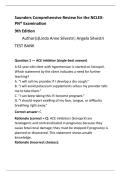
Saunders Comprehensive Review for the NCLEX-
PN® Examination
9th Edition
Author(s)Linda Anne Silvestri; Angela Silvestri
TEST BANK
Question 1 — ACE inhibitor (single-best answer)
A 62-year-old client with hypertension is started on lisinopril.
Which statement by the client indicates a need for further
teaching?
A. “I will call my provider if I develop a dry cough.”
B. “I will avoid potassium supplements unless my provider tells
me to take them.”
C. “I can keep taking this if I become pregnant.”
D. “I should report swelling of my face, tongue, or difficulty
breathing right away.”
Correct answer: C
Rationale (correct = C): ACE inhibitors (lisinopril) are
teratogenic and contraindicated in pregnancy because they
cause fetal renal damage; they must be stopped if pregnancy is
planned or discovered. This statement shows unsafe
knowledge.
Rationale (incorrect choices):
,A — Correct knowledge: ACE inhibitors commonly cause a
persistent dry cough; patient should report it so alternatives
(ARBs) can be considered.
B — Correct: ACE inhibitors can increase serum potassium;
patient should avoid routine K+ supplements and report
potassium-raising OTC products.
D — Correct: Angioedema (facial/tongue swelling, dyspnea) is a
life-threatening adverse effect; immediate medical attention is
needed.
Question 2 — Beta-blocker (single-best answer)
A client with acute myocardial infarction is prescribed
metoprolol PO. Which assessment finding would warrant
holding the medication and contacting the provider?
A. BP 136/82 mm Hg and HR 58 bpm.
B. BP 118/70 mm Hg and HR 78 bpm.
C. BP 90/56 mm Hg and HR 48 bpm.
D. BP 142/86 mm Hg and HR 92 bpm.
Correct answer: C
Rationale (correct = C): Metoprolol decreases heart rate and
contractility. A HR of 48 bpm and hypotension (90/56) indicate
bradycardia and reduced perfusion — hold the beta-blocker
and notify provider.
Rationale (incorrect choices):
A — HR 58 is borderline; many clinicians accept HR ≥ 50
,depending on protocol; BP is acceptable — often OK to
administer per standing parameters.
B — Hemodynamics acceptable; administer.
D — Hypertensive and tachycardic; metoprolol likely indicated.
Question 3 — Tablet calculation (dosage calculation)
Order: Digoxin 125 mcg PO once daily. Available: tablets 62.5
mcg. How many tablets should the nurse administer? (show
work)
Correct answer: 2 tablets
Calculation (digit-by-digit):
Desired dose = 125 mcg.
Tablet strength = 62.5 mcg.
Number of tablets = 125 ÷ 62.5 = 2.
Rationale: 62.5 × 2 = 125 mcg, which equals the ordered 125
mcg (0.125 mg). Administer 2 tablets.
Question 4 — IV infusion rate (dosage calculation)
The provider orders D5W 1,000 mL IV to infuse over 8 hours.
Calculate the infusion rate in mL/hr. (show work)
Correct answer: 125 mL/hr
Calculation:
Total volume 1,000 mL ÷ total hours 8 = 125 mL/hour.
Rationale: 1,000 ÷ 8 = 125. Set the pump to 125 mL/hr.
, Question 5 — Insulin & inpatient glycemic management
(single-best answer; NGN clinical reasoning)
A hospitalized non-critically ill adult has persistent blood
glucose readings > 220 mg/dL. Per current inpatient glycemic
guidance, which is the best next step?
A. Continue only PRN sliding-scale regular insulin when
hyperglycemia occurs.
B. Start scheduled basal insulin plus correctional (supplemental)
insulin as needed.
C. Begin oral metformin immediately regardless of renal
function.
D. Give IV regular insulin boluses every hour while awake.
Correct answer: B.
Rationale (correct = B): Contemporary inpatient glycemic
guidance discourages sole use of reactive sliding-scale insulin.
For non-critically ill patients with persistent hyperglycemia,
initiating scheduled basal insulin with correctional doses as
needed is preferred to reduce glucose variability and
hypoglycemia risk. (See ADA / Standards of Care for inpatient
glycemic management.) Diabetes Journals+1
Rationale (incorrect choices):
A — Sliding scale alone is reactive and associated with poorer
control/higher variability; not recommended as sole therapy.
C — Metformin is not automatically appropriate in hospitalized
patients — factors like renal function, hemodynamic instability,
PN® Examination
9th Edition
Author(s)Linda Anne Silvestri; Angela Silvestri
TEST BANK
Question 1 — ACE inhibitor (single-best answer)
A 62-year-old client with hypertension is started on lisinopril.
Which statement by the client indicates a need for further
teaching?
A. “I will call my provider if I develop a dry cough.”
B. “I will avoid potassium supplements unless my provider tells
me to take them.”
C. “I can keep taking this if I become pregnant.”
D. “I should report swelling of my face, tongue, or difficulty
breathing right away.”
Correct answer: C
Rationale (correct = C): ACE inhibitors (lisinopril) are
teratogenic and contraindicated in pregnancy because they
cause fetal renal damage; they must be stopped if pregnancy is
planned or discovered. This statement shows unsafe
knowledge.
Rationale (incorrect choices):
,A — Correct knowledge: ACE inhibitors commonly cause a
persistent dry cough; patient should report it so alternatives
(ARBs) can be considered.
B — Correct: ACE inhibitors can increase serum potassium;
patient should avoid routine K+ supplements and report
potassium-raising OTC products.
D — Correct: Angioedema (facial/tongue swelling, dyspnea) is a
life-threatening adverse effect; immediate medical attention is
needed.
Question 2 — Beta-blocker (single-best answer)
A client with acute myocardial infarction is prescribed
metoprolol PO. Which assessment finding would warrant
holding the medication and contacting the provider?
A. BP 136/82 mm Hg and HR 58 bpm.
B. BP 118/70 mm Hg and HR 78 bpm.
C. BP 90/56 mm Hg and HR 48 bpm.
D. BP 142/86 mm Hg and HR 92 bpm.
Correct answer: C
Rationale (correct = C): Metoprolol decreases heart rate and
contractility. A HR of 48 bpm and hypotension (90/56) indicate
bradycardia and reduced perfusion — hold the beta-blocker
and notify provider.
Rationale (incorrect choices):
A — HR 58 is borderline; many clinicians accept HR ≥ 50
,depending on protocol; BP is acceptable — often OK to
administer per standing parameters.
B — Hemodynamics acceptable; administer.
D — Hypertensive and tachycardic; metoprolol likely indicated.
Question 3 — Tablet calculation (dosage calculation)
Order: Digoxin 125 mcg PO once daily. Available: tablets 62.5
mcg. How many tablets should the nurse administer? (show
work)
Correct answer: 2 tablets
Calculation (digit-by-digit):
Desired dose = 125 mcg.
Tablet strength = 62.5 mcg.
Number of tablets = 125 ÷ 62.5 = 2.
Rationale: 62.5 × 2 = 125 mcg, which equals the ordered 125
mcg (0.125 mg). Administer 2 tablets.
Question 4 — IV infusion rate (dosage calculation)
The provider orders D5W 1,000 mL IV to infuse over 8 hours.
Calculate the infusion rate in mL/hr. (show work)
Correct answer: 125 mL/hr
Calculation:
Total volume 1,000 mL ÷ total hours 8 = 125 mL/hour.
Rationale: 1,000 ÷ 8 = 125. Set the pump to 125 mL/hr.
, Question 5 — Insulin & inpatient glycemic management
(single-best answer; NGN clinical reasoning)
A hospitalized non-critically ill adult has persistent blood
glucose readings > 220 mg/dL. Per current inpatient glycemic
guidance, which is the best next step?
A. Continue only PRN sliding-scale regular insulin when
hyperglycemia occurs.
B. Start scheduled basal insulin plus correctional (supplemental)
insulin as needed.
C. Begin oral metformin immediately regardless of renal
function.
D. Give IV regular insulin boluses every hour while awake.
Correct answer: B.
Rationale (correct = B): Contemporary inpatient glycemic
guidance discourages sole use of reactive sliding-scale insulin.
For non-critically ill patients with persistent hyperglycemia,
initiating scheduled basal insulin with correctional doses as
needed is preferred to reduce glucose variability and
hypoglycemia risk. (See ADA / Standards of Care for inpatient
glycemic management.) Diabetes Journals+1
Rationale (incorrect choices):
A — Sliding scale alone is reactive and associated with poorer
control/higher variability; not recommended as sole therapy.
C — Metformin is not automatically appropriate in hospitalized
patients — factors like renal function, hemodynamic instability,