PROBLEM 5: Shakespeare to be
Sources: Shaffer & Kipp, Berk
Language: small number of individually meaningless symbols that can be combined
according to agreed-on rules to produce an infinite number of messages.
5 Components of Language
Phonology: the sound system of a language and the rules of combining these sounds to
produce meaningful units of speech.
- Phenomes: basic units of sound that are used in spoken language
Morphology: rules governing the formation of meaningful words from sounds
Semantics: Expressed meaning of words and sentences
- Smallest meaningful units of language are morphemes
o Free morphemes: can stand alone as words (dog)
o Bound morphemes: cannot stand alone but can change meaning when
attached to a free morpheme (adding s to dogs means person is talking
about more than one)
Syntax: structure of a language, the roles specifying how words and grammatical markers are
to be combined to produce meaningful sentences.
Pragmatics: principles that underlie the effective and appropriate use of language in social
contexts. (to communicate effectively)
- Also involves sociolinguistic knowledge: culturally specific rules specifying how
language should be structured and used in particular social contexts.
Theories of Language Development
The Learning (or Empiricist Perspective)
- Caregivers “teach” language by modeling and by reinforcing grammatical speech
- Children imitate what they hear and are reinforced when they use proper grammar
and are corrected when they say things wrong
Skinner:
- children learn to speak appropriately because they are reinforced for correct
speech.
Bandura:
- children learn languages by carefully listening and imitating the language of older
companions.
, CRITICISM:
• little success accounting for the development of syntax.
o Mothers approval or disapproval depends far more on the semantics of what a
child says not the statements grammatical correctness (syntax).
• Children don’t acquire grammatical rules by imitating adults
o their sentences do not appear in adult speech and could not have been learned
by imitation
The Nativist Perspective
- humans are biologically programmed to acquire language- it is innate.
Noam Chomsky:
- structure of simplest languages is elaborate and far too complex to be taught by
parents or discovered via trial-and error.
- Proposed that humans are equipped with language acquisition device- unborn
linguistic processor that is activated by verbal input and contains universal
grammar or knowledge of rules that are common to all languages.
Dan Slobin:
- Does not assume children have innate knowledge of language but thinks they have
an inborn language-making capacity – set of cognitive and perceptual abilities
that are highly specialized for language learning.
- Enable young children to process linguistic input and infer the phonological
regularities, semantic relations and rules of syntax that characterize whatever
language to which they are listening.
SUPPORT:
• Brain Specialization and language:
o Aphasic children- recover because right hemisphere can assume linguistic
functions, but adults cannot because past puberty brain is already fully
specialized for language
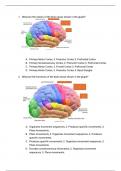
o Injuries to Broca’s area (speech production) near frontal lobe of left
hemisphere typically affects speech production and not comprehension.
Wernicke’s area (interpreting speech) is opposite this.
• Sensitive period hypothesis:
o language acquired most easily between birth and puberty when lateralized
brain becomes more specialized for linguistic functions
o Learn foreign language- more difficult post-puberty because sensitive period
for language learning is over
o Isolated children would learn to communicate and might invent own language
CRITICISM:
• Other species show similar auditory discrimination
• Doesn’t explain language development by attributing it to a built-in language
acquisition device.
• Only focuses on biological mechanisms
Sources: Shaffer & Kipp, Berk
Language: small number of individually meaningless symbols that can be combined
according to agreed-on rules to produce an infinite number of messages.
5 Components of Language
Phonology: the sound system of a language and the rules of combining these sounds to
produce meaningful units of speech.
- Phenomes: basic units of sound that are used in spoken language
Morphology: rules governing the formation of meaningful words from sounds
Semantics: Expressed meaning of words and sentences
- Smallest meaningful units of language are morphemes
o Free morphemes: can stand alone as words (dog)
o Bound morphemes: cannot stand alone but can change meaning when
attached to a free morpheme (adding s to dogs means person is talking
about more than one)
Syntax: structure of a language, the roles specifying how words and grammatical markers are
to be combined to produce meaningful sentences.
Pragmatics: principles that underlie the effective and appropriate use of language in social
contexts. (to communicate effectively)
- Also involves sociolinguistic knowledge: culturally specific rules specifying how
language should be structured and used in particular social contexts.
Theories of Language Development
The Learning (or Empiricist Perspective)
- Caregivers “teach” language by modeling and by reinforcing grammatical speech
- Children imitate what they hear and are reinforced when they use proper grammar
and are corrected when they say things wrong
Skinner:
- children learn to speak appropriately because they are reinforced for correct
speech.
Bandura:
- children learn languages by carefully listening and imitating the language of older
companions.
, CRITICISM:
• little success accounting for the development of syntax.
o Mothers approval or disapproval depends far more on the semantics of what a
child says not the statements grammatical correctness (syntax).
• Children don’t acquire grammatical rules by imitating adults
o their sentences do not appear in adult speech and could not have been learned
by imitation
The Nativist Perspective
- humans are biologically programmed to acquire language- it is innate.
Noam Chomsky:
- structure of simplest languages is elaborate and far too complex to be taught by
parents or discovered via trial-and error.
- Proposed that humans are equipped with language acquisition device- unborn
linguistic processor that is activated by verbal input and contains universal
grammar or knowledge of rules that are common to all languages.
Dan Slobin:
- Does not assume children have innate knowledge of language but thinks they have
an inborn language-making capacity – set of cognitive and perceptual abilities
that are highly specialized for language learning.
- Enable young children to process linguistic input and infer the phonological
regularities, semantic relations and rules of syntax that characterize whatever
language to which they are listening.
SUPPORT:
• Brain Specialization and language:
o Aphasic children- recover because right hemisphere can assume linguistic
functions, but adults cannot because past puberty brain is already fully
specialized for language
o Injuries to Broca’s area (speech production) near frontal lobe of left
hemisphere typically affects speech production and not comprehension.
Wernicke’s area (interpreting speech) is opposite this.
• Sensitive period hypothesis:
o language acquired most easily between birth and puberty when lateralized
brain becomes more specialized for linguistic functions
o Learn foreign language- more difficult post-puberty because sensitive period
for language learning is over
o Isolated children would learn to communicate and might invent own language
CRITICISM:
• Other species show similar auditory discrimination
• Doesn’t explain language development by attributing it to a built-in language
acquisition device.
• Only focuses on biological mechanisms