PROBLEM 1: The Birds and the Bees
Source: Shaffer & Kipp, Berk
Genetic material
First development that occurs after conception is protective:
1. sperm cell penetrates lining of the ovum
2. other sperm are repelled to prevent another fertilization process
3. Within a few hours the sperm cell disintegrates and releases its genetic material.
4. Ovum releases genetic material and new cell forms around hereditary info.
New cell = zygote (contains biochemical material for the development)
Hereditary Material
- 46 chromosomes- matching pairs (23 pairs)
- Genes: basic units of heredity that work to build a single protein.
o they are Deoxyribonucleic acid (DNA) – chemical basis or development
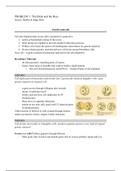
MITOSIS:
Cell duplicated chromosomes and divides into 2 genetically identical daughter cells- same
genetic material as original cells
- zygote moves through fallopian tube towards
uterus, it replicates itself
- before each division, cell duplicates its 46
chromosomes
- these move in opposite directions
- results in two new cells (each with 23 identical pairs
of chromosomes)
Child consists of billions of cells created through mitosis:
makes up muscles, bones, organs, bodily structures.
MEIOSIS
Cell divides and results in 4 daughter cells, produces gametes sperm or ova- half of original
genetic material
Germ (sex) cells Produce gametes through Meiosis
- Male germ cells in testes and female germ cells in ovaries produce sperm and ova
, - Crossing over: genetic material is exchanged
between pairs of chromosomes
- Pairs of duplicated chromosomes segregate into
two new cells- each contain 46 chromosomes
- New cell divides so that each gamete contains 23
single chromosomes
- At conception, sperm with 23 chromosomes
unites with ovum with 23 chromosomes =
zygote with 46 chromosomes.
- Independent assortment: random combinations
of chromosomes gives unique hereditary
Multiple Births:
- Monozygotic twins: identical, share genotype, zygote split into separate identical cells
- Dizygotic twins: fraternal, two ova are fertilized by different sperm
Male or Female:
Karyotypes: 22 of the 23 human chromosomes (autosomes) similar in males and females
Sex determined by 23rd chromosome
Gene expression
Genes produce amino acids: form enzymes, and proteins
Genotype: the genes that one inherits, expressed as a phenotype
Phenotype: Ones observable or measurable characteristics
SIMPLE DOMINANT RECESSIVE INHERITANCE:
A pattern of inheritance in which one allele dominates another so that its phenotype is
expressed
- Characteristics influenced by alleles
Alleles: pair of genes that influence traits (one
from mother other from father)
- Homozygous: same 2 alleles for
attribute (NN or nn)- identical to their
effects
- Heterozygous: two different alleles for
an attribute (Nn)- different effects
Source: Shaffer & Kipp, Berk
Genetic material
First development that occurs after conception is protective:
1. sperm cell penetrates lining of the ovum
2. other sperm are repelled to prevent another fertilization process
3. Within a few hours the sperm cell disintegrates and releases its genetic material.
4. Ovum releases genetic material and new cell forms around hereditary info.
New cell = zygote (contains biochemical material for the development)
Hereditary Material
- 46 chromosomes- matching pairs (23 pairs)
- Genes: basic units of heredity that work to build a single protein.
o they are Deoxyribonucleic acid (DNA) – chemical basis or development
MITOSIS:
Cell duplicated chromosomes and divides into 2 genetically identical daughter cells- same
genetic material as original cells
- zygote moves through fallopian tube towards
uterus, it replicates itself
- before each division, cell duplicates its 46
chromosomes
- these move in opposite directions
- results in two new cells (each with 23 identical pairs
of chromosomes)
Child consists of billions of cells created through mitosis:
makes up muscles, bones, organs, bodily structures.
MEIOSIS
Cell divides and results in 4 daughter cells, produces gametes sperm or ova- half of original
genetic material
Germ (sex) cells Produce gametes through Meiosis
- Male germ cells in testes and female germ cells in ovaries produce sperm and ova
, - Crossing over: genetic material is exchanged
between pairs of chromosomes
- Pairs of duplicated chromosomes segregate into
two new cells- each contain 46 chromosomes
- New cell divides so that each gamete contains 23
single chromosomes
- At conception, sperm with 23 chromosomes
unites with ovum with 23 chromosomes =
zygote with 46 chromosomes.
- Independent assortment: random combinations
of chromosomes gives unique hereditary
Multiple Births:
- Monozygotic twins: identical, share genotype, zygote split into separate identical cells
- Dizygotic twins: fraternal, two ova are fertilized by different sperm
Male or Female:
Karyotypes: 22 of the 23 human chromosomes (autosomes) similar in males and females
Sex determined by 23rd chromosome
Gene expression
Genes produce amino acids: form enzymes, and proteins
Genotype: the genes that one inherits, expressed as a phenotype
Phenotype: Ones observable or measurable characteristics
SIMPLE DOMINANT RECESSIVE INHERITANCE:
A pattern of inheritance in which one allele dominates another so that its phenotype is
expressed
- Characteristics influenced by alleles
Alleles: pair of genes that influence traits (one
from mother other from father)
- Homozygous: same 2 alleles for
attribute (NN or nn)- identical to their
effects
- Heterozygous: two different alleles for
an attribute (Nn)- different effects