Comprehensive Exam Preparation – PYC4802
Updated 2/01/2021
Textbook: Abnormal Psychology: A South Africa perspective (3rd Ed) - Burke
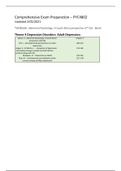
Theme 4 Depressive Disorders: Adult Depression
Burke, A - Abnormal Psychology: A South Africa Chapter 5
perspective (3rd Ed)
Hill, J – Developmental perspectives on adult 200-212
depression
Kagee, A., & Martin, L. – Symptoms of depression 159-165
and anxiety among a sample of South African
patients living with HIV
McQueen, D. – Depression in Adults 225-235
Maj, M. – Development and validation of the 135 -146
current concept of Major depression
, DSM 5 of Major Depressive Disorder
A. Five (or more) of the following symptoms have been present during the same 2-week period and
represent a change from previous functioning; at least one of the symptoms is either (1)
depressed mood or (2) loss of interest or pleasure.
Note: Do not include symptoms that are clearly due to another medical condition.
1. Depressed mood most of the day, nearly every day, as indicated by either subjective report
(e.g., feels sad or empty) or observation made by others (e.g., appears tearful).
Note: In children and adolescents, can be irritable mood.
2. Markedly diminished interest or pleasure in all, or almost all, activities most of the day, nearly
every day (as indicated by either subjective account or observation made by others).
3. Significant weight loss when not dieting or weight gain (e.g., a change of more than 5% of
body weight in a month) or decrease or increase in appetite nearly every day.
(Note: In children, consider failure to make expected weight gain.)
4. Insomnia or hypersomnia nearly every day.
5. Psychomotor agitation or retardation nearly every day (observable by others, not merely
subjective feelings of restlessness or being slowed down).
6. Fatigue or loss of energy nearly every day.
7. Feelings of worthlessness or excessive or inappropriate guilt (which may be delusional) nearly
every day (not merely self-reproach or guilt about being sick).
8. Diminished ability to think or concentrate, or indecisiveness, nearly every day (either by
subjective account or as observed by others).
9. Recurrent thoughts of death (not just fear of dying), recurrent suicidal ideation without a
specific plan, or a suicide attempt or a specific plan for committing suicide.
B. The symptoms cause clinically significant distress or impairment in social, occupational, or other
important areas of functioning.
C. The episode is not attributable to the physiological effects of a substance or to another medical
condition.
Note: Criteria A-C represent a major depressive episode.
D. The occurrence of the major depressive episode is not better explained by schizoaffective
disorder, schizophrenia, schizophreniform disorder, delusional disorder, or other specified and
unspecified schizophrenia spectrum and other psychotic disorders.
E. There has never been a manic episode or a hypomanic episode.
Note: This exclusion does not apply if all of the manic-like or hypomanic-like episodes are
substance-induced or are attributable to the physiological effects of another medical
condition.
Specify the following:
• Whether it is a single episode or a recurrent episode.
• The current severity (e.g., mild, moderate, severe, with psychotic features, in partial
remission, in full remission, unspecified).
Whether it is with anxious distress, with mixed features, with melancholic features, with atypical features,
with mood-congruent psychotic features, with mood incongruent psychotic features, with catatonia, with
post-partum onset, with seasonal pattern.
Aetiology
Biological
1. Genetics
a. inherit a vulnerability for changes in certain neurotransmitters i.e. serotonin and
dopamine, which results in a mood disorder when interacting with adverse life
events (More vulnerable to stressful life events)
2. Brain structure
a. studies on brain scans- patients with depression showed differences in brain
structure. Increased volume of lateral ventricles (increased cortical atrophy in these
Updated 2/01/2021
Textbook: Abnormal Psychology: A South Africa perspective (3rd Ed) - Burke
Theme 4 Depressive Disorders: Adult Depression
Burke, A - Abnormal Psychology: A South Africa Chapter 5
perspective (3rd Ed)
Hill, J – Developmental perspectives on adult 200-212
depression
Kagee, A., & Martin, L. – Symptoms of depression 159-165
and anxiety among a sample of South African
patients living with HIV
McQueen, D. – Depression in Adults 225-235
Maj, M. – Development and validation of the 135 -146
current concept of Major depression
, DSM 5 of Major Depressive Disorder
A. Five (or more) of the following symptoms have been present during the same 2-week period and
represent a change from previous functioning; at least one of the symptoms is either (1)
depressed mood or (2) loss of interest or pleasure.
Note: Do not include symptoms that are clearly due to another medical condition.
1. Depressed mood most of the day, nearly every day, as indicated by either subjective report
(e.g., feels sad or empty) or observation made by others (e.g., appears tearful).
Note: In children and adolescents, can be irritable mood.
2. Markedly diminished interest or pleasure in all, or almost all, activities most of the day, nearly
every day (as indicated by either subjective account or observation made by others).
3. Significant weight loss when not dieting or weight gain (e.g., a change of more than 5% of
body weight in a month) or decrease or increase in appetite nearly every day.
(Note: In children, consider failure to make expected weight gain.)
4. Insomnia or hypersomnia nearly every day.
5. Psychomotor agitation or retardation nearly every day (observable by others, not merely
subjective feelings of restlessness or being slowed down).
6. Fatigue or loss of energy nearly every day.
7. Feelings of worthlessness or excessive or inappropriate guilt (which may be delusional) nearly
every day (not merely self-reproach or guilt about being sick).
8. Diminished ability to think or concentrate, or indecisiveness, nearly every day (either by
subjective account or as observed by others).
9. Recurrent thoughts of death (not just fear of dying), recurrent suicidal ideation without a
specific plan, or a suicide attempt or a specific plan for committing suicide.
B. The symptoms cause clinically significant distress or impairment in social, occupational, or other
important areas of functioning.
C. The episode is not attributable to the physiological effects of a substance or to another medical
condition.
Note: Criteria A-C represent a major depressive episode.
D. The occurrence of the major depressive episode is not better explained by schizoaffective
disorder, schizophrenia, schizophreniform disorder, delusional disorder, or other specified and
unspecified schizophrenia spectrum and other psychotic disorders.
E. There has never been a manic episode or a hypomanic episode.
Note: This exclusion does not apply if all of the manic-like or hypomanic-like episodes are
substance-induced or are attributable to the physiological effects of another medical
condition.
Specify the following:
• Whether it is a single episode or a recurrent episode.
• The current severity (e.g., mild, moderate, severe, with psychotic features, in partial
remission, in full remission, unspecified).
Whether it is with anxious distress, with mixed features, with melancholic features, with atypical features,
with mood-congruent psychotic features, with mood incongruent psychotic features, with catatonia, with
post-partum onset, with seasonal pattern.
Aetiology
Biological
1. Genetics
a. inherit a vulnerability for changes in certain neurotransmitters i.e. serotonin and
dopamine, which results in a mood disorder when interacting with adverse life
events (More vulnerable to stressful life events)
2. Brain structure
a. studies on brain scans- patients with depression showed differences in brain
structure. Increased volume of lateral ventricles (increased cortical atrophy in these