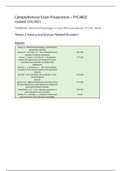
Comprehensive Exam Preparation – PYC4802
Updated 2/01/2021
Textbook: Abnormal Psychology: A South Africa perspective (3rd Ed) - Burke
Theme 2 Trauma and Stressor Related Disorders
Resources:
Burke, A - Abnormal Psychology: A South Africa
perspective (3rd Ed)
Green, B. L., & Lindy, J.D. – Post-traumatic stress 301-309
disorder in victims of disasters
Perrin, S., Smith, P., & Yule, W. – Practitioner 277-289
review: the assessment and treatment of post-
traumatic stress disorder in children and
adolescents
Stevens, J. L., & Goosen, J., - The nature of post- -
traumatic stress disorder (ptsd) in the gold mine
industry
De Silva – Post traumatic stress disorder: Cross- 217-229
Cultural aspects
Duncan
Keane et al - Differentiating post-traumatic stress 317-328
disorder (ptsd) from major depression (mdd) and
generalized anxiety disorder
MacFarlane, A. C., et al – Physical symptoms in 715-726
post-traumatic stress disorder
Brown, P. J., & Wolfe, J., - Substance abuse and 51-59
post-traumatic stress disorder comorbidity
,DSM 5 Diagnostic criteria for Acute Stress Disorder:
A. Exposure to actual or threatened death, serious injury, or sexual violation in one (or more) of the following
ways:
1. Directly experiencing the traumatic event(s).
2. Witnessing in person the event(s) as it occurred to others.
3. Learning that the traumatic event(s) occurred to a close family member or close friend. In cases of
actual or threatened death of a family member or friend, the event(s) must have been violent or
accidental.
4. Experiencing repeated or extreme exposure to aversive details of the traumatic event(s) (e.g. first
responders collecting human remains; police officers repeatedly exposed to details of child abuse).
Note: Criterion A4 does not apply to exposure through electronic media, television, movies, or pictures,
unless this exposure is work related.
B. Presence of nine (or more) of the following symptoms from any of the five categories of intrusion, negative
mood, dissociation, avoidance, and arousal, beginning or worsening after the traumatic events occurred:
Intrusion Symptoms:
1. Recurrent, involuntary, and intrusive distressing memories of the traumatic event(s).
Note: In children repetitive play may occur in which themes or aspects of the traumatic event(s) are
expressed.
2. Recurrent distressing dreams in which the content and/or effect of the dream are related to the
traumatic event(s).
Note: In children, there may be frightening dreams without recognizable content.
3. Dissociative reactions (e.g. flashbacks) in which the individual feels or acts as if the traumatic
event(s) were recurring. (Such reactions may occur on a continuum, with the most extreme
expression being a complete loss of awareness of present surroundings.) Note: In children, trauma
specific re-enactment may occur in play.
4. Intense or prolonged psychological distress or marked physiological reactions in response to
internal or external cues that symbolize or resemble an aspect of the traumatic event(s).
Negative Mood:
5. 5. Persistent inability to experience positive emotions (e.g. Inability to experience happiness,
satisfaction, or loving feelings).
Dissociative Symptoms:
6. 6. An altered sense of reality of one’s surroundings or oneself (e.g. seeing oneself from another’s
perspective, being in a daze, time slowing).
7. 7. Inability to remember an important aspect of the traumatic event(s) typically due to dissociative
amnesia and not to other factors such as head injury, alcohol, or drugs).
Avoidance Symptoms:
8. 8. Efforts to avoid distressing memories, thoughts, or feelings about or closely associated with the
traumatic event(s).
9. 9. Efforts to avoid external reminders (people, places, conversations, activities, objects, situations)
that arouse distressing memories, thoughts, or feelings about or closely associated with the
traumatic event(s).
Arousal Symptoms:
10. Sleep disturbance (e.g. Difficulty falling or staying asleep, or restless sleep).
11. Irritable behaviour and angry outbursts (with little or no provocation) typically expressed as verbal
or physical aggression toward people or objects.
12. Hypervigilance.
13. Problems with concentration.
14. Exaggerated startle response.
C. Duration of the disturbance (symptoms in Criterion B) is 3 days to 1 month after trauma exposure.
Note: Symptoms typically begin immediately after the trauma, but persistence for at least three days and up
to a month is needed to meet disorder criteria. The disturbance causes clinically significant distress or
impairment in social occupational, or other important areas of functioning.
D. The disturbance is not attributable to the physiological effects of a substance (e.g. Medication, alcohol) or
another medical condition (e.g. mild traumatic brain injury) and is not better explained by brief psychotic
disorder.
, DSM-5 diagnostic criteria for Posttraumatic Stress Disorder:
Note: The following criteria apply to adults, adolescents, and children older than 6 years.
A. Exposure to actual or threatened death, serious injury, or sexual violence in one (or more) of the following
ways:
1. Directly experiencing the traumatic event(s).
2. Witnessing in person the event(s) as it occurred to others.
3. Learning that the traumatic event(s) occurred to a close family member or close friend. In cases of
actual or threatened death of a family member or friend, the event(s) must have been violent or
accidental.
4. Experiencing repeated or extreme exposure to aversive details of the traumatic event(s) (e.g. first
responders collecting human remains; police officers repeatedly exposed to details of child abuse).
Note: Criterion A4 does not apply to exposure through electronic media, television, movies, or pictures,
unless this exposure is work related.
B. Presence of one (or more) of the following intrusion symptoms associated with the traumatic event(s),
beginning after the traumatic event(s) occurred:
1. Recurrent, involuntary, and intrusive distressing memories of the traumatic events.
Note: In children older than 6 years, repetitive play may occur in which themes or aspects of the traumatic
event(s) are expressed.
2. Recurrent distressing dreams in which the content and/or effect of the dream are related to the
traumatic event(s).
Note: In children, there may be frightening dreams without recognizable content.
3. Dissociative reactions (e.g. flashbacks) in which the individual feels or acts as if the traumatic
event(s) were recurring. (Such reactions may occur on a continuum, with the most extreme
expression being a complete loss of awareness of present surroundings.)
Note: In children, trauma-specific re-enactment may occur in play.
4. Intense or prolonged psychological distress at exposure to internal or external cues that symbolize
or resemble an aspect of the traumatic event(s).
5. Marked physiological reactions to internal or external cues that symbolize or resemble an aspect of
the traumatic event(s).
C. Persistent avoidance of stimuli associated with the traumatic event(s), beginning after the traumatic event(s)
occurred, as evidenced by one or both of the following:
1. Avoidance of or efforts to avoid distressing memories, thoughts, or feelings about or closely
associated with the traumatic event(s).
2. Avoidance of or efforts to avoid external reminders (people, places, conversations, activities,
objects, situations) that arouse distressing memories, thoughts, or feelings about or closely
associated with the traumatic event(s).
D. Negative alterations in cognitions and mood associated with the traumatic event(s), beginning, or worsening
after the traumatic event(s) occurred, as evidenced by two (or more) of the following:
1. Inability to remember an important aspect of the traumatic event(s) (typically due to dissociative
amnesia and not to other factors such as head injury, alcohol, or drugs).
2. Persistent and exaggerated negative beliefs or expectations about oneself, others, or the world (e.g.
“I am bad”, “No one can be trusted”, “The world is completely dangerous”, “My whole nervous
system is permanently ruined”).
3. Persistent, distorted cognitions about the cause or consequences of the traumatic event(s) that
lead the individual to blame himself/herself or others.
4. Persistent negative emotional state (e.g. fear, horror, anger, guilt, or shame).
5. Markedly diminished interest or participation in significant activities.
6. Feelings of detachment or estrangement from others.
7. Persistent inability to experience positive emotions (e.g. inability to experience happiness,
satisfaction, or loving feelings).
E. Marked alterations in arousal and reactivity associated with the traumatic event(s), beginning, or worsening
after the traumatic event(s) occurred, as evidenced by two (or more) of the following:
1. Irritable behaviour and angry outbursts (with little or no provocation) typically expressed as verbal
or physical aggression toward people or objects.
2. Reckless or self-destructive behaviour.
3. Hypervigilance.
4. Exaggerated startle response.
5. Problems with concentration.
6. Sleep disturbance (e.g. difficulty falling or staying asleep, or restless sleep).
F. Duration of the disturbance (Criteria B, C, D, and E) is more than 1 month.
G. The disturbance causes clinically significant distress or impairment in social, occupational, or other important
areas of functioning.
Updated 2/01/2021
Textbook: Abnormal Psychology: A South Africa perspective (3rd Ed) - Burke
Theme 2 Trauma and Stressor Related Disorders
Resources:
Burke, A - Abnormal Psychology: A South Africa
perspective (3rd Ed)
Green, B. L., & Lindy, J.D. – Post-traumatic stress 301-309
disorder in victims of disasters
Perrin, S., Smith, P., & Yule, W. – Practitioner 277-289
review: the assessment and treatment of post-
traumatic stress disorder in children and
adolescents
Stevens, J. L., & Goosen, J., - The nature of post- -
traumatic stress disorder (ptsd) in the gold mine
industry
De Silva – Post traumatic stress disorder: Cross- 217-229
Cultural aspects
Duncan
Keane et al - Differentiating post-traumatic stress 317-328
disorder (ptsd) from major depression (mdd) and
generalized anxiety disorder
MacFarlane, A. C., et al – Physical symptoms in 715-726
post-traumatic stress disorder
Brown, P. J., & Wolfe, J., - Substance abuse and 51-59
post-traumatic stress disorder comorbidity
,DSM 5 Diagnostic criteria for Acute Stress Disorder:
A. Exposure to actual or threatened death, serious injury, or sexual violation in one (or more) of the following
ways:
1. Directly experiencing the traumatic event(s).
2. Witnessing in person the event(s) as it occurred to others.
3. Learning that the traumatic event(s) occurred to a close family member or close friend. In cases of
actual or threatened death of a family member or friend, the event(s) must have been violent or
accidental.
4. Experiencing repeated or extreme exposure to aversive details of the traumatic event(s) (e.g. first
responders collecting human remains; police officers repeatedly exposed to details of child abuse).
Note: Criterion A4 does not apply to exposure through electronic media, television, movies, or pictures,
unless this exposure is work related.
B. Presence of nine (or more) of the following symptoms from any of the five categories of intrusion, negative
mood, dissociation, avoidance, and arousal, beginning or worsening after the traumatic events occurred:
Intrusion Symptoms:
1. Recurrent, involuntary, and intrusive distressing memories of the traumatic event(s).
Note: In children repetitive play may occur in which themes or aspects of the traumatic event(s) are
expressed.
2. Recurrent distressing dreams in which the content and/or effect of the dream are related to the
traumatic event(s).
Note: In children, there may be frightening dreams without recognizable content.
3. Dissociative reactions (e.g. flashbacks) in which the individual feels or acts as if the traumatic
event(s) were recurring. (Such reactions may occur on a continuum, with the most extreme
expression being a complete loss of awareness of present surroundings.) Note: In children, trauma
specific re-enactment may occur in play.
4. Intense or prolonged psychological distress or marked physiological reactions in response to
internal or external cues that symbolize or resemble an aspect of the traumatic event(s).
Negative Mood:
5. 5. Persistent inability to experience positive emotions (e.g. Inability to experience happiness,
satisfaction, or loving feelings).
Dissociative Symptoms:
6. 6. An altered sense of reality of one’s surroundings or oneself (e.g. seeing oneself from another’s
perspective, being in a daze, time slowing).
7. 7. Inability to remember an important aspect of the traumatic event(s) typically due to dissociative
amnesia and not to other factors such as head injury, alcohol, or drugs).
Avoidance Symptoms:
8. 8. Efforts to avoid distressing memories, thoughts, or feelings about or closely associated with the
traumatic event(s).
9. 9. Efforts to avoid external reminders (people, places, conversations, activities, objects, situations)
that arouse distressing memories, thoughts, or feelings about or closely associated with the
traumatic event(s).
Arousal Symptoms:
10. Sleep disturbance (e.g. Difficulty falling or staying asleep, or restless sleep).
11. Irritable behaviour and angry outbursts (with little or no provocation) typically expressed as verbal
or physical aggression toward people or objects.
12. Hypervigilance.
13. Problems with concentration.
14. Exaggerated startle response.
C. Duration of the disturbance (symptoms in Criterion B) is 3 days to 1 month after trauma exposure.
Note: Symptoms typically begin immediately after the trauma, but persistence for at least three days and up
to a month is needed to meet disorder criteria. The disturbance causes clinically significant distress or
impairment in social occupational, or other important areas of functioning.
D. The disturbance is not attributable to the physiological effects of a substance (e.g. Medication, alcohol) or
another medical condition (e.g. mild traumatic brain injury) and is not better explained by brief psychotic
disorder.
, DSM-5 diagnostic criteria for Posttraumatic Stress Disorder:
Note: The following criteria apply to adults, adolescents, and children older than 6 years.
A. Exposure to actual or threatened death, serious injury, or sexual violence in one (or more) of the following
ways:
1. Directly experiencing the traumatic event(s).
2. Witnessing in person the event(s) as it occurred to others.
3. Learning that the traumatic event(s) occurred to a close family member or close friend. In cases of
actual or threatened death of a family member or friend, the event(s) must have been violent or
accidental.
4. Experiencing repeated or extreme exposure to aversive details of the traumatic event(s) (e.g. first
responders collecting human remains; police officers repeatedly exposed to details of child abuse).
Note: Criterion A4 does not apply to exposure through electronic media, television, movies, or pictures,
unless this exposure is work related.
B. Presence of one (or more) of the following intrusion symptoms associated with the traumatic event(s),
beginning after the traumatic event(s) occurred:
1. Recurrent, involuntary, and intrusive distressing memories of the traumatic events.
Note: In children older than 6 years, repetitive play may occur in which themes or aspects of the traumatic
event(s) are expressed.
2. Recurrent distressing dreams in which the content and/or effect of the dream are related to the
traumatic event(s).
Note: In children, there may be frightening dreams without recognizable content.
3. Dissociative reactions (e.g. flashbacks) in which the individual feels or acts as if the traumatic
event(s) were recurring. (Such reactions may occur on a continuum, with the most extreme
expression being a complete loss of awareness of present surroundings.)
Note: In children, trauma-specific re-enactment may occur in play.
4. Intense or prolonged psychological distress at exposure to internal or external cues that symbolize
or resemble an aspect of the traumatic event(s).
5. Marked physiological reactions to internal or external cues that symbolize or resemble an aspect of
the traumatic event(s).
C. Persistent avoidance of stimuli associated with the traumatic event(s), beginning after the traumatic event(s)
occurred, as evidenced by one or both of the following:
1. Avoidance of or efforts to avoid distressing memories, thoughts, or feelings about or closely
associated with the traumatic event(s).
2. Avoidance of or efforts to avoid external reminders (people, places, conversations, activities,
objects, situations) that arouse distressing memories, thoughts, or feelings about or closely
associated with the traumatic event(s).
D. Negative alterations in cognitions and mood associated with the traumatic event(s), beginning, or worsening
after the traumatic event(s) occurred, as evidenced by two (or more) of the following:
1. Inability to remember an important aspect of the traumatic event(s) (typically due to dissociative
amnesia and not to other factors such as head injury, alcohol, or drugs).
2. Persistent and exaggerated negative beliefs or expectations about oneself, others, or the world (e.g.
“I am bad”, “No one can be trusted”, “The world is completely dangerous”, “My whole nervous
system is permanently ruined”).
3. Persistent, distorted cognitions about the cause or consequences of the traumatic event(s) that
lead the individual to blame himself/herself or others.
4. Persistent negative emotional state (e.g. fear, horror, anger, guilt, or shame).
5. Markedly diminished interest or participation in significant activities.
6. Feelings of detachment or estrangement from others.
7. Persistent inability to experience positive emotions (e.g. inability to experience happiness,
satisfaction, or loving feelings).
E. Marked alterations in arousal and reactivity associated with the traumatic event(s), beginning, or worsening
after the traumatic event(s) occurred, as evidenced by two (or more) of the following:
1. Irritable behaviour and angry outbursts (with little or no provocation) typically expressed as verbal
or physical aggression toward people or objects.
2. Reckless or self-destructive behaviour.
3. Hypervigilance.
4. Exaggerated startle response.
5. Problems with concentration.
6. Sleep disturbance (e.g. difficulty falling or staying asleep, or restless sleep).
F. Duration of the disturbance (Criteria B, C, D, and E) is more than 1 month.
G. The disturbance causes clinically significant distress or impairment in social, occupational, or other important
areas of functioning.