
FNP I Exam #1
Study online at https://quizlet.com/_7199x4
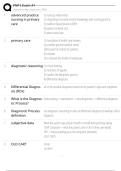
1. advanced practice 1) nurse-pt relationship
nursing in primary 2) integrating increased medical knowledge with nursing practice
care 3) evidence based practice (EBP)
4) patient centered care
5) wears many hats
2. primary care 1) foundation of health care delivery
2) provides general medical needs
3)first point of contact for patients
4) complex
5) to improve the health of individuals
3. diagnostic reasoning 1) critical thinking
2) intuitions sill applies
3) involves the diagnostic process
4) differential diagnosis
4. Differential Diagno- all of the possible diagnoses based not he patient's signs and symptoms
sis (DDx)
5. What is the Diagnos- history taking -> examination -> labs/diagnostics -> differential diagnosis
tic Process?
6. Diagnostic Process use diagnostic reasoning to rule out differential diagnosis to develop a final
definition diagnosis
7. subjective data What the patient says about himself or herself during history taking
Chief Complaint -> what the patient came in for in their own words
HPI -> history leading up to the complaint (detailed)
(OLD CART)
8. OLD CART Onset
Location
, FNP I Exam #1
Study online at https://quizlet.com/_7199x4
Duration
Characteristics
Aggravating factors
Relieving factors
Treatment
9. history taking Past Medical History
Past Surgical History
Health Maintenance
Medication List
Allergies
Family History
Social History
Review of Systems (neg/pos)
10. objective data (phys- vitals, weight, height, BMI
ical exam) what is seen, felt, heard
what you examine based on the patient's complaint
11. objective data (diag- labs, x-rays, scans, spirometry, etc.
nostic tests) consider which test is best (cost, convince, sensitivity, specificity)
what will make a difference in treatment?
what is the risk of missing the diagnosis?
12. treatment plan -shared decision making = better outcomes and increased patient satisfac-
tion
-evidenced based on current practice guidelines
-education
-follow up
13. oral reporting -case presentation
-purpose
, FNP I Exam #1
Study online at https://quizlet.com/_7199x4
-follow the diagnostic process
-communicate with the most pertinent information
14. how to give oral re- 1) opening statement (age, gender, cc)
port? 2) report HPI (cardinal symptoms, pos/neg)
3) focused assessment with findings
4) synthesis statement of the differential diagnoses
5) final diagnosis and treatment you recommend
15. comprehensive his- captures entire medical history (complete physical exam, diagnosis, diag-
tory and physical nostic studies, initial plan of care for all problems)
foundation of care (new patient establishing care)
16. components of a 1) CC
comprehensive H&P 2) HPI
3) PMH
4) FH
5) SH
6) ROS
7) PE
8) Lab data
9) Assessment
10) Interventions
11) Education
12) Treatment
13) Follow up
17. Review of Systems A systematic approach for collecting the patient's self-reported data on all
(ROS) body systems.
18. ROS in order 1)constitutional
2) eyes
3) ears, nose, mouth/throat
Study online at https://quizlet.com/_7199x4
1. advanced practice 1) nurse-pt relationship
nursing in primary 2) integrating increased medical knowledge with nursing practice
care 3) evidence based practice (EBP)
4) patient centered care
5) wears many hats
2. primary care 1) foundation of health care delivery
2) provides general medical needs
3)first point of contact for patients
4) complex
5) to improve the health of individuals
3. diagnostic reasoning 1) critical thinking
2) intuitions sill applies
3) involves the diagnostic process
4) differential diagnosis
4. Differential Diagno- all of the possible diagnoses based not he patient's signs and symptoms
sis (DDx)
5. What is the Diagnos- history taking -> examination -> labs/diagnostics -> differential diagnosis
tic Process?
6. Diagnostic Process use diagnostic reasoning to rule out differential diagnosis to develop a final
definition diagnosis
7. subjective data What the patient says about himself or herself during history taking
Chief Complaint -> what the patient came in for in their own words
HPI -> history leading up to the complaint (detailed)
(OLD CART)
8. OLD CART Onset
Location
, FNP I Exam #1
Study online at https://quizlet.com/_7199x4
Duration
Characteristics
Aggravating factors
Relieving factors
Treatment
9. history taking Past Medical History
Past Surgical History
Health Maintenance
Medication List
Allergies
Family History
Social History
Review of Systems (neg/pos)
10. objective data (phys- vitals, weight, height, BMI
ical exam) what is seen, felt, heard
what you examine based on the patient's complaint
11. objective data (diag- labs, x-rays, scans, spirometry, etc.
nostic tests) consider which test is best (cost, convince, sensitivity, specificity)
what will make a difference in treatment?
what is the risk of missing the diagnosis?
12. treatment plan -shared decision making = better outcomes and increased patient satisfac-
tion
-evidenced based on current practice guidelines
-education
-follow up
13. oral reporting -case presentation
-purpose
, FNP I Exam #1
Study online at https://quizlet.com/_7199x4
-follow the diagnostic process
-communicate with the most pertinent information
14. how to give oral re- 1) opening statement (age, gender, cc)
port? 2) report HPI (cardinal symptoms, pos/neg)
3) focused assessment with findings
4) synthesis statement of the differential diagnoses
5) final diagnosis and treatment you recommend
15. comprehensive his- captures entire medical history (complete physical exam, diagnosis, diag-
tory and physical nostic studies, initial plan of care for all problems)
foundation of care (new patient establishing care)
16. components of a 1) CC
comprehensive H&P 2) HPI
3) PMH
4) FH
5) SH
6) ROS
7) PE
8) Lab data
9) Assessment
10) Interventions
11) Education
12) Treatment
13) Follow up
17. Review of Systems A systematic approach for collecting the patient's self-reported data on all
(ROS) body systems.
18. ROS in order 1)constitutional
2) eyes
3) ears, nose, mouth/throat


