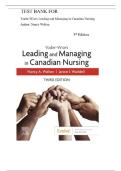
,TEST BANK FOR YODER-WISE’S LEADING AND MANAGING IN CANADIAN NURSING, 3RD EDITION,
PATRICIA S. YODER-WISE, JANICE WADDELL, NANCY WALTON
TEST BANK FOR YODER-
WISE’S LEADING AND MANAGING IN CANADIAN NURSING, 3rd EDITION, PATRICIA S. YODER-
WISE, JANICE WADDELL, NANCY WALTON,
ISBN: 9781771721684,
ISBN: 9781771721745,
ISBN: 9781771721677
Table of Contents
Part I: Core Concepts Overview
1. Leading, Managing, and Following
2. Developing the Role of Leader
3. Developing the Role of Manager
4. Nursing Leadership and Indigenous Health
5. Patient Focus
Context
6. Ethical Issues
7. Legal Issues
8. Making Decisions andj Solving Problems
9. Health Care Organizations
10. Understandingj5and Designingj5Organizational Structures
11. Cultural Diversity in Health Care
12. Power, Politics, and Influence
Part II: Managing Resources
13. Caring, Communicating, and Managing with Technology
14. Managing Costs and Budgets
15. Care Delivery Strategies
16. Staffing and Scheduling (available only on Evolve)
17. Selecting, Developing, and Evaluating Staff (available only on Evolve)
Part III: Changing the Status Quo
18. Strategic Planning, Goal-Setting, and Marketing
19. Nurses Leading Change: A Relational Emancipatory Framework for Health and Social
Action
20. Building Teams Through Communication and Partnerships
21. Collective Nursingj5Advocacy
22. Understanding Quality, Risk, and Safety
23. Translating Research into Practice
2
,TEST BANK FOR YODER-WISE’S LEADING AND MANAGING IN CANADIAN NURSING, 3RD EDITION,
PATRICIA S. YODER-WISE, JANICE WADDELL, NANCY WALTON
Part IV: Interpersonal and Personal Skills
Interpersonal
24. Understanding and Resolving Conflict
25. Managingj5Personal/Personnel Problems
26. Workplace Violence and Incivility
27. Inter andj5Intraprofessional Practice and Leadingj5in Professional Practice Settings
Personal
28. Role Transition
29. Self-Management: Stress and Time
Future
30. Thriving for the Future
31. Leadingj5and Managing Your Career
32. Nursing Students as Leaders
3
, TEST BANK FOR YODER-WISE’S LEADING AND MANAGING IN CANADIAN NURSING, 3RD EDITION,
PATRICIA S. YODER-WISE, JANICE WADDELL, NANCY WALTON
Chapter 01: Leading, Managing, and Following Waddell/Walton: Yoder-
Wise’s Leading and Managing in Canadian Nursing, 3rd Edition
MULTIPLE CHOICE
1. A nurse manager of a 20-bed medical unit finds that 80% of the patients are older
adults. She is asked to assess and ad apt the unit to better meet the unique needs of older adult
patients. Accordingj5to complexity principles, what would be the best approach to take in
makingj5this change?
a. Leverage the hierarchical managementj5position to get unit staff involvedj5in
assessment and planning.
b. Engage involved staff at all levels in the decision-making process.
c. Focus the assessment on the unit, and omit the hospital and community environment.
d. Hire a geriatric specialist to oversee and control the project.
ANS: B
Complexity theory suggests that systems interact and adapt and that decision making occurs t
hroughout the systems, as opposed to being held in a hierarchy. In complexity theory, every
body‘s opinion counts; therefore, all levels of staff would be involved in decision making.
DIF: Cognitive Level: Apply
REF: Page 14 TOP: Nursing Process: Implementation
2. A unit manager of a 25-bedj5medical/surgical area receives a phone call from a nurse
who has called in sick five times in the past month. He tells the manager that he very much
wants to come to work when scheduled, but must often care for his wife, who is undergoing
treatment for breast cancer. In the practice of a strengths-
based nursing leader, what would be the best approach to satisfying the needs of this nurse,
other staff, and patients?
a. Line up agency nurses who can be called in to work on short notice.
b. Place the nurse on unpaid leave for the remainder of his wife‘s treatment.
c. Sympathize with the nurse‘s dilemma and let the charge nurse know that this nurse may
be callingj5in frequently in the future.
d. Work with the nurse, staffing office, and other nurses to arrange his scheduled days off
around his wife‘s treatments.
ANS: D
Placingj5the nurse on unpaid leave may threaten physiologic needs and demotivate the nurse.
Unsatisfactory coverage of shifts on short notice could affect patient care and threaten staff
members‘ sense of competence. Strengths-
based nurse leaders honour the uniqueness of individuals, teams, systems, and organizations
; therefore arrangingj5the schedule around the wife‘s needs would result in a win-
win situation, also creating a work environment that promotes the health of all the nurses an d
facilitates their development.
4
PATRICIA S. YODER-WISE, JANICE WADDELL, NANCY WALTON
TEST BANK FOR YODER-
WISE’S LEADING AND MANAGING IN CANADIAN NURSING, 3rd EDITION, PATRICIA S. YODER-
WISE, JANICE WADDELL, NANCY WALTON,
ISBN: 9781771721684,
ISBN: 9781771721745,
ISBN: 9781771721677
Table of Contents
Part I: Core Concepts Overview
1. Leading, Managing, and Following
2. Developing the Role of Leader
3. Developing the Role of Manager
4. Nursing Leadership and Indigenous Health
5. Patient Focus
Context
6. Ethical Issues
7. Legal Issues
8. Making Decisions andj Solving Problems
9. Health Care Organizations
10. Understandingj5and Designingj5Organizational Structures
11. Cultural Diversity in Health Care
12. Power, Politics, and Influence
Part II: Managing Resources
13. Caring, Communicating, and Managing with Technology
14. Managing Costs and Budgets
15. Care Delivery Strategies
16. Staffing and Scheduling (available only on Evolve)
17. Selecting, Developing, and Evaluating Staff (available only on Evolve)
Part III: Changing the Status Quo
18. Strategic Planning, Goal-Setting, and Marketing
19. Nurses Leading Change: A Relational Emancipatory Framework for Health and Social
Action
20. Building Teams Through Communication and Partnerships
21. Collective Nursingj5Advocacy
22. Understanding Quality, Risk, and Safety
23. Translating Research into Practice
2
,TEST BANK FOR YODER-WISE’S LEADING AND MANAGING IN CANADIAN NURSING, 3RD EDITION,
PATRICIA S. YODER-WISE, JANICE WADDELL, NANCY WALTON
Part IV: Interpersonal and Personal Skills
Interpersonal
24. Understanding and Resolving Conflict
25. Managingj5Personal/Personnel Problems
26. Workplace Violence and Incivility
27. Inter andj5Intraprofessional Practice and Leadingj5in Professional Practice Settings
Personal
28. Role Transition
29. Self-Management: Stress and Time
Future
30. Thriving for the Future
31. Leadingj5and Managing Your Career
32. Nursing Students as Leaders
3
, TEST BANK FOR YODER-WISE’S LEADING AND MANAGING IN CANADIAN NURSING, 3RD EDITION,
PATRICIA S. YODER-WISE, JANICE WADDELL, NANCY WALTON
Chapter 01: Leading, Managing, and Following Waddell/Walton: Yoder-
Wise’s Leading and Managing in Canadian Nursing, 3rd Edition
MULTIPLE CHOICE
1. A nurse manager of a 20-bed medical unit finds that 80% of the patients are older
adults. She is asked to assess and ad apt the unit to better meet the unique needs of older adult
patients. Accordingj5to complexity principles, what would be the best approach to take in
makingj5this change?
a. Leverage the hierarchical managementj5position to get unit staff involvedj5in
assessment and planning.
b. Engage involved staff at all levels in the decision-making process.
c. Focus the assessment on the unit, and omit the hospital and community environment.
d. Hire a geriatric specialist to oversee and control the project.
ANS: B
Complexity theory suggests that systems interact and adapt and that decision making occurs t
hroughout the systems, as opposed to being held in a hierarchy. In complexity theory, every
body‘s opinion counts; therefore, all levels of staff would be involved in decision making.
DIF: Cognitive Level: Apply
REF: Page 14 TOP: Nursing Process: Implementation
2. A unit manager of a 25-bedj5medical/surgical area receives a phone call from a nurse
who has called in sick five times in the past month. He tells the manager that he very much
wants to come to work when scheduled, but must often care for his wife, who is undergoing
treatment for breast cancer. In the practice of a strengths-
based nursing leader, what would be the best approach to satisfying the needs of this nurse,
other staff, and patients?
a. Line up agency nurses who can be called in to work on short notice.
b. Place the nurse on unpaid leave for the remainder of his wife‘s treatment.
c. Sympathize with the nurse‘s dilemma and let the charge nurse know that this nurse may
be callingj5in frequently in the future.
d. Work with the nurse, staffing office, and other nurses to arrange his scheduled days off
around his wife‘s treatments.
ANS: D
Placingj5the nurse on unpaid leave may threaten physiologic needs and demotivate the nurse.
Unsatisfactory coverage of shifts on short notice could affect patient care and threaten staff
members‘ sense of competence. Strengths-
based nurse leaders honour the uniqueness of individuals, teams, systems, and organizations
; therefore arrangingj5the schedule around the wife‘s needs would result in a win-
win situation, also creating a work environment that promotes the health of all the nurses an d
facilitates their development.
4