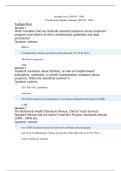
Attempt Score 100/100 – 100%
Overall Grade (Highest Attempt) 100/100 – 100%
Subsection
Question 1
What mandates that any federally assisted substance abuse treatment
program must adhere to strict confidentiality guidelines and legal
procedures?
Question options:
HIPAA
Confidentiality of Drug and Alcohol Abuse Records, 42 C.F.R. Part 2
The Joint Commission
CMS
Question 2
Inpatient substance abuse facilities, as well as hospital-based
ambulatory, residential, or partial hospitalization substance abuse
programs, follow the standards outlined in:
Question options:
42 C.F.R. Part 2 guidelines.
state laws.
The Joint Commission's Comprehensive Accreditation Manual for Hospitals (CAMH).
CARF.
Question 3
The Behavioral Health Standards Manual, Child & Youth Services
Standard Manual and the Opioid Treatment Program Standards Manual
(CARF, 1994) are:
Question options:
two CARF standards manuals are relevant to substance abuse programs.
part of the Confidentiality of Drug and Alcohol Abuse Records, 42 C.F.R. Part 2
Joint Commission manuals.
, HIPAA regulations.
Question 4
Most ICF/IID facilities are funded by Title XIX (Medicaid) and,
therefore, must meet the standards of:
Question options:
CARF.
42 C.F.R. Part 2 guidelines.
each state.
the Conditions of Participation for Intermediate Care Facilities for Individuals with Intellectual Disabil
Question 5
Formerly the Accreditation Council on Services for People with
Developmental Disabilities, which has set standards for facilities serving
persons with intellectual or developmental disabilities?
Question options:
CARF
Council on Quality and Leadership (CQL)
The Joint Commission
HIPAA
Question 6
In the long-term care industry, which means that any deficiencies the
surveyors find are deemed to be of minimal potential for harm to the
residents?
Question options:
substantial compliance
substandard quality of care
deemed status
A+ rating
Question 7
Overall Grade (Highest Attempt) 100/100 – 100%
Subsection
Question 1
What mandates that any federally assisted substance abuse treatment
program must adhere to strict confidentiality guidelines and legal
procedures?
Question options:
HIPAA
Confidentiality of Drug and Alcohol Abuse Records, 42 C.F.R. Part 2
The Joint Commission
CMS
Question 2
Inpatient substance abuse facilities, as well as hospital-based
ambulatory, residential, or partial hospitalization substance abuse
programs, follow the standards outlined in:
Question options:
42 C.F.R. Part 2 guidelines.
state laws.
The Joint Commission's Comprehensive Accreditation Manual for Hospitals (CAMH).
CARF.
Question 3
The Behavioral Health Standards Manual, Child & Youth Services
Standard Manual and the Opioid Treatment Program Standards Manual
(CARF, 1994) are:
Question options:
two CARF standards manuals are relevant to substance abuse programs.
part of the Confidentiality of Drug and Alcohol Abuse Records, 42 C.F.R. Part 2
Joint Commission manuals.
, HIPAA regulations.
Question 4
Most ICF/IID facilities are funded by Title XIX (Medicaid) and,
therefore, must meet the standards of:
Question options:
CARF.
42 C.F.R. Part 2 guidelines.
each state.
the Conditions of Participation for Intermediate Care Facilities for Individuals with Intellectual Disabil
Question 5
Formerly the Accreditation Council on Services for People with
Developmental Disabilities, which has set standards for facilities serving
persons with intellectual or developmental disabilities?
Question options:
CARF
Council on Quality and Leadership (CQL)
The Joint Commission
HIPAA
Question 6
In the long-term care industry, which means that any deficiencies the
surveyors find are deemed to be of minimal potential for harm to the
residents?
Question options:
substantial compliance
substandard quality of care
deemed status
A+ rating
Question 7