
FSC100 - WEEK 3 UPDATED ACTUAL Questions and CORRECT Answers
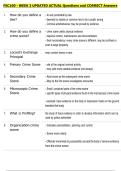
1. How do you define a - An act punishable by law
law? - deemed by statute or common law to be a public wrong
- Criminal acts/behaviour may be proved by evidence
2. How do you define a - crime scene yields physical evidence
crime scene? - requires control, maintenance and documentation
- their inconsistency: every crime scene is different, may be confined or
over a large property
3. Locard's Exchange every contact leaves a trace
Principal
4. Primary Crime Scene - site of the original criminal activity
- may yield more useable evidence (not always)
5. Secondary Crime - Also known as the subsequent crime scene
Scene - May be the first scene investigators encounter
6. Microscopic Crime - Small, contained parts of the crime scene
Scene - specific types of physical evidence found in the macroscopic crime scene
- example: trace evidence on the body or impression marks on the ground
besides the body
7. What is Profiling? the study of trace evidence in order to develop information which can be
used by police authorities
8. Organization crime - Indicates premeditation, planning and control
scene
- Scene more orderly
- Offender more likely to purposefully conceal the body or remove evidence
from the crime scene
, 9. Disorganized crime - Reflects sense of disorder, little (if any) premeditation: E.g hit and run
scene
- Scene in disarray, evidence more likely to be found, body often open in
view
- Disproportionate number of scenes are disorganized type
10. How do you manage - Approach every scene as if it is a crime scene ’following the same
crime scenes? guidelines, authority until find out that it's not a crime
- Ensuring integrity of evidence key to whether evidence will be admitted
in Court
- Strict management
11. What are the stages of - The initial response
crime scene manage- - Securing and preserving the crime scene
ment? - Scene assessment and documentation
- Searching the scene
- Releasing the scene
12. Inner perimeter of a - Core area where criminal act took place
crime scene - Evidence most likely to be compromised
13. Outer perimeter of a - Larger perimeter surrounding inner perimeter
crime scene - Crime scene tape
14. The CSI Effect - Popular media represents crime scene investigators as amalgams of may
different roles
- Result of popular media representations:
’Glamourization
’Public misinformation - idea that one person does the whole process
2/6
1. How do you define a - An act punishable by law
law? - deemed by statute or common law to be a public wrong
- Criminal acts/behaviour may be proved by evidence
2. How do you define a - crime scene yields physical evidence
crime scene? - requires control, maintenance and documentation
- their inconsistency: every crime scene is different, may be confined or
over a large property
3. Locard's Exchange every contact leaves a trace
Principal
4. Primary Crime Scene - site of the original criminal activity
- may yield more useable evidence (not always)
5. Secondary Crime - Also known as the subsequent crime scene
Scene - May be the first scene investigators encounter
6. Microscopic Crime - Small, contained parts of the crime scene
Scene - specific types of physical evidence found in the macroscopic crime scene
- example: trace evidence on the body or impression marks on the ground
besides the body
7. What is Profiling? the study of trace evidence in order to develop information which can be
used by police authorities
8. Organization crime - Indicates premeditation, planning and control
scene
- Scene more orderly
- Offender more likely to purposefully conceal the body or remove evidence
from the crime scene
, 9. Disorganized crime - Reflects sense of disorder, little (if any) premeditation: E.g hit and run
scene
- Scene in disarray, evidence more likely to be found, body often open in
view
- Disproportionate number of scenes are disorganized type
10. How do you manage - Approach every scene as if it is a crime scene ’following the same
crime scenes? guidelines, authority until find out that it's not a crime
- Ensuring integrity of evidence key to whether evidence will be admitted
in Court
- Strict management
11. What are the stages of - The initial response
crime scene manage- - Securing and preserving the crime scene
ment? - Scene assessment and documentation
- Searching the scene
- Releasing the scene
12. Inner perimeter of a - Core area where criminal act took place
crime scene - Evidence most likely to be compromised
13. Outer perimeter of a - Larger perimeter surrounding inner perimeter
crime scene - Crime scene tape
14. The CSI Effect - Popular media represents crime scene investigators as amalgams of may
different roles
- Result of popular media representations:
’Glamourization
’Public misinformation - idea that one person does the whole process
2/6


