
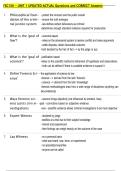
FSC100 - UNIT 1 UPDATED ACTUAL Questions and CORRECT Answers
1. Philosophical foun- - protect the innocent and the public overall
dation of the crimi- - ensure the truth emerges
nal justice system - law defines certain behaviours as criminal
-determines enough standard evidence required for prosecution
2. What is the 'goal of - outcome based
law'? - relies on the adversarial system to resolve conflict and make arguments
- settle disputes, obtain favourable outcome
-truth decided by the trier of fact --> by the judge or jury
3. What is the 'goal of -justification based
science'? -relies on the scientific method & refinement of hypothesis and observations
- truth can be defined if there is available evidence to support it
4. Define 'Forensic Sci- - the application of science to law
ence' -forensic --> derived from the latin 'forensis'
- science --> derived from the latin 'knowledge'
-forensic methodologies draw from a wide range of disciplines (anything can
be evidence)
5. Ways forensic sci- - science brings objectivity (not influenced by emotion, bias)
ence assists crim in- -past - convictions based on subjective evidence
vestigations -now - scientific evidence allows criminal investigations to be more objective
6. Expert Witness - declared by judge
- testifies at a trial due to their subject knowledge
- trained and experienced
- their findings can weigh heavily on the outcome of the case
7. Lay Witness - on a personal basis
- what was heard, saw, done, or experienced
- no specialized expertise
- anyone can be called
, 8. What are the stages - Formulate question
for the scientific - Generate a hypothesis
method? - Collect data by experimenting/observing
- Interpret data
- Draw conclusions
9. What is the dif- Crime Scene Investigation:
ference between - Attends the crime scene, goes to the scene
Crime Scene Inves- - Recognizes, identify and collect evidence at a crime scene
tigation and Foren- - Assist in the formation of a theory about the crime e.g the sequence of events
sic Science?
Forensic Science:
- Works in a forensic laboratory
- Perform scientific analysis on evidence submitted by the Crime Scene Inves-
tigator
-Does not collect data
-Unbiased advocate --> does not work for police
10. Explain the CSI Ef- - When crime fighting shows make jurors unreasonable, believe there is a lack
fect of evidence and cause a misunderstanding of forensic science
- Inaccurate depictions in media about the capabilities of CSI and forensic
science
11. Impact of the CSI ef- - Impact on the court and legal system e.g jurors, prosecution (higher rates of
fect acquittal), defence, judge
- Impact on criminal activity: the CSI effect may educate criminals to avoid being
caught
12. What year did -1248
forensic science be- -China: postmortem examination may give information about the cause of
come a new career death
field?
2/8
1. Philosophical foun- - protect the innocent and the public overall
dation of the crimi- - ensure the truth emerges
nal justice system - law defines certain behaviours as criminal
-determines enough standard evidence required for prosecution
2. What is the 'goal of - outcome based
law'? - relies on the adversarial system to resolve conflict and make arguments
- settle disputes, obtain favourable outcome
-truth decided by the trier of fact --> by the judge or jury
3. What is the 'goal of -justification based
science'? -relies on the scientific method & refinement of hypothesis and observations
- truth can be defined if there is available evidence to support it
4. Define 'Forensic Sci- - the application of science to law
ence' -forensic --> derived from the latin 'forensis'
- science --> derived from the latin 'knowledge'
-forensic methodologies draw from a wide range of disciplines (anything can
be evidence)
5. Ways forensic sci- - science brings objectivity (not influenced by emotion, bias)
ence assists crim in- -past - convictions based on subjective evidence
vestigations -now - scientific evidence allows criminal investigations to be more objective
6. Expert Witness - declared by judge
- testifies at a trial due to their subject knowledge
- trained and experienced
- their findings can weigh heavily on the outcome of the case
7. Lay Witness - on a personal basis
- what was heard, saw, done, or experienced
- no specialized expertise
- anyone can be called
, 8. What are the stages - Formulate question
for the scientific - Generate a hypothesis
method? - Collect data by experimenting/observing
- Interpret data
- Draw conclusions
9. What is the dif- Crime Scene Investigation:
ference between - Attends the crime scene, goes to the scene
Crime Scene Inves- - Recognizes, identify and collect evidence at a crime scene
tigation and Foren- - Assist in the formation of a theory about the crime e.g the sequence of events
sic Science?
Forensic Science:
- Works in a forensic laboratory
- Perform scientific analysis on evidence submitted by the Crime Scene Inves-
tigator
-Does not collect data
-Unbiased advocate --> does not work for police
10. Explain the CSI Ef- - When crime fighting shows make jurors unreasonable, believe there is a lack
fect of evidence and cause a misunderstanding of forensic science
- Inaccurate depictions in media about the capabilities of CSI and forensic
science
11. Impact of the CSI ef- - Impact on the court and legal system e.g jurors, prosecution (higher rates of
fect acquittal), defence, judge
- Impact on criminal activity: the CSI effect may educate criminals to avoid being
caught
12. What year did -1248
forensic science be- -China: postmortem examination may give information about the cause of
come a new career death
field?
2/8


