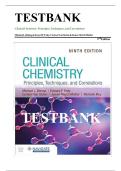
TESTBANK
Clinical Chemistry: Principles,Techniques, and Correlations
i i i i i
MichaelL. Bishop, Edward P. Fody, CarleenVan Siclen &James March Mistler
i i i i i i i i i i i i
9THEdition
TESTBANK u
,Clinical Chemistry: Principles, Techniques, and Correlations, Ninth Edition
i i i i i i i
Test bank
i
Import Settings: i
Base Settings: Brownstone Default
i i i
iInformation Field: Complexity i i
iInformation Field: Ahead i i
iInformation Field: Subject i i
iInformation Field: Title i i
Highest Answer Letter: D i i i
Multiple Keywords in Same Paragraph: No
i i i i i
NAS ISBN13: 9781284238884, add to Ahead, Title tags
i i i i i i i
Chapter: Chapter 01 – Test Bank i i i i i
Multiple Choice i
1. One nanogram is equivalent to how many grams?
i i i i i i i
A) 10-6
B) 10-9
C) 10-12
D) 10-15
Ans: B i
iComplexity:RL2 i
Ahead: Units of Measure i i i
iSubject: Chapter 1 i i
Title: Basic Principles and Practices of Clinical Chemistry
i i i i i i i
2. How many milliliters of 0.5N NaOH are required to make 100 milliliters of 0.2N NaOH?
i i i i i i i i i i i i i i
A) 250
B) 40
C) 25
D) 4
Ans: B i
iComplexity:RL2 i
Ahead: Laboratory Mathematics and Calculations
i i i i
iSubject: Chapter 1 i i
Title: Basic Principles and Practices of Clinical Chemistry
i i i i i i i
3. A patient sample for uric acid gave an absorbance reading of 0.4, and the 50 mg/dL standard gave an
i i i i i i i i i i i i i i i i i i
iabsorbance reading of 0.1. What is the concentration of uric acid in the patient's sample in grams
i i i i i i i i i i i i i i i i
iper deciliter?
i
A) 0.2
B) 12.5
C) 125
D) 200
Ans: D i
iComplexity:RL2 i
Ahead: Laboratory Mathematics and Calculations
i i i i
© Jones & Bartlett Learning, LLC, an Ascend Learning Company
i i i i i i i i i 1-1
,Clinical Chemistry: Principles, Techniques, and Correlations, Ninth Edition
i i i i i i i
Test bank
i
Subject: Chapter 1 i i
Title: Basic Principles and Practices of Clinical Chemistry
i i i i i i i
4. How many millimoles of NaCl are contained in 300 mL of a 4M solution? (gmw = 58.5)
i i i i i i i i i i i i i i i i
A) 70
B) 120
C) 234
D) 1200
Ans: D i
iComplexity:RL2 i
Ahead: Laboratory Mathematics and Calculations
i i i i
iSubject: Chapter 1 i i
Title: Basic Principles and Practices of Clinical Chemistry
i i i i i i i
5. How is 10 mg/dL of calcium reported in mmol/L? (gmw = 40)
i i i i i i i i i i i
A) 2.5
B) 5.0
C) 10
D) 25
Ans: A i
iComplexity:RL2 i
Ahead: Laboratory Mathematics and Calculations
i i i i
iSubject: Chapter 1 i i
Title: Basic Principles and Practices of Clinical Chemistry
i i i i i i i
6. How many milliliters of concentrated sulfuric acid (H2S04), G.M.W. = 98 grams, specific gravity =
i i i i i i i i i i i i i i
i1.500, purity = 80%, are needed to make 400 mL of a 2N solution?
i i i i i i i i i i i i i
A) 26.1
B) 32.7
C) 52.3
D) 65.3
Ans: B i
iComplexity:RL2 i
Ahead: Laboratory Mathematics and Calculations
i i i i
iSubject: Chapter 1 i i
Title: Basic Principles and Practices of Clinical Chemistry
i i i i i i i
7. How many grams of hydrated MgSO4 5 H20 (M.W.: MgSO4
i i i i i i i i i i i = 119, H20 = 18) are required to
i i i i i i i
imake a 10% solution of MgS04?
i i i i i
A) 5.7 g/dL i
B) 11.9 g/dL i
C) 17.6 g/dL i
D) 20.9 g/dL i
iAns: C i
iComplexity:
RL2
Ahead: Laboratory Mathematics and Calculations
i i i i
iSubject: Chapter 1 i i
Title: Basic Principles and Practices of Clinical Chemistry
i i i i i i i
© Jones & Bartlett Learning, LLC, an Ascend Learning Company
i i i i i i i i i 1-2
, Clinical Chemistry: Principles, Techniques, and Correlations, Ninth Edition
i i i i i i i
Test bank i
8. What is the molarity (M) of a 4% solution of sodium hydroxide (NaOH)? M.W: Na = 23, O = 16, H = 1.
i i i i i i i i i i i i i i i i i i i i i i
A) 0.1M
B) 0.25M
C) 1.0M
D) 2.5M
Ans: C i
iComplexity:RL2 i
Ahead: Laboratory Mathematics and Calculations
i i i i
iSubject: Chapter 1 i i
Title: Basic Principles and Practices of Clinical Chemistry
i i i i i i i
9. 3 mg/dL is equivalent to how many grams per liter?
i i i i i i i i i
A) 0.003
B) 0.03
C) 0.3
D) 3
Ans: B i
iComplexity:RL2 i
Ahead: Units of Measure i i i
iSubject: Chapter 1 i i
Title: Basic Principles and Practices of Clinical Chemistry
i i i i i i i
10. What is the normality of a solution containing 4.5 grams of BaCl2 in 400 mL? (gmw = 208)
i i i i i i i i i i i i i i i i i
A) 1.10
B) 0.50
C) 0.25
D) 0.11
Ans: D i
iComplexity:RL2 i
Ahead: Laboratory Mathematics and Calculations
i i i i
iSubject: Chapter 1 i i
Title: Basic Principles and Practices of Clinical Chemistry
i i i i i i i
11. What are the optimal conditions for specimen transport, handling, and storage of specimens
i i i i i i i i i i i i
ifor clinical chemistry testing?
i i i
A) Specimen transported to lab within 2 hours after collection, stored at room temperature,
i i i i i i i i i i i i
iand centrifuged within 4 hours.
i i i i
B) Specimen transported to lab immediately, permitted to clot, serum separated and tested as soon as
i i i i i i i i i i i i i i
ipossible.
C) Specimen brought to lab immediately, spun down, and serum left to stand on clot until tested.
i i i i i i i i i i i i i i i
D) None of these represent optimal conditions.
i i i i i
iAns: B i
Complexity: RL1 i
Ahead: Specimen Collection and Handling Subject:
i i i i i
iChapter 1 i
Title: Basic Principles and Practices of Clinical Chemistry
i i i i i i i
© Jones & Bartlett Learning, LLC, an Ascend Learning Company
i i i i i i i i i 1-3
Clinical Chemistry: Principles,Techniques, and Correlations
i i i i i
MichaelL. Bishop, Edward P. Fody, CarleenVan Siclen &James March Mistler
i i i i i i i i i i i i
9THEdition
TESTBANK u
,Clinical Chemistry: Principles, Techniques, and Correlations, Ninth Edition
i i i i i i i
Test bank
i
Import Settings: i
Base Settings: Brownstone Default
i i i
iInformation Field: Complexity i i
iInformation Field: Ahead i i
iInformation Field: Subject i i
iInformation Field: Title i i
Highest Answer Letter: D i i i
Multiple Keywords in Same Paragraph: No
i i i i i
NAS ISBN13: 9781284238884, add to Ahead, Title tags
i i i i i i i
Chapter: Chapter 01 – Test Bank i i i i i
Multiple Choice i
1. One nanogram is equivalent to how many grams?
i i i i i i i
A) 10-6
B) 10-9
C) 10-12
D) 10-15
Ans: B i
iComplexity:RL2 i
Ahead: Units of Measure i i i
iSubject: Chapter 1 i i
Title: Basic Principles and Practices of Clinical Chemistry
i i i i i i i
2. How many milliliters of 0.5N NaOH are required to make 100 milliliters of 0.2N NaOH?
i i i i i i i i i i i i i i
A) 250
B) 40
C) 25
D) 4
Ans: B i
iComplexity:RL2 i
Ahead: Laboratory Mathematics and Calculations
i i i i
iSubject: Chapter 1 i i
Title: Basic Principles and Practices of Clinical Chemistry
i i i i i i i
3. A patient sample for uric acid gave an absorbance reading of 0.4, and the 50 mg/dL standard gave an
i i i i i i i i i i i i i i i i i i
iabsorbance reading of 0.1. What is the concentration of uric acid in the patient's sample in grams
i i i i i i i i i i i i i i i i
iper deciliter?
i
A) 0.2
B) 12.5
C) 125
D) 200
Ans: D i
iComplexity:RL2 i
Ahead: Laboratory Mathematics and Calculations
i i i i
© Jones & Bartlett Learning, LLC, an Ascend Learning Company
i i i i i i i i i 1-1
,Clinical Chemistry: Principles, Techniques, and Correlations, Ninth Edition
i i i i i i i
Test bank
i
Subject: Chapter 1 i i
Title: Basic Principles and Practices of Clinical Chemistry
i i i i i i i
4. How many millimoles of NaCl are contained in 300 mL of a 4M solution? (gmw = 58.5)
i i i i i i i i i i i i i i i i
A) 70
B) 120
C) 234
D) 1200
Ans: D i
iComplexity:RL2 i
Ahead: Laboratory Mathematics and Calculations
i i i i
iSubject: Chapter 1 i i
Title: Basic Principles and Practices of Clinical Chemistry
i i i i i i i
5. How is 10 mg/dL of calcium reported in mmol/L? (gmw = 40)
i i i i i i i i i i i
A) 2.5
B) 5.0
C) 10
D) 25
Ans: A i
iComplexity:RL2 i
Ahead: Laboratory Mathematics and Calculations
i i i i
iSubject: Chapter 1 i i
Title: Basic Principles and Practices of Clinical Chemistry
i i i i i i i
6. How many milliliters of concentrated sulfuric acid (H2S04), G.M.W. = 98 grams, specific gravity =
i i i i i i i i i i i i i i
i1.500, purity = 80%, are needed to make 400 mL of a 2N solution?
i i i i i i i i i i i i i
A) 26.1
B) 32.7
C) 52.3
D) 65.3
Ans: B i
iComplexity:RL2 i
Ahead: Laboratory Mathematics and Calculations
i i i i
iSubject: Chapter 1 i i
Title: Basic Principles and Practices of Clinical Chemistry
i i i i i i i
7. How many grams of hydrated MgSO4 5 H20 (M.W.: MgSO4
i i i i i i i i i i i = 119, H20 = 18) are required to
i i i i i i i
imake a 10% solution of MgS04?
i i i i i
A) 5.7 g/dL i
B) 11.9 g/dL i
C) 17.6 g/dL i
D) 20.9 g/dL i
iAns: C i
iComplexity:
RL2
Ahead: Laboratory Mathematics and Calculations
i i i i
iSubject: Chapter 1 i i
Title: Basic Principles and Practices of Clinical Chemistry
i i i i i i i
© Jones & Bartlett Learning, LLC, an Ascend Learning Company
i i i i i i i i i 1-2
, Clinical Chemistry: Principles, Techniques, and Correlations, Ninth Edition
i i i i i i i
Test bank i
8. What is the molarity (M) of a 4% solution of sodium hydroxide (NaOH)? M.W: Na = 23, O = 16, H = 1.
i i i i i i i i i i i i i i i i i i i i i i
A) 0.1M
B) 0.25M
C) 1.0M
D) 2.5M
Ans: C i
iComplexity:RL2 i
Ahead: Laboratory Mathematics and Calculations
i i i i
iSubject: Chapter 1 i i
Title: Basic Principles and Practices of Clinical Chemistry
i i i i i i i
9. 3 mg/dL is equivalent to how many grams per liter?
i i i i i i i i i
A) 0.003
B) 0.03
C) 0.3
D) 3
Ans: B i
iComplexity:RL2 i
Ahead: Units of Measure i i i
iSubject: Chapter 1 i i
Title: Basic Principles and Practices of Clinical Chemistry
i i i i i i i
10. What is the normality of a solution containing 4.5 grams of BaCl2 in 400 mL? (gmw = 208)
i i i i i i i i i i i i i i i i i
A) 1.10
B) 0.50
C) 0.25
D) 0.11
Ans: D i
iComplexity:RL2 i
Ahead: Laboratory Mathematics and Calculations
i i i i
iSubject: Chapter 1 i i
Title: Basic Principles and Practices of Clinical Chemistry
i i i i i i i
11. What are the optimal conditions for specimen transport, handling, and storage of specimens
i i i i i i i i i i i i
ifor clinical chemistry testing?
i i i
A) Specimen transported to lab within 2 hours after collection, stored at room temperature,
i i i i i i i i i i i i
iand centrifuged within 4 hours.
i i i i
B) Specimen transported to lab immediately, permitted to clot, serum separated and tested as soon as
i i i i i i i i i i i i i i
ipossible.
C) Specimen brought to lab immediately, spun down, and serum left to stand on clot until tested.
i i i i i i i i i i i i i i i
D) None of these represent optimal conditions.
i i i i i
iAns: B i
Complexity: RL1 i
Ahead: Specimen Collection and Handling Subject:
i i i i i
iChapter 1 i
Title: Basic Principles and Practices of Clinical Chemistry
i i i i i i i
© Jones & Bartlett Learning, LLC, an Ascend Learning Company
i i i i i i i i i 1-3