

Written by students who passed Immediately available after payment Read online or as PDF Wrong document? Swap it for free 4.6 TrustPilot
logo-home
Document preview thumbnail
Preview 2 out of 12 pages
Exam (elaborations)

NSG 3280 Exam 2025

Document preview thumbnail
Preview 2 out of 12 pages

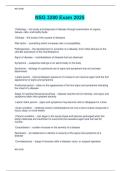
NSG 3280 Exam 2025 Pathology - -the study and diagnosis of disease through examination of organs, tissues, cells, and bodily fluids. Etiology - -the study of the causes of diseases Risk factor - -something which increases risk or susceptibility. Pathogenesis - -the development or evolution of a disease, from initial stimulus to the ultimate expression of the manifestations Signs of disease - -manifestations of disease that are observed Symptoms - -subjective feelings of an abnormality in the body Syndrome - -etiology of a particular set of signs and symptoms has not yet been determined Latent period - -interval between exposure of a tissue to an injurious agent and the first appearance of signs and symptoms Prodromal period - -refers to the appearance of the first signs and symptoms indicating the onset of a disease Stage of manifest illness/acute phase - -disease reaches its full intensity, and signs and symptoms attain their greatest severity Latent/ silent period - -signs and symptoms may become mild or disappear for a time Acute condition - -relatively severe manifestations but runs a short coarse measured in hours, days, or a few weeks Chronic condition - -can begin in the acute phase and become prolonged when the body's defenses are insufficient to overcome the causative agent and can last for months Exacerbation - -sudden increase in the severity of a disease Remission - -an abatement or decline in severity of the signs and symptoms of a disease Convalescence - -stage of recovery after a disease, injury, or surgical operation NSG 3280 NSG 3280 Sequela (sequelae) - -subsequent pathologic condition produced by a disease Validity/accuracy - -the degree to which a measurement reflects the true value of the object it is intended to measure Reliability/precision - -the ability of a test to give the same result in repeated measurements Predictive value - -the extent to which a test can differentiate between the presence or absence of a condition in an individual Positive predictive value - -estimate of the probability that disease is present if the test is positive Negative predictive value - -an estimate of the probability that disease is absent if the test is negative Sensitivity - -probability that a test will be positive when applied to a person with the condition Specificity - -probability that a test will be negative when applied to a person who does not have a given condition Influencers of physiologic parameters? - -age, gender, genetic and ethnic background, geographic area, and time of day Acclimatization - -a normal adaptive response Epidemiology - -study of patterns of a disease Endemic disease - -disease that is native to a local region (a town or county) Epidemic - -disease is disseminated to many people at the same time (a country) Pandemic - -disease that spreads widely across a large area (the world) Principal factors affecting patterns of disease in human populations? - -age, ethnic group, gender, socioeconomic factors and lifestyle considerations, and geographic location Developmental process - -changes in function that occur during the early years of life Homeostasis - -maintaining internal conditions in a stable state by keeping parameters relatively the same/ the state of being in which all systems are in balance around a fairly narrow ideal "set point" NSG 3280 Allostasis - -ability to successfully adapt to changes Stress - -physical, chemical, or emotional factor that produces tension in the body or mind Stressor - -anything that throws the body out of allostatic balance General adaptation syndrome (gas) - -alarm reaction, stage of existence, stage of exhaustion Alarm - -fight or flight response Idiopathic - -unknown cause Eitology - -cause of disease Iatrogenic - -result of an unintended or unwanted medical treatment Pathogenesis - -development of disease from initial stimulation Symptoms are - -subjective characteristics of a disease that only the patient can feel Incubation period/ latent - -interval between initial infection and first signs and symptoms Prodomal phase - -time of mild signs or symptoms indicating onset of disease Manifest phase - -the disease reaches its full intensity, and signs and symptoms attain their greatest severity Convalescence - -gradual recovery after an illness Signs - -observed and objective manifestations Symptoms - -subjective feelings from patient Syndrome - -s/s that has not been identified Exacerbation - -a sudden increase in severity of disease or signs or symptoms Remission - -improvement or absence of signs of disease Subclinical - -stage of a disease or disorder not severe enough to produce symptoms that can be detected or diagnosed. Sequela - -subsequent pathologic condition resulting from an acute illness NSG 3280 NSG 3280 NSG 3280 Endemic disease - -local region or native disease Epidemic disease - -disease acquired by many hosts in a given area in a short time Pandemic disease - -worldwide epidemic Secondary prevention - -efforts to limit the effects of an injury or illness that you cannot completely prevent. Colonoscopies, treating for obesity, high bp but being treated for it, Primary prevention - -efforts to prevent an injury or illness from ever occurring. Vaccinations Tertiary prevention - -actions taken to contain damage once a disease or disability has progressed beyond its early stages. Therapies Homeostasis - -a tendency to maintain a balanced or constant internal state; the regulation of any aspect of body chemistry, such as blood glucose, around a particular level Allostasis - -process by which the body achieves stability through physiological change Gas stages of stress - --alarm -resistance -exhaustion Alarm stage of gas - -organism recognizes stress, begins to respond. Fight or flight and sympathetic nervous system engages Epinephrine and norepinephrine Resistance stage of gas - -second stage; Body functions normalize while responding to the stressor. The body attempts to cope with the stressor Normalization/resolution of glucocorticoid secretion, fight or flight, and secretions and epinephrine and norepinephrine. Exhaustion stage of gas - -third stage; If the client reaches this stage, body functions are no longer able to maintain an adaptive response to the stressor Increased glucocorticoid secretions followed by dysregulation Allostatic overload Epinephrine - -enhances myocardialcontractility, increases heartrate, and increases cardiacoutput ▪causes bronchodilation NSG 3280 NSG 3280 ▪ increases the release ofglucose from the liver(glycogenolysis) andelevates blood glucoselevels Norepinephrine - -▪ constricts blood vessels andraises blood pressure ▪ reduces gastric secretions ▪increases night and farvision (pupil dilation) Cortisol - -▪ primary glucocorticoid ▪ affects protein metabolism ▪ promotes appetite ▪ has anti-inflammatoryeffects ▪ too much cortisol over timecan lead to pro-inflammatory effects Aldosterone - -▪ primary mineralocorticoid ▪ promotes reabsorption ofsodium and water ▪ increases blood pressure Endorphins and enkephalins - -•endogenous opioids (body's natural pain relievers) •raise pain threshold •produce sedation and euphoria Immune cytokines - -•secreted by macrophages during stress response •enhance immune system response •prolonged stress can suppress immune functioning. Sex hormones - -• affect stress responses, thus influencing allostasis • may help explain gender responses during stress • examples estrogen, testosterone, and dehydroepiandrosterone (dhea) Adaptation - -biopsychosocial process of adjusting physiology, morphology, and behavior in response to new or altered circumstances, internal and external in origin, in the physical and social environment Adaptation and resilience have been ________ with allostasis - -intertwined Maladaptation - -ineffective, inadequate, or inappropriate change in response to new or altered circumstances Ways allostatic loads can accumulate - - (1) repeated exposures to multiple stressors, (2) inability to habituate or adapt to the stressor, (3) unnecessarily prolonged stress response or stress response that continues after the stressor is removed, and (4) inadequate response to the stressor that causes other stress response mediators to attempt to compensate. Homeostasis, the steady-state that previously existed, cannot be attained NSG 3280 NSG 3280 Elevated cortisol levels - -are connected with depressive illnesses and immune suppression Aldosterone does not raise - -glucose levels while stress induced Hydronic swelling - -cellular swelling due to accumulation of water First manifestation of most forms of reversible cell injury Results from malfunction of sodium-potassium pump with accumulation of sodium ions within the cell Na does not leave cell, causing water to flow into cell Characteristics of hydronic swelling - -large, pale cytoplasm Dilated endoplasmic reticulum Swollen mitochondria Intracellular accumulation - -excess accumulation of substances in cells which leads to cell injury b/c of toxicity, immune response, tak

Content preview

NSG 3280


NSG 3280 Exam 2025

Pathology - -the study and diagnosis of disease through examination of organs,
tissues, cells, and bodily fluids.

Etiology - -the study of the causes of diseases

Risk factor - -something which increases risk or susceptibility.

Pathogenesis - -the development or evolution of a disease, from initial stimulus to the
ultimate expression of the manifestations

Signs of disease - -manifestations of disease that are observed

Symptoms - -subjective feelings of an abnormality in the body

Syndrome - -etiology of a particular set of signs and symptoms has not yet been
determined

Latent period - -interval between exposure of a tissue to an injurious agent and the first
appearance of signs and symptoms

Prodromal period - -refers to the appearance of the first signs and symptoms indicating
the onset of a disease

Stage of manifest illness/acute phase - -disease reaches its full intensity, and signs and
symptoms attain their greatest severity

Latent/ silent period - -signs and symptoms may become mild or disappear for a time

Acute condition - -relatively severe manifestations but runs a short coarse measured in
hours, days, or a few weeks

Chronic condition - -can begin in the acute phase and become prolonged when the
body's defenses are insufficient to overcome the causative agent and can last for
months

Exacerbation - -sudden increase in the severity of a disease

Remission - -an abatement or decline in severity of the signs and symptoms of a
disease

Convalescence - -stage of recovery after a disease, injury, or surgical operation


NSG 3280

, NSG 3280


Sequela (sequelae) - -subsequent pathologic condition produced by a disease

Validity/accuracy - -the degree to which a measurement reflects the true value of the
object it is intended to measure

Reliability/precision - -the ability of a test to give the same result in repeated
measurements

Predictive value - -the extent to which a test can differentiate between the presence or
absence of a condition in an individual

Positive predictive value - -estimate of the probability that disease is present if the test
is positive

Negative predictive value - -an estimate of the probability that disease is absent if the
test is negative

Sensitivity - -probability that a test will be positive when applied to a person with the
condition

Specificity - -probability that a test will be negative when applied to a person who does
not have a given condition

Influencers of physiologic parameters? - -age, gender, genetic and ethnic background,
geographic area, and time of day

Acclimatization - -a normal adaptive response

Epidemiology - -study of patterns of a disease

Endemic disease - -disease that is native to a local region (a town or county)

Epidemic - -disease is disseminated to many people at the same time (a country)

Pandemic - -disease that spreads widely across a large area (the world)

Principal factors affecting patterns of disease in human populations? - -age, ethnic
group, gender, socioeconomic factors and lifestyle considerations, and geographic
location

Developmental process - -changes in function that occur during the early years of life

Homeostasis - -maintaining internal conditions in a stable state by keeping parameters
relatively the same/ the state of being in which all systems are in balance around a fairly
narrow ideal "set point"


NSG 3280

Document information

Uploaded on
September 30, 2025
Number of pages
12
Written in
2025/2026
Type
Exam (elaborations)
Contains
Questions & answers
$24.69

Wrong document? Swap it for free Within 14 days of purchase and before downloading, you can choose a different document. You can simply spend the amount again.
Written by students who passed
Immediately available after payment
Read online or as PDF

Seller avatar
Reputation scores are based on the amount of documents a seller has sold for a fee and the reviews they have received for those documents. There are three levels: Bronze, Silver and Gold. The better the reputation, the more your can rely on the quality of the sellers work.
AlexScorer
2.5
(2)
Sold
11
Followers
0
Items
1800
Last sold
2 weeks ago


Why students choose Stuvia

Created by fellow students, verified by reviews

Quality you can trust: written by students who passed their tests and reviewed by others who've used these notes.

Didn't get what you expected? Choose another document

No worries! You can instantly pick a different document that better fits what you're looking for.

Pay as you like, start learning right away

No subscription, no commitments. Pay the way you're used to via credit card and download your PDF document instantly.

Student with book image

“Bought, downloaded, and aced it. It really can be that simple.”

Alisha Student

Working on your references?

Create accurate citations in APA, MLA and Harvard with our free citation generator.

Working on your references?

Frequently asked questions
