
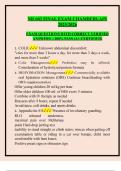
Nr 602 Final Exam Chamberlain 2025/2026 Exam Questions With Correct Verified Answers | 100% Pass (A+ Certified)
NR 602 FINAL EXAM CHAMBERLAIN 2025/2026 EXAM QUESTIONS WITH CORRECT VERIFIED ANSWERS | 100% PASS (A+ CERTIFIED) 1. COLIC Unknown abdominal discomfort; "cries for more than 3 hours a day, for more than 3 days a week, and more than 3 weeks" 2. Colic Management Probiotics may be offered; Consideration of hydrolyzed protein formula 3. DEHYDRATION Management Commercially available oral hydration solutions (ORS) Continue breastfeeding with ORS supplementation Offer young children 20 ml/kg per hour Offer older children 100 mL of ORS every 5 minutes Combine with IV therapy as needed Reassess after 4 hours; repeat if needed Avoid juice, soft drinks, and sports drinks 4. Appendicitis S/S Presence of involuntary guarding, RLQ rebound tenderness, maximal pain over McBurney point Heel-drop jarring test inability to stand straight or climb stairs; winces when getting off examination table or riding in a car over bumps; child most comfortable with bent knees. Positive psoas sign or obturator sign Rovsing sign or rebound tenderness strongly suggests peritoneal irritation. Tenderness and possibly a mass (abscess) on the right side on rectal examination. 5. McBurney point/sign Pain w/ palpation and release; Rebound tenderness is most reliable. 1.5 to 2 inches in from the right anterior superior iliac crest (on a line toward the umbilicus) on abdominal examination (most reliable finding 6. positive psoas sign retract R thigh while on left side; illicit pain consistent with appendicitis 7. Positive Rovsing Sign Pain RLQ w/ pressure and release of LLQ; R/O appendicitis 8. Positive Obturator Sign Supine; bend R leg and rotate inward; illicit pain in RLQ 9. Intusscuception Anterograde intestine into proximal bowel; Most common cause of for Pediatric GI obstruction 10. S/S of intussusception S/S of intussuception intermittent abdominal pain currant jelly stools Dance Sign (sausage like mass) 11. Management of Intussusception Therapeutic Air Contrast Enema under fluoroscopy 12. Failure to Thrive (FTT) The most common cause is nutritional deficiency without an underlying medical condition (greater than 80%). 13. Asymptomatic bacteriuria bacteria in the urine without
Document information
- Uploaded on
- September 29, 2025
- Number of pages
- 14
- Written in
- 2025/2026
- Type
- Exam (elaborations)
- Contains
- Questions & answers


