Robbins & Cotran 10th Ed. Pathology Test Bank | Chapter-
by-Chapter Questions & Verified Solutions
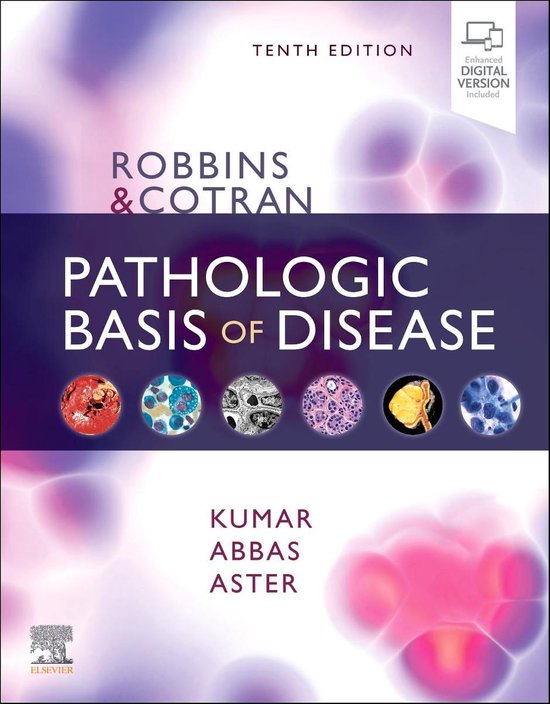
Robbins & Cotran Pathologic Basis of Disease
10th Edition
• Author(s)Vinay Kumar; Abul K. Abbas; Jon C. Aster
Chapter 1: The Cell as a Unit of Health and Disease
The Genome
1. Chapter 1: The Genome
A 6-year-old boy presents with recurrent infections and failure
to thrive. Genetic testing reveals a frameshift mutation in a DNA
repair gene critical for non-homologous end joining. Which
cellular consequence most directly results from this specific
defect in DNA double-strand break repair?
A. Increased point mutations due to defective mismatch repair
B. Chromosomal translocations and genome instability
C. Accumulation of single-stranded DNA nicks leading to
progeria
D. Impaired base excision repair causing uracil incorporation
Correct Answer: B
Rationale: Defective non-homologous end joining directly
,impairs the repair of DNA double-strand breaks, leading to the
misjoining of DNA ends from different chromosomes. This
misjoining causes chromosomal translocations and large-scale
genomic instability, which predisposes cells to malignant
transformation .
• A: Mismatch repair defects cause microsatellite instability
but are not primarily responsible for double-strand break-
associated translocations.
• C: Single-stranded nicks are repaired by different
mechanisms; progeria is more commonly linked to nuclear
lamina defects.
• D: Base excision repair handles small, specific base lesions
(e.g., uracil), not double-strand breaks.
Teaching Point: Defects in double-strand break repair
pathways cause chromosomal instability.
2. Chapter 1: The Genome
A research scientist is studying gene regulation. She observes
that a specific histone modification (acetylation) is associated
with an activated gene state in a cell culture model. What is the
primary mechanism by which histone acetylation influences
gene expression?
A. It directly methylates DNA nucleotides, silencing the gene.
B. It adds negative charges, reducing the affinity between
histones and DNA.
C. It promotes the degradation of messenger RNA before
translation.
D. It causes double-strand breaks that are repaired error-prone.
,Correct Answer: B
Rationale: Histone acetylation adds acetyl groups to lysine
residues, which neutralizes their positive charge. This reduces
the electrostatic attraction between the positively charged
histones and the negatively charged DNA backbone, resulting in
a looser chromatin structure that is more accessible for
transcription .
• A: DNA methylation, not histone acetylation, directly
silences genes by modifying DNA nucleotides.
• C: Histone modifications affect transcription, not mRNA
degradation.
• D: This describes a consequence of DNA repair failure, not
a mechanism of histone modification.
Teaching Point: Histone acetylation promotes gene
expression by relaxing chromatin structure.
Cellular Housekeeping
3. Chapter 1: Cellular Housekeeping
A pathologist examines a tissue sample from a patient after a
prolonged period of nutrient deprivation and notes cells with
abundant autophagic vacuoles. Which intracellular process is
primarily responsible for delivering cytoplasmic organelles to
lysosomes during starvation?
A. Ubiquitin-proteasome system
B. Macroautophagy (autophagosome formation)
C. Endocytosis via clathrin-coated pits
D. Chaperone-mediated proteolysis
Correct Answer: B
, Rationale: Macroautophagy is a survival mechanism activated
during nutrient stress. It involves the formation of double-
membrane vesicles (autophagosomes) that engulf damaged
organelles and bulk cytoplasm, which then fuse with lysosomes
for degradation and recycling of components .
• A: The ubiquitin-proteasome system degrades individual,
tagged proteins but not entire organelles.
• C: Endocytosis internalizes extracellular materials and
membrane receptors.
• D: Chaperone-mediated autophagy translocates specific
soluble proteins, not organelles, into lysosomes.
Teaching Point: Macroautophagy is a bulk degradation
pathway for organelles during stress.
4. Chapter 1: Cellular Housekeeping
A patient with a neurodegenerative disease has an accumulation
of misfolded proteins in neurons. Which cellular system is
primarily responsible for the degradation of soluble, misfolded
proteins that are tagged with ubiquitin?
A. Lysosomal autophagy
B. Proteasome complex
C. Mitochondrial protease system
D. Calpain-mediated cytosolic degradation
Correct Answer: B
Rationale: The ubiquitin-proteasome pathway is the primary
mechanism for degrading short-lived and abnormal soluble
proteins. Ubiquitin tagging targets these proteins to the
by-Chapter Questions & Verified Solutions
Robbins & Cotran Pathologic Basis of Disease
10th Edition
• Author(s)Vinay Kumar; Abul K. Abbas; Jon C. Aster
Chapter 1: The Cell as a Unit of Health and Disease
The Genome
1. Chapter 1: The Genome
A 6-year-old boy presents with recurrent infections and failure
to thrive. Genetic testing reveals a frameshift mutation in a DNA
repair gene critical for non-homologous end joining. Which
cellular consequence most directly results from this specific
defect in DNA double-strand break repair?
A. Increased point mutations due to defective mismatch repair
B. Chromosomal translocations and genome instability
C. Accumulation of single-stranded DNA nicks leading to
progeria
D. Impaired base excision repair causing uracil incorporation
Correct Answer: B
Rationale: Defective non-homologous end joining directly
,impairs the repair of DNA double-strand breaks, leading to the
misjoining of DNA ends from different chromosomes. This
misjoining causes chromosomal translocations and large-scale
genomic instability, which predisposes cells to malignant
transformation .
• A: Mismatch repair defects cause microsatellite instability
but are not primarily responsible for double-strand break-
associated translocations.
• C: Single-stranded nicks are repaired by different
mechanisms; progeria is more commonly linked to nuclear
lamina defects.
• D: Base excision repair handles small, specific base lesions
(e.g., uracil), not double-strand breaks.
Teaching Point: Defects in double-strand break repair
pathways cause chromosomal instability.
2. Chapter 1: The Genome
A research scientist is studying gene regulation. She observes
that a specific histone modification (acetylation) is associated
with an activated gene state in a cell culture model. What is the
primary mechanism by which histone acetylation influences
gene expression?
A. It directly methylates DNA nucleotides, silencing the gene.
B. It adds negative charges, reducing the affinity between
histones and DNA.
C. It promotes the degradation of messenger RNA before
translation.
D. It causes double-strand breaks that are repaired error-prone.
,Correct Answer: B
Rationale: Histone acetylation adds acetyl groups to lysine
residues, which neutralizes their positive charge. This reduces
the electrostatic attraction between the positively charged
histones and the negatively charged DNA backbone, resulting in
a looser chromatin structure that is more accessible for
transcription .
• A: DNA methylation, not histone acetylation, directly
silences genes by modifying DNA nucleotides.
• C: Histone modifications affect transcription, not mRNA
degradation.
• D: This describes a consequence of DNA repair failure, not
a mechanism of histone modification.
Teaching Point: Histone acetylation promotes gene
expression by relaxing chromatin structure.
Cellular Housekeeping
3. Chapter 1: Cellular Housekeeping
A pathologist examines a tissue sample from a patient after a
prolonged period of nutrient deprivation and notes cells with
abundant autophagic vacuoles. Which intracellular process is
primarily responsible for delivering cytoplasmic organelles to
lysosomes during starvation?
A. Ubiquitin-proteasome system
B. Macroautophagy (autophagosome formation)
C. Endocytosis via clathrin-coated pits
D. Chaperone-mediated proteolysis
Correct Answer: B
, Rationale: Macroautophagy is a survival mechanism activated
during nutrient stress. It involves the formation of double-
membrane vesicles (autophagosomes) that engulf damaged
organelles and bulk cytoplasm, which then fuse with lysosomes
for degradation and recycling of components .
• A: The ubiquitin-proteasome system degrades individual,
tagged proteins but not entire organelles.
• C: Endocytosis internalizes extracellular materials and
membrane receptors.
• D: Chaperone-mediated autophagy translocates specific
soluble proteins, not organelles, into lysosomes.
Teaching Point: Macroautophagy is a bulk degradation
pathway for organelles during stress.
4. Chapter 1: Cellular Housekeeping
A patient with a neurodegenerative disease has an accumulation
of misfolded proteins in neurons. Which cellular system is
primarily responsible for the degradation of soluble, misfolded
proteins that are tagged with ubiquitin?
A. Lysosomal autophagy
B. Proteasome complex
C. Mitochondrial protease system
D. Calpain-mediated cytosolic degradation
Correct Answer: B
Rationale: The ubiquitin-proteasome pathway is the primary
mechanism for degrading short-lived and abnormal soluble
proteins. Ubiquitin tagging targets these proteins to the