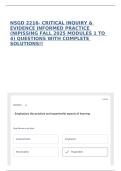
NSGD 2216- CRITICAL INQUIRY &
EVIDENCE INFORMED PRACTICE
(NIPISSING FALL 2025 MODULES 1 TO
4) QUESTIONS WITH COMPLETE
SOLUTIONS!!
1 of 84
Definition
- Emphasizes the practical and experiential aspects of learning
Give this one a try later!
Constructivism Empiricism
Structuralism Pragmatism
, Don't know?
2 of 84
Definition
- Inaccurate or incorrect information that is spread unintentionally
- Often due to lack of data or inaccurate data, lack of knowledge or
a failure to notice or do something, such as checking the reliability
or validity of information
Give this one a try later!
Misinformation Information Literacy
Literacy Ontology
Don't know?
,3 of 84
Term
In the information literacy process, information found in a
search must be evaluated to see if:
A. It answered the questions, it is from a reliable source, or if it is
biased
B.It is what the patient wanted to hear
C. It is from recent published articles
D.It is the most common opinion about the topic
Give this one a try later!
A. Do the authors and/or sponsors make their intentions clear?
because understanding the purpose behind the creation of the information is
crucial for evaluating its reliability. The modules emphasize that critical
inquiry involves questioning assumptions and understanding the broader
context in which information is created, including the motives of the authors
or sponsors.
Other options, like identifying the source or relevance of the information, are
important steps in the evaluation process, but they do not specifically
address the purpose behind the information's existence.
A. the ability to find reliable information
Information Literacy encompasses a set of abilities requiring individuals to
"recognize when information is needed and have the ability to locate, evaluate,
and use effectively the needed information." This definition from the American
Library Association highlights that it's not just about finding information but also
about evaluating its reliability and using it effectively. However, among the
options provided, the ability to find reliable information comes closest to
capturing the essence of information literacy by focusing on the ability to find
reliable information, which is a critical first step in the process.
, C. Identifying the need for information
The first step in the information literacy process involves recognizing the need
for information, which sets the foundation for subsequent steps like finding,
evaluating, and applying information.
SCONUL The Seven Pillars Model:
Identify
Scope
Plan
Gather
Evaluate
Manage
Present
Big Six Information Literacy Model: Integrates information search and uses skills
and technology tools systematically to FIND, USE, APPLY, and EVALUATE
information for specific needs and tasks
Information literacy encompasses diverse skills that enable individuals to
effectively locate, evaluate, and utilize information to address information
needs and solve problems. These skills include critically assessing the credibility
and
reliability of sources, navigating information landscapes, and synthesizing
information from multiple sources to inform judgements and decisions
A. It answered the questions, it is from a reliable source, or if it is biased
Answering the Questions: Information must be relevant to the inquiry or
need at hand. If it doesn't address the questions or issues you're
researching, it's not useful.
Reliable Source: Evaluating the source's credibility is crucial. Reliable
sources are more likely to provide accurate and trustworthy information.
Bias: Understanding if the information is biased helps in assessing its
objectivity and whether it presents a balanced view or is skewed towards a
particular perspective.
Don't know?