Robbins & Cotran 10th Ed. Pathology Test Bank | Chapter-
by-Chapter Questions & Verified Solutions
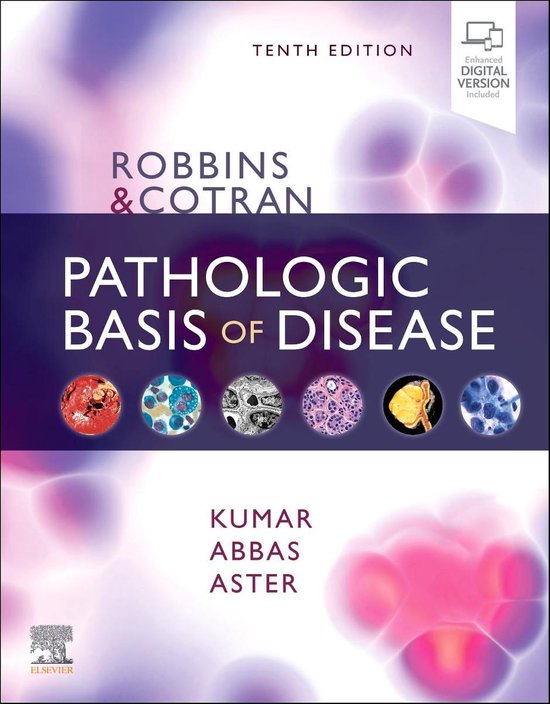
Robbins & Cotran Pathologic Basis of Disease
10th Edition
• Author(s)Vinay Kumar; Abul K. Abbas; Jon C. Aster
Chapter 1 — The Genome
Question: A newborn has features of a metabolic disorder
caused by a single-base mutation that substitutes one amino
acid for another in a critical enzyme. Which molecular change
best describes this mutation type?
A. Nonsense mutation
B. Missense mutation
C. Frameshift mutation
D. Silent mutation
Correct Answer: B
Rationales:
• Correct (B): A missense mutation replaces one codon so
that a different amino acid is incorporated; clinically this
, often produces a dysfunctional but full-length enzyme,
matching the scenario. (Robbins Ch.1, The Genome).
• A: A nonsense mutation creates a premature stop codon
leading to truncated proteins, not a single amino-acid
substitution.
• C: Frameshift mutations from insertions/deletions shift the
reading frame and dramatically alter downstream
sequence, not a single amino-acid change.
• D: Silent mutations change the DNA codon without
altering the amino acid and would not change the
enzyme’s primary sequence.
Teaching Point: Missense mutations change one amino acid
and can impair protein function.
Citation: Robbins & Cotran Pathologic Basis of Disease, 10th
Ed., Chapter 1 — The Genome.
2) Chapter 1 — The Genome
Question: A patient’s tumor is found to have a mutation that
increases telomerase activity in cancer cells. Which cellular
consequence most directly supports tumor cell immortality?
A. Increased DNA repair fidelity
B. Maintenance of telomere length
C. Enhanced mitochondrial oxidative phosphorylation
D. Increased histone acetylation
,Correct Answer: B
Rationales:
• Correct (B): Telomerase maintains telomere length,
preventing replicative senescence and allowing unlimited
cell divisions — a hallmark of cancer. (Robbins Ch.1, The
Genome).
• A: Increased DNA repair fidelity would limit mutations and
is not associated with immortalization.
• C: Mitochondrial changes affect metabolism but are not
the primary mechanism for replicative immortality.
• D: Histone acetylation alters chromatin and gene
expression but does not directly maintain telomere length.
Teaching Point: Telomerase activity preserves telomeres and
enables replicative immortality.
Citation: Robbins & Cotran Pathologic Basis of Disease, 10th
Ed., Chapter 1 — The Genome.
3) Chapter 1 — Cellular Housekeeping
Question: A patient with a lysosomal storage disorder
accumulates undegraded substrates within cells. Which cellular
process is primarily defective?
A. Proteasomal degradation of ubiquitinated proteins
B. Autophagy delivering cytoplasmic content to lysosomes
, C. Fusion of endocytic vesicles with lysosomes
D. Lysosomal hydrolase activity
Correct Answer: D
Rationales:
• Correct (D): Lysosomal storage diseases result from
deficient lysosomal hydrolases, causing substrate
accumulation within lysosomes. (Robbins Ch.1, Cellular
Housekeeping).
• A: Proteasomal degradation is a separate pathway for
short-lived or ubiquitinated proteins, not classical
lysosomal substrate accumulation.
• B: Autophagy delivers material to lysosomes; while
involved, the primary defect in storage disorders is
hydrolase activity, not delivery.
• C: Failure of vesicle–lysosome fusion would impair
degradation, but most inherited storage disorders are due
to enzyme deficiency rather than fusion defects.
Teaching Point: Lysosomal hydrolase deficiency causes
intracellular substrate buildup.
Citation: Robbins & Cotran Pathologic Basis of Disease, 10th
Ed., Chapter 1 — Cellular Housekeeping.
4) Chapter 1 — Cellular Housekeeping
by-Chapter Questions & Verified Solutions
Robbins & Cotran Pathologic Basis of Disease
10th Edition
• Author(s)Vinay Kumar; Abul K. Abbas; Jon C. Aster
Chapter 1 — The Genome
Question: A newborn has features of a metabolic disorder
caused by a single-base mutation that substitutes one amino
acid for another in a critical enzyme. Which molecular change
best describes this mutation type?
A. Nonsense mutation
B. Missense mutation
C. Frameshift mutation
D. Silent mutation
Correct Answer: B
Rationales:
• Correct (B): A missense mutation replaces one codon so
that a different amino acid is incorporated; clinically this
, often produces a dysfunctional but full-length enzyme,
matching the scenario. (Robbins Ch.1, The Genome).
• A: A nonsense mutation creates a premature stop codon
leading to truncated proteins, not a single amino-acid
substitution.
• C: Frameshift mutations from insertions/deletions shift the
reading frame and dramatically alter downstream
sequence, not a single amino-acid change.
• D: Silent mutations change the DNA codon without
altering the amino acid and would not change the
enzyme’s primary sequence.
Teaching Point: Missense mutations change one amino acid
and can impair protein function.
Citation: Robbins & Cotran Pathologic Basis of Disease, 10th
Ed., Chapter 1 — The Genome.
2) Chapter 1 — The Genome
Question: A patient’s tumor is found to have a mutation that
increases telomerase activity in cancer cells. Which cellular
consequence most directly supports tumor cell immortality?
A. Increased DNA repair fidelity
B. Maintenance of telomere length
C. Enhanced mitochondrial oxidative phosphorylation
D. Increased histone acetylation
,Correct Answer: B
Rationales:
• Correct (B): Telomerase maintains telomere length,
preventing replicative senescence and allowing unlimited
cell divisions — a hallmark of cancer. (Robbins Ch.1, The
Genome).
• A: Increased DNA repair fidelity would limit mutations and
is not associated with immortalization.
• C: Mitochondrial changes affect metabolism but are not
the primary mechanism for replicative immortality.
• D: Histone acetylation alters chromatin and gene
expression but does not directly maintain telomere length.
Teaching Point: Telomerase activity preserves telomeres and
enables replicative immortality.
Citation: Robbins & Cotran Pathologic Basis of Disease, 10th
Ed., Chapter 1 — The Genome.
3) Chapter 1 — Cellular Housekeeping
Question: A patient with a lysosomal storage disorder
accumulates undegraded substrates within cells. Which cellular
process is primarily defective?
A. Proteasomal degradation of ubiquitinated proteins
B. Autophagy delivering cytoplasmic content to lysosomes
, C. Fusion of endocytic vesicles with lysosomes
D. Lysosomal hydrolase activity
Correct Answer: D
Rationales:
• Correct (D): Lysosomal storage diseases result from
deficient lysosomal hydrolases, causing substrate
accumulation within lysosomes. (Robbins Ch.1, Cellular
Housekeeping).
• A: Proteasomal degradation is a separate pathway for
short-lived or ubiquitinated proteins, not classical
lysosomal substrate accumulation.
• B: Autophagy delivers material to lysosomes; while
involved, the primary defect in storage disorders is
hydrolase activity, not delivery.
• C: Failure of vesicle–lysosome fusion would impair
degradation, but most inherited storage disorders are due
to enzyme deficiency rather than fusion defects.
Teaching Point: Lysosomal hydrolase deficiency causes
intracellular substrate buildup.
Citation: Robbins & Cotran Pathologic Basis of Disease, 10th
Ed., Chapter 1 — Cellular Housekeeping.
4) Chapter 1 — Cellular Housekeeping