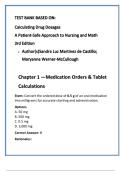
Chapter 1 —Medication Orders & Tablet
Calculations
Stem: Convert the ordered dose of 0.5 g of an oral medication
into milligrams for accurate charting and administration.
Options
A. 50 mg
B. 500 mg
C. 0.5 mg
D. 5,000 mg
Correct Answer: B
Rationales:
, • Correct (B): 0.5 g × 1000 mg/g = 500 mg. Step: multiply
grams by 1000 to convert to mg.
• A (50 mg): Decimal place error — moved decimal one
place left instead of three (0.5 → 0.05 g → 50 mg).
• C (0.5 mg): Confused units — treated grams as if they
were milligrams (no conversion).
• D (5,000 mg): Off by factor of 10 — multiplied by 10,000
instead of 1,000.
Teaching Point: Always convert grams to milligrams by
multiplying by 1,000.
2. Chapter 1 | Section: Medication Math Safety | Safety in
Medication Administration
Stem: Order: 250 mg PO. Available: 125 mg tablets. How many
tablets should the nurse give?
Options
A. 1 tablet
B. 2 tablets
C. 0.5 tablet
D. 3 tablets
Correct Answer: B
Rationales:
, • Correct (B): 250 mg ÷ 125 mg/tablet = 2 tablets. Step:
divide ordered dose by strength per tablet.
• A (1 tablet): Under-dosing — likely forgot to divide
(assumed 125 mg meets 250 mg).
• C (0.5 tablet): Decimal/place error — 125 × 0.5 = 62.5 mg,
not 250 mg.
• D (3 tablets): Overdose error — 125 mg × 3 = 375 mg; may
reflect rounding up unnecessarily.
Teaching Point: Divide ordered dose by tablet strength; avoid
guessing tablet counts.
3. Chapter 1 | Section: Medication Math Safety | Safety in
Medication Administration
Stem: Order: Morphine 4 mg IV. Available: 2 mg/mL vial. What
volume (mL) will you draw up?
Options
A. 0.5 mL
B. 2 mL
C. 4 mL
D. 8 mL
Correct Answer: B
Rationales:
, • Correct (B): 4 mg ÷ (2 mg/mL) = 2 mL. Step: divide ordered
mg by concentration (mg per mL).
• A (0.5 mL): Decimal misplaced — would correspond to 1
mg if concentration 2 mg/mL.
• C (4 mL): Error of doubling — gives 8 mg (2 mg/mL × 4 mL
= 8 mg).
• D (8 mL): Large decimal/place error (would give 16 mg).
Teaching Point: Use dose ÷ concentration (mg ÷ mg per mL) to
find mL.
4. Chapter 1 | Section: Medication Math Safety | Safety in
Medication Administration
Stem: Heparin infusion ordered: 1,000 units/hr. Heparin
available 25,000 units in 500 mL. At what rate (mL/hr) should
the pump be set?
Options
A. 2 mL/hr
B. 10 mL/hr
C. 20 mL/hr
D. 40 mL/hr
Correct Answer: C
Rationales:
Calculations
Stem: Convert the ordered dose of 0.5 g of an oral medication
into milligrams for accurate charting and administration.
Options
A. 50 mg
B. 500 mg
C. 0.5 mg
D. 5,000 mg
Correct Answer: B
Rationales:
, • Correct (B): 0.5 g × 1000 mg/g = 500 mg. Step: multiply
grams by 1000 to convert to mg.
• A (50 mg): Decimal place error — moved decimal one
place left instead of three (0.5 → 0.05 g → 50 mg).
• C (0.5 mg): Confused units — treated grams as if they
were milligrams (no conversion).
• D (5,000 mg): Off by factor of 10 — multiplied by 10,000
instead of 1,000.
Teaching Point: Always convert grams to milligrams by
multiplying by 1,000.
2. Chapter 1 | Section: Medication Math Safety | Safety in
Medication Administration
Stem: Order: 250 mg PO. Available: 125 mg tablets. How many
tablets should the nurse give?
Options
A. 1 tablet
B. 2 tablets
C. 0.5 tablet
D. 3 tablets
Correct Answer: B
Rationales:
, • Correct (B): 250 mg ÷ 125 mg/tablet = 2 tablets. Step:
divide ordered dose by strength per tablet.
• A (1 tablet): Under-dosing — likely forgot to divide
(assumed 125 mg meets 250 mg).
• C (0.5 tablet): Decimal/place error — 125 × 0.5 = 62.5 mg,
not 250 mg.
• D (3 tablets): Overdose error — 125 mg × 3 = 375 mg; may
reflect rounding up unnecessarily.
Teaching Point: Divide ordered dose by tablet strength; avoid
guessing tablet counts.
3. Chapter 1 | Section: Medication Math Safety | Safety in
Medication Administration
Stem: Order: Morphine 4 mg IV. Available: 2 mg/mL vial. What
volume (mL) will you draw up?
Options
A. 0.5 mL
B. 2 mL
C. 4 mL
D. 8 mL
Correct Answer: B
Rationales:
, • Correct (B): 4 mg ÷ (2 mg/mL) = 2 mL. Step: divide ordered
mg by concentration (mg per mL).
• A (0.5 mL): Decimal misplaced — would correspond to 1
mg if concentration 2 mg/mL.
• C (4 mL): Error of doubling — gives 8 mg (2 mg/mL × 4 mL
= 8 mg).
• D (8 mL): Large decimal/place error (would give 16 mg).
Teaching Point: Use dose ÷ concentration (mg ÷ mg per mL) to
find mL.
4. Chapter 1 | Section: Medication Math Safety | Safety in
Medication Administration
Stem: Heparin infusion ordered: 1,000 units/hr. Heparin
available 25,000 units in 500 mL. At what rate (mL/hr) should
the pump be set?
Options
A. 2 mL/hr
B. 10 mL/hr
C. 20 mL/hr
D. 40 mL/hr
Correct Answer: C
Rationales: